The Ultimate Guide to Earring Hoop Sizes: Fit, Gauge, and Face Shape
Master earring hoop sizes with our expert buying guide. Learn exact mm measurements, gauge thicknesses, and how to choose hoops for lobes or cartilage.

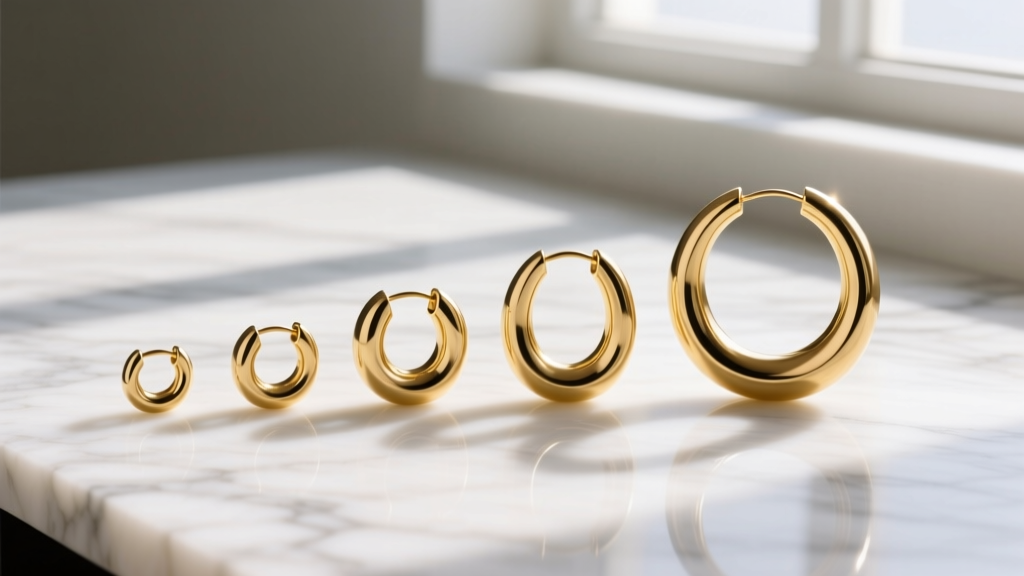
When shopping for hoops, relying solely on visual estimates often leads to disappointment. A hoop that looks perfectly proportional on a model might choke a helix piercing or drag down a delicate earlobe in real life. Understanding earring hoop sizes requires navigating a matrix of millimeter diameters, wire gauge thicknesses, and anatomical placements. This comprehensive buying guide breaks down the exact metrics you need to select hoops that offer structural integrity, comfort, and aesthetic harmony.
Decoding the Millimeter (mm) Scale
The jewelry industry universally uses millimeters to measure hoop diameter. However, the most critical mistake buyers make is confusing outer diameter with inner diameter. For standard lobe piercings, the difference is negligible. But for cartilage placements like the helix, tragus, or daith, the inner diameter dictates whether the jewelry will sit flush or painfully compress the tissue.
Huggies and Micro Hoops (8mm - 12mm)
Designed to 'hug' the earlobe or sit snugly in a tragus piercing, these sizes offer a minimalist look. An 8mm hoop is typically the smallest size that can comfortably close around a standard earlobe without pressing into the neck of the piercing. For thicker cartilage folds, a 10mm inner diameter is usually the baseline for a comfortable fit.
Small to Medium Hoops (13mm - 25mm)
This is the most versatile range. A 15mm hoop provides a classic, understated look for standard lobe piercings, while 20mm to 25mm sizes begin to drop slightly below the earlobe, making them ideal for second or third lobe holes and rook piercings.
Statement and Large Hoops (30mm - 60mm+)
Hoops exceeding 30mm enter statement territory. At 50mm and above, the physical weight of the metal becomes a primary concern, requiring specific gauge thicknesses to prevent tissue damage (detailed in the gauge section below).
The Comprehensive Hoop Size & Placement Chart
Use this reference table to match your desired aesthetic with the correct anatomical placement. Keep in mind that swelling can temporarily alter your required size; always wait until a piercing is fully healed before downsizing to a snug hoop.
| Diameter (mm) | Inch Equivalent | Best Placement | Style Category |
|---|---|---|---|
| 8mm - 10mm | 5/16" - 3/8" | Tragus, Snug, Thin Lobes | Huggie / Micro |
| 12mm - 15mm | 1/2" - 5/8" | Standard Lobe, Helix | Small / Fitted |
| 20mm - 25mm | 3/4" - 1" | Upper Lobes, Rook, Daith | Medium / Classic |
| 30mm - 40mm | 1 1/4" - 1 1/2" | Standard Lobe (Drop) | Large / Statement |
| 50mm+ | 2"+ | Standard Lobe Only | Oversized / Bold |
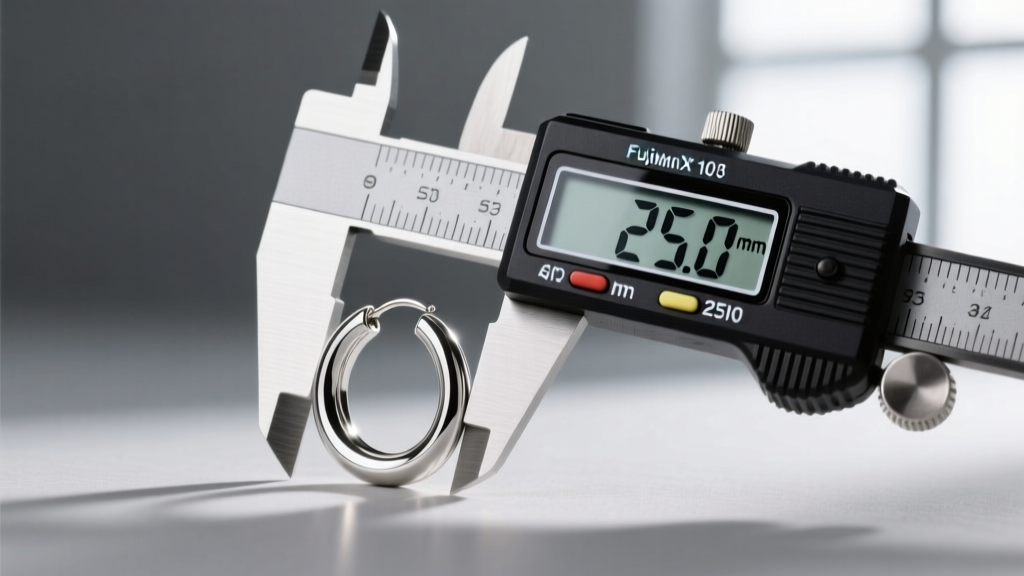
Gauge Thickness: The Hidden Variable in Sizing
Diameter is only half the equation; the wire thickness (gauge) determines the earring's structural integrity and weight distribution. According to the Association of Professional Piercers (APP), wearing jewelry that is too thin for its diameter can lead to the 'cheese-cutter effect,' where the thin wire slowly migrates through the tissue under the stress of gravity and movement.
- 22G (0.6mm) & 20G (0.8mm): Standard for lightweight, small-diameter lobe hoops (under 20mm). Avoid these gauges for large hoops, as the wire will easily bend out of shape and pull on the piercing hole.
- 18G (1.0mm): The gold standard for most cartilage piercings and medium-sized lobe hoops (20mm - 35mm). It provides enough rigidity to maintain a perfect circle without being overly heavy.
- 16G (1.2mm) & 14G (1.6mm): Mandatory for large statement hoops (40mm+). The thicker wire distributes the increased weight across a wider surface area of the earlobe, preventing elongation and tearing over time.
Proportional Styling: Matching Diameters to Face Shapes
Beyond anatomy, earring hoop sizes play a crucial role in facial balancing. The geometry of the hoop can either contrast or complement your natural bone structure.
Round and Square Faces
If you have a round or square jawline, avoid perfectly circular, medium-sized hoops (20mm-30mm), as they can emphasize the width of the face. Instead, opt for elongated oval hoops or geometric square hoops in the 40mm+ range. The vertical drop creates an optical illusion that lengthens the face and draws the eye downward.
Heart and Diamond Faces
These face shapes feature wider cheekbones or foreheads tapering to a narrow chin. Teardrop-shaped hoops or medium-sized circular hoops (25mm-35mm) add visual weight to the lower half of the face, creating a harmonious balance with the upper facial structure.
Oval Faces
The universal donor of face shapes. Oval faces can carry virtually any earring hoop size, from tight 10mm huggies to dramatic 60mm runway-style circles. Experiment with angular, geometric hoops to add sharp contrast to soft, balanced features.

Clasp Mechanisms and Material Integrity
The closure type heavily influences both the security and the usable inner diameter of the hoop.
Pro-Tip: Continuous (endless) hoops offer a seamless look but require you to bend the wire to open and close them. Over time, this metal fatigue weakens the wire, especially in 18G and 20G sizes. For longevity, hinged clickers or latch-back closures are vastly superior for daily wear.
When investing in larger hoop sizes, the material becomes critical. Large hoops have more surface area to react with skin oils and environmental moisture. The American Academy of Dermatology frequently warns against nickel alloys in jewelry, which can cause severe contact dermatitis. For any hoop that will be worn continuously, especially in fresh or sensitive piercings, insist on ASTM F-136 Implant-Grade Titanium or solid 14k/18k gold. Plated metals will eventually wear off, exposing base metals that cause irritation and green discoloration.
Troubleshooting Common Sizing Failures
Even experienced buyers fall victim to these specific sizing errors:
- The Helix Choke: Buying a 12mm hoop based on outer diameter for a helix piercing. Once the clasp is accounted for, the inner diameter shrinks, causing the hoop to press tightly against the cartilage ridge. Always measure the inner space required.
- The Snag Hazard: Wearing 50mm+ latch-back hoops to sleep or during exercise. Large hoops act as levers; if caught on a sweater or pillow, the mechanical advantage can easily tear the earlobe. Switch to hinged clickers with a secure snap-lock for active days.
- The Asymmetry Illusion: Assuming both ears require the same size. It is incredibly common for left and right earlobes to sit at slightly different heights or angles. If you are wearing multiple hoops in a curated ear setup, map out your sizes with a physical ruler against your ear before purchasing to ensure the visual cascade is intentional.
By prioritizing precise inner diameters, matching gauge thickness to the hoop's overall weight, and selecting biocompatible materials, you can curate a hoop collection that is as structurally sound as it is stylish.


