What an Earring in Right Ear Means: Cultural Codes & Sizing
Discover what an earring in right ear means historically and today. Explore technical sizing, gauge charts, and asymmetrical styling tips.


For decades, the placement of ear piercings was heavily burdened by cultural coding, secret societal signals, and rigid gender norms. Today, as we navigate the jewelry landscape of 2026, the modern wearer prioritizes anatomical curation, metallurgical safety, and asymmetrical aesthetics over outdated tropes. However, the search volume surrounding the phrase earring in right ear means remains exceptionally high, proving that historical curiosity still intersects with modern style choices. This expert deep dive dismantles the historical myths, transitions into the biomechanical realities of unilateral piercings, and provides a technical framework for curating a flawless right-ear focal point.
Decoding the Myth: Historical and Cultural Context
To understand what an earring in right ear means, we must first look back at the mid-to-late 20th century. During the 1970s and 1980s, a pervasive cultural trope emerged in Western societies, often summarized by the discriminatory playground rhyme: 'Left is right, and right is wrong.' This was a covert signaling method used to denote sexual orientation in an era where open expression was dangerous or socially penalized. A piercing in the right ear was widely coded as a marker of homosexuality, while the left ear was deemed the 'acceptable' standard for heterosexual men.
'The historical coding of ear piercings was a product of societal repression, not anatomical or aesthetic science. In contemporary jewelry design, side-specific signaling is entirely obsolete.' — Archives of Modern Body Modification, 2024.
Prior to the 20th century, maritime lore offered a completely different explanation. Sailors historically pierced their ears—often the right, sometimes both—based on the ancient acupuncture myth that stimulating the earlobe's central nerve point would improve long-distance eyesight and protect against drowning. The Association of Professional Piercers (APP) notes that modern body modification has completely divorced itself from these archaic superstitions. Today, choosing the right ear as your primary canvas is purely an exercise in asymmetrical styling and facial symmetry balancing.
The Technical Framework: Gauge, Threading, and Metallurgy
Once you discard the cultural baggage, the true 'meaning' of your right ear piercing is defined by its technical execution. Whether you are opting for a single lobe statement or a complex cartilage constellation, understanding gauge sizes, threading mechanisms, and material grades is non-negotiable for tissue health and aesthetic longevity.
Standard Sizing and Threading Matrix
The most common failure mode in ear piercings is the use of improper gauge sizes or externally threaded jewelry, which causes micro-tearing in the fistula (the piercing channel). Below is the technical matrix for right-ear placements.
| Piercing Site | Standard Gauge | Optimal Jewelry Type | Threading Standard |
|---|---|---|---|
| Standard Lobe | 18G (1.0mm) or 16G (1.2mm) | Flat-Back Labret, Huggie Hoop | Threadless Push-Pin or Internal |
| Helix / Flat | 16G (1.2mm) | Flat-Back Labret, Clicker Ring | Threadless Push-Pin or Internal |
| Rook / Daith | 16G (1.2mm) | Curved Barbell, Clicker Ring | Internally Threaded Only |
| Conch | 14G (1.6mm) or 16G (1.2mm) | Large Flat-Back Labret | Threadless Push-Pin |
When sourcing jewelry for your right ear, you must demand ASTM F136 implant-grade titanium. Unlike 316L surgical steel, which contains nickel and can trigger contact dermatitis or hypersensitivity reactions over time, F136 titanium is entirely biocompatible. As detailed in the APP's official aftercare and material guidelines, implant-grade titanium features a mirror-polished surface finish (Ra < 0.8 µm) that prevents bacterial adhesion and promotes seamless fistula formation.
Asymmetrical Styling: Building a Right-Ear Focal Point
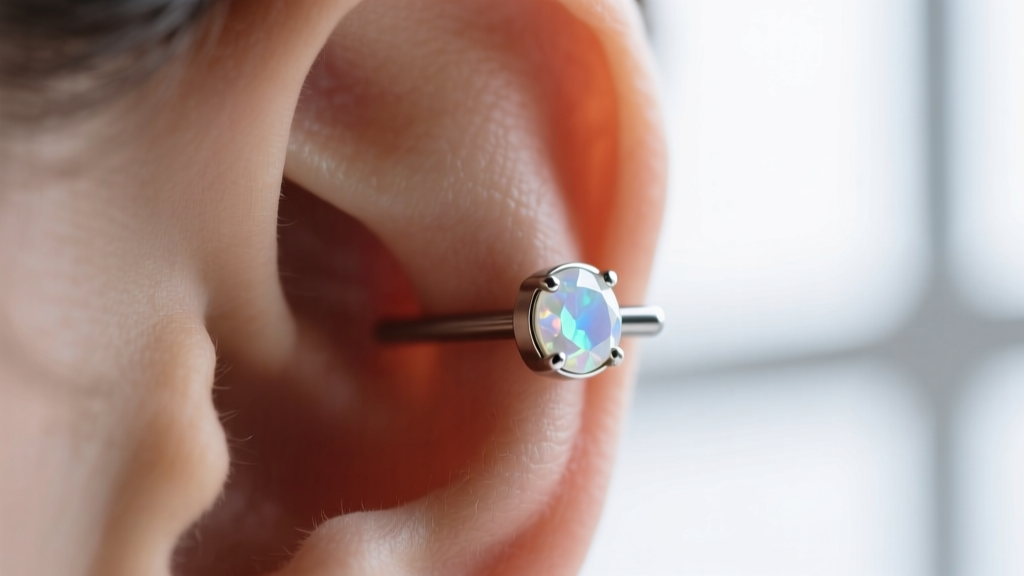
Asymmetry is a cornerstone of contemporary editorial styling. Dedicating your right ear as the sole focal point—or weighting it heavily compared to the left—creates a dynamic visual imbalance that draws the eye and highlights your jawline. Here is how to approach the technical curation of a right-heavy stack.
The Single Lobe Statement
If you are committing to a single right-lobe piercing, avoid flimsy, high-gauge (20G or 22G) butterfly-back studs. These are structurally unstable and prone to embedding. Instead, opt for a 16G or 14G huggie hoop with a clicker closure. A 14-karat gold or platinum huggie provides the necessary mass to anchor the earlobe visually, while the clicker mechanism ensures the hinge remains flush, preventing hair snagging and mechanical irritation.
The Cartilage Constellation
For a multi-piercing right ear, spatial distribution is critical. A technically sound constellation requires a minimum of 6mm to 8mm of tissue between each fistula to prevent vascular crowding and localized swelling. A classic, anatomically viable right-ear stack includes:
- The Flat: Positioned on the outer scapha, utilizing a 16G threadless labret with a 3mm bezel-set gemstone to catch lateral light.
- The Mid-Helix: Placed along the outer rim, mirroring the flat but utilizing a slightly larger 4mm end to create a cascading size gradient.
- The Rook: Tucked into the inner antihelix fold, requiring a 16G internally threaded curved barbell to accommodate the tissue's natural curvature.
Biomechanics and Aftercare: The Right-Side Sleeper’s Dilemma
The most significant technical challenge of a dedicated right-ear piercing strategy is biomechanical: sleep positioning. If you are a natural right-side sleeper, you are introducing chronic compression forces to your healing or established piercings. This is not merely a comfort issue; it is a tissue health hazard.
Chronic pressure on a healing cartilage piercing leads to pressure necrosis (tissue death caused by restricted blood flow) and angle migration. If the jewelry is forced into the tissue at an unnatural angle night after night, the fistula will heal crooked, causing the jewelry to sit at a severe, protruding slant once fully healed. In severe cases, the jewelry can embed entirely into the swollen tissue, requiring surgical removal.

The Travel Pillow Protocol
To mitigate sleep compression, professional piercers universally recommend the U-shaped travel pillow method. By placing your right ear in the hollow center of the pillow, you completely suspend the ear in negative space, eliminating all friction and compression forces against the mattress. This is especially critical during the first 12 to 16 weeks of cartilage healing, where the fistula is highly vascular and prone to hypertrophic scarring (irritation bumps) triggered by mechanical trauma.
Long-Term Maintenance and Tissue Health
Once your right ear piercings are fully healed (typically 3 months for lobes, 12 to 18 months for cartilage), maintenance shifts from wound care to structural integrity. You must periodically inspect the threading and closure mechanisms of your jewelry. Threadless push-pin ends can loosen over time due to thermal expansion and contraction (such as moving from cold outdoor air to a heated indoor environment). Every six months, gently test the tension of your threadless ends by attempting to pull the gemstone head away from the post. If it yields with minimal resistance, remove the post and use a pair of nylon-jaw pliers to gently bend the pin to a sharper angle, restoring the friction-fit lock.
Ultimately, the question of what an earring in right ear means is no longer answered by outdated societal codes or maritime myths. In the modern era of high-end body jewelry, a right-ear piercing means you have chosen to embrace asymmetrical artistry, prioritize implant-grade metallurgy, and master the biomechanics of your own anatomy. By adhering to strict gauge standards, utilizing internal or threadless threading, and respecting the physiological demands of sleep and tissue healing, your right ear becomes a masterclass in technical style and personal curation.


