Earring Jump Rings: 2026 Style Trends & Sizing Guide
Explore 2026 trends for earring jump rings, from micro-chainmaille huggies to modular drops. Master gauge sizes, materials, and structural integrity.

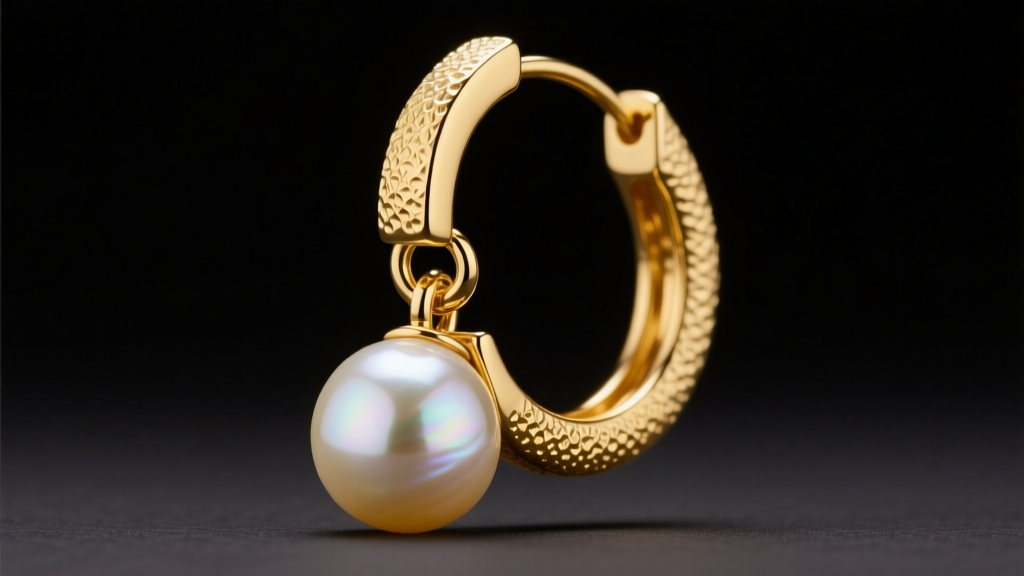
The Unsung Heroes of Earring Architecture
In the intricate world of jewelry design, the most critical components are often the smallest. As we navigate the 2026 landscape of fine and fashion jewelry, earring jump rings have transitioned from hidden structural necessities to forefront design elements. Whether you are examining a delicate micro-chainmaille huggie or a heavy, asymmetric modular drop, the jump ring dictates the kinetic movement, the drape, and the ultimate structural integrity of the piece. For collectors, designers, and everyday wearers, understanding the nuanced mechanics of these tiny connectors is essential for both aesthetic appreciation and practical longevity.
The modern earring is no longer a static object; it is a dynamic, modular system. The surge in customizable "charm carrier" hoops and interchangeable dangle systems means that the humble jump ring is now the primary interface between the base earring and its decorative attachments. This guide dives deep into the metallurgy, sizing matrices, and style trends defining earring jump rings this year, providing you with the expert knowledge needed to curate, design, and maintain high-performance ear adornments.
The Modular Movement: Why Connectors Are the Focal Point
The defining earring trend of 2026 is modularity. Consumers are increasingly investing in high-quality base pieces—such as 14k gold huggies or ASTM F136 titanium seamless hoops—and curating a wardrobe of interchangeable charms. In this ecosystem, earring jump rings serve as the vital hinges. Unlike the soldered, permanent links of traditional fine jewelry, modern modular designs rely on precision-engineered unsoldered rings that can be opened and closed repeatedly without compromising the metal's integrity.
This shift has elevated the visual importance of the connector. Designers are now intentionally exposing the jump ring, using contrasting metals or textured wires to turn a functional joint into a deliberate aesthetic feature. A polished 18k yellow gold charm suspended from an oxidized sterling silver jump ring creates an industrial-chic juxtaposition that is highly sought after in contemporary ear curation. Furthermore, the kinetic drape of a drop earring is entirely dependent on the inner diameter (ID) of the connecting ring. A larger ID allows for a fluid, pendulum-like swing, while a tighter ID creates a stiff, structured silhouette.
Anatomy of the Link: Saw-Cut vs. Machine-Cut
When evaluating high-end earrings, the cut of the jump ring is a primary indicator of quality. There are two primary methods used to slice the coiled wire into individual rings, and the difference is palpable both visually and structurally.
The Saw-Cut (Flush) Advantage
Premium earring jump rings are saw-cut. A jeweler's saw removes a microscopic kerf (the width of the saw blade) of metal, resulting in two perfectly flat, flush surfaces. When closed properly, a saw-cut ring becomes virtually seamless to the naked eye. This is critical for fine jewelry, as it prevents the snagging of hair or delicate fabrics—a common failure point in lower-tier accessories. According to the Rio Grande Jewelry Supply technical guides, flush-cut rings also distribute tensile stress more evenly across the seam, reducing the likelihood of the ring pulling open under the weight of heavy gemstone drops.
Machine-Cut (Pinch) Limitations
Conversely, machine-cut or "pinch-cut" rings are sheared with wire cutters, leaving sharp, angled bevels at the seam. While cost-effective for mass-produced fashion jewelry, these sharp edges can scratch the skin, catch on knitwear, and create a weak point where the seam can easily wedge open. For cartilage piercings or heavy dangle earrings, machine-cut rings should be strictly avoided.
The Gauge and Inner Diameter (ID) Matrix
Selecting the correct proportions for earring jump rings requires balancing wire thickness (gauge) against the inner diameter (ID). A ring that is too wide relative to its wire thickness will easily pull apart; a ring that is too thick will look clumsy and restrict the movement of the earring. Below is the definitive 2026 sizing matrix for fine earring construction.
| Wire Gauge (Thickness) | Millimeter Equivalent | Ideal Inner Diameter (ID) | Best Application in Earrings | Structural Notes |
|---|---|---|---|---|
| 22-Gauge | 0.64mm | 2.5mm - 3.0mm | Micro-chainmaille, ultra-light pearl drops | Low tensile strength; must be work-hardened; strictly for lightweight dangles. |
| 20-Gauge | 0.81mm | 3.0mm - 4.0mm | Standard charm connectors, delicate huggies | The industry standard for most commercial 14k gold modular charm hoops. |
| 18-Gauge | 1.02mm | 4.0mm - 5.0mm | Heavy gemstone drops, ear cuff linkages | Excellent balance of durability and drape; resists pulling from moderate weight. |
| 16-Gauge | 1.29mm | 5.0mm - 7.0mm | Industrial aesthetic links, heavy statement hoops | Requires two pairs of pliers to open; often used as a visible design element. |
| 14-Gauge | 1.63mm | 6.0mm - 8.0mm | Chainmaille harnesses, avant-garde ear cuffs | Extremely rigid; usually soldered or permanently riveted in fine applications. |
As a general rule of thumb endorsed by the Fire Mountain Gems Jewelry-Making Encyclopedia, the "Aspect Ratio" (AR)—calculated by dividing the Inner Diameter by the Wire Diameter—should remain between 4.0 and 6.0 for optimal structural integrity in unsoldered earring connectors. An AR higher than 6.0 indicates a ring that is too wide and prone to distorting into an oval shape under the gravitational pull of a heavy earring drop.
Material Grades: Biocompatibility and Drape
The material of a jump ring dictates not only its color and luster but also its biocompatibility and spring-back memory. When a jump ring is opened and closed, the metal undergoes stress. High-quality alloys possess a "memory" that allows them to snap back into perfect alignment, whereas softer metals may warp.
- ASTM F136 Implant-Grade Titanium: The undisputed king of hypoallergenic jewelry. For jump rings that pass directly through a fresh piercing or sit against sensitive cartilage, F136 titanium is mandatory. It is highly resistant to corrosion and possesses excellent tensile strength, meaning a 20-gauge titanium ring will hold its shape far better than a 20-gauge pure silver ring.
- 14k and 18k Solid Gold: 18k gold offers a richer, warmer hue and is highly prized in luxury fine jewelry, but it is inherently softer due to its higher pure gold content. Therefore, 18k gold jump rings must be work-hardened (tumbled or hammered) to increase their structural rigidity. 14k gold, alloyed with more copper or silver, offers superior spring-back and is often preferred for heavy, load-bearing connectors.
- Argentium Silver: Traditional sterling silver (925) is prone to oxidation and can become brittle over time. In 2026, premium designers have largely migrated to Argentium silver, which replaces some of the copper with germanium. This results in a jump ring that is highly tarnish-resistant, brighter, and possesses better thermal and structural properties for soldering.
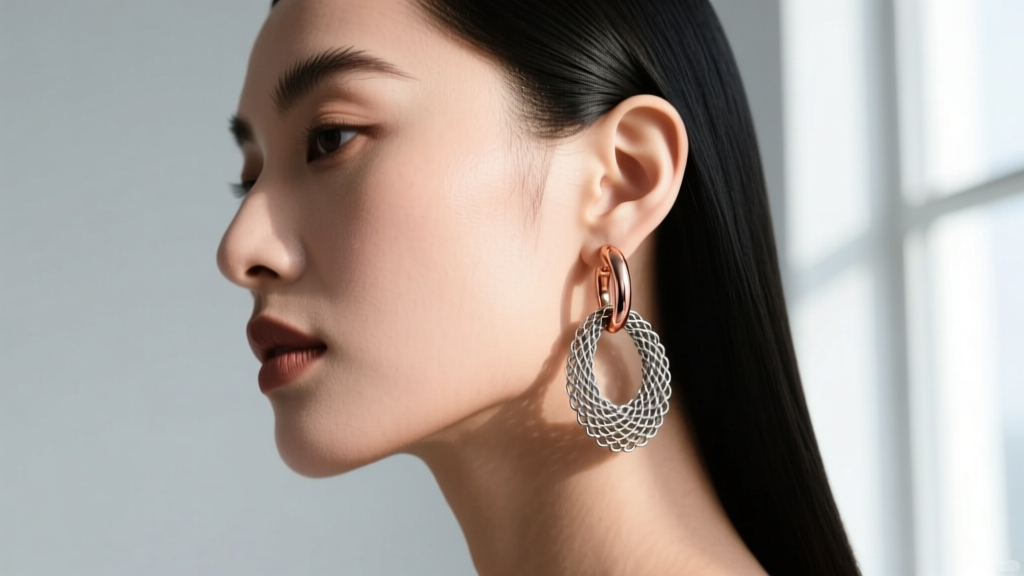
2026 Style Trends: Micro-Links and Asymmetric Architecture
The aesthetic application of earring jump rings has evolved dramatically. We are seeing a departure from hidden connectors toward celebrated, visible linkages that define the character of the earring.
The Micro-Chainmaille Huggie
One of the most prominent trends of the year is the micro-chainmaille huggie. Designers are weaving dozens of tiny, 22-gauge saw-cut jump rings into intricate Byzantine or Persian weaves that wrap snugly around the earlobe. The flexibility of the woven metal mimics fabric, creating a soft, textile-like drape that catches the light from multiple angles. This requires absolute precision; a single poorly closed ring can unravel the entire weave.
Mixed-Metal Industrialism
Contrasting metals are being used to highlight the modular nature of contemporary earrings. A popular 2026 configuration features a polished platinum or white gold base hoop, accented with heavy, 16-gauge oxidized silver or black rhodium-plated jump rings that hold vibrant, uncut sapphire drops. The dark, chunky connectors provide an edgy, architectural framework that contrasts beautifully with the delicate gemstones.
The "Floating" Illusion
By utilizing ultra-fine, high-polish 20-gauge jump rings in reflective metals, designers are creating "floating" drop earrings. When the jump rings are perfectly flush-cut and aligned, they become virtually invisible against the skin, making heavy diamond or opal pendants appear as though they are suspended in mid-air beneath the earlobe.
Troubleshooting Common Jump Ring Failures
Even the most beautifully designed earring will fail if the jump rings are manipulated incorrectly. The most common cause of lost charms and broken dangles is improper opening techniques.
The Fatal Flaw: Pulling Apart
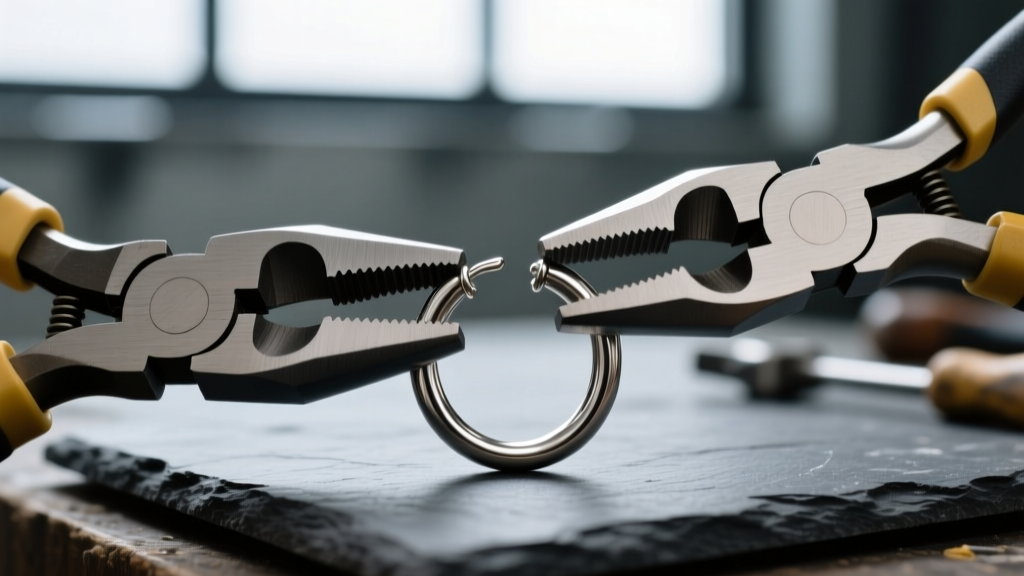
Never pull the ends of a jump ring outward away from each other. This distorts the perfect circle into an oval, work-softens the metal at the stress points, and makes it nearly impossible to close the ring flush again without specialized tools.
The Correct Technique: The Lateral Twist
To properly open an earring jump ring, you must use two pairs of flat-nose pliers (or a jump ring opening tool). Grip the ring on either side of the seam, and twist one hand toward you while pushing the other hand away. This lateral twisting motion preserves the circular shape of the ring. When closing, twist the ends back together, applying slight inward pressure to ensure the flush-cut ends snap tightly against one another. You should feel a microscopic "click" or friction as the flat surfaces meet perfectly.
Final Verdict: Elevating Your Earring Architecture
As the boundaries between fine jewelry and modular fashion continue to blur in 2026, the earring jump ring has rightfully claimed its place as a critical element of design. Whether you are a collector investing in interchangeable charm systems, a designer experimenting with micro-chainmaille weaves, or simply a wearer looking to understand why your favorite drop earrings move the way they do, mastering the nuances of these tiny links is invaluable. By paying close attention to the aspect ratio, the cut of the seam, and the metallurgical grade of the wire, you ensure that your earrings are not only visually stunning but structurally engineered to last a lifetime.


