The Earring Star Guide: 2026 Celestial Trend Analysis
Discover 2026's top celestial jewelry trends. Our earring star guide covers metal grades, gauge sizing, and constellation mapping for every ear shape.

The Evolution of the Celestial Motif in Ear Curation
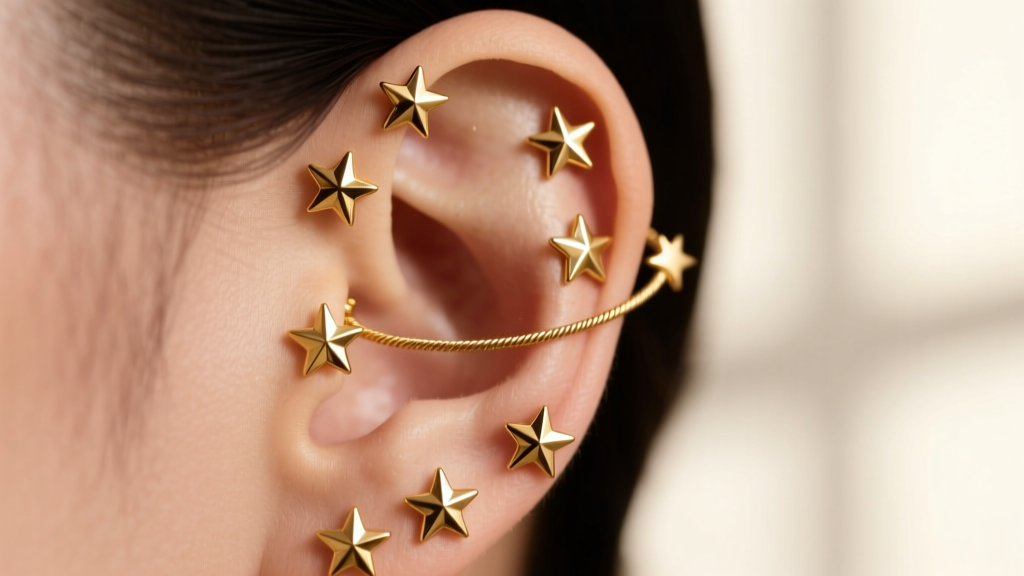
The celestial trend has matured significantly as we move through 2026. Gone are the days when an earring star was relegated to childish novelty or costume jewelry. Today, the star motif is an architectural staple in high-end curated ear projects, bridging the gap between astrological sentimentality and sharp, modern geometry. Jewelry designers are now treating the earring star not just as a shape, but as a structural framework for light refraction and ear mapping.
Whether you are building a constellation across your cartilage or anchoring a lobe with a single, striking starburst, understanding the nuances of star geometry, metallurgical grades, and gauge specifications is critical. This guide breaks down the technical and stylistic elements of the modern earring star, providing a data-driven approach to celestial ear styling.
Decoding Star Geometry: 4, 5, and 8-Point Designs
The number of points on a star earring drastically alters its visual weight, light performance, and stylistic vibe. In 2026, we are seeing a distinct divergence in how different star geometries are applied to the ear.
The 4-Point Compass Star
Minimalist and directional, the 4-point star (often called a compass rose) is the dominant choice for cartilage placements. Its sleek, elongated axes draw the eye vertically or horizontally, making it an excellent tool for balancing ear proportions. A 4-point star stud in a flat or helix piercing creates a sharp, modern aesthetic that pairs seamlessly with industrial bars or seamless hoops.
The Classic 5-Point Star
The traditional 5-point star carries nostalgic and classic associations. In contemporary styling, it is most frequently utilized in dangle earrings or as a subtle charm on huggie hoops. Because of its inherent symmetry, it works best as a standalone statement piece on the primary lobe piercing rather than being lost in a dense cluster.
The 8-Point Starburst
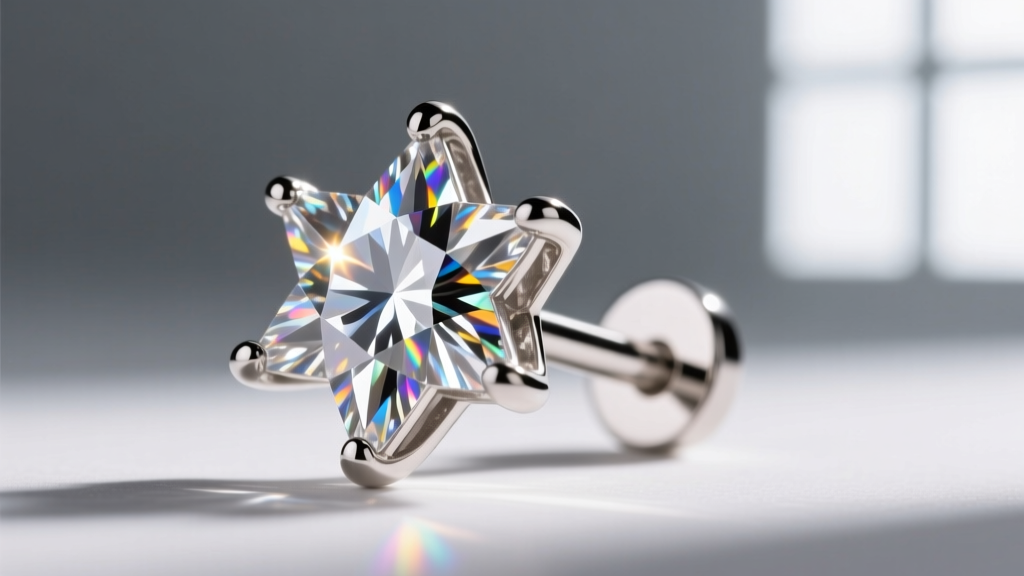
For maximum brilliance, the 8-point starburst is the undisputed champion. Drawing heavy inspiration from Art Deco architecture, the 8-point design features alternating long and short rays, often paved with melee diamonds or moissanite. This geometry creates a 'starburst' optical illusion, maximizing light refraction. It is the preferred silhouette for high-impact lobe studs and threadless push-pin ends.
Metallurgy and Gauge: What the Professionals Use
Selecting the correct metal and gauge for your earring star is non-negotiable, particularly for cartilage piercings where the risk of irritation bumps is high. The Association of Professional Piercers strictly recommends specific materials for both fresh and healed piercings to prevent allergic contact dermatitis.
Implant-Grade Titanium (ASTM F136)
For any new cartilage piercing (helix, flat, conch) or for individuals with nickel sensitivities, ASTM F136 implant-grade titanium is the gold standard. It is completely nickel-free and highly polished, reducing bacterial adhesion. Most high-quality 16g and 14g star-shaped threadless ends are crafted from this alloy.
Solid Gold vs. Vermeil
For healed lobes, 14k and 18k solid gold are excellent choices. According to the Federal Trade Commission's Gold Jewelry Guidelines, the karat weight dictates the purity and durability. 14k gold (58.5% pure gold) offers superior scratch resistance for daily-wear star studs, while 18k gold (75% pure) provides a richer, warmer yellow hue but is slightly softer. Avoid gold vermeil (sterling silver plated with gold) for high-friction areas like the helix or tragus, as the friction from hair and headphones will rapidly wear away the gold plating, exposing the tarnish-prone silver beneath.
The Constellation Mapping Framework
Curating an ear with star motifs requires a strategic approach to scale and spacing. The 'Constellation Mapping' framework relies on the Rule of Three to create visual harmony without overcrowding the ear's anatomy.
- The Anchor (Primary Lobe): Use a larger, 8-point starburst stud (6mm to 8mm). This grounds the design and draws immediate attention.
- The Satellite (Helix or Flat): Place a medium 4-point compass star (3mm to 4mm) in the upper cartilage. This creates a diagonal line of sight that lifts the face.
- The Dust (Secondary/Tertiary Lobe): Use tiny, 2mm bezel-set star dots or a delicate star threader chain to connect the anchor to the rest of the ear.
When mapping, ensure that the metal color remains consistent across all placements. Mixing yellow gold and white gold star motifs in the same ear often results in a chaotic, unplanned appearance unless explicitly balanced by a two-tone industrial bar.
Star Earring Style Matrix: Specs and Pricing
Understanding the technical specifications and market pricing of different star earring styles helps in building a sustainable, high-quality collection. The table below outlines standard configurations for 2026.
| Earring Style | Standard Gauge | Ideal Placement | Price Range (Solid Gold) | Wearability Rating |
|---|---|---|---|---|
| Threadless Push-Pin Stud | 16g (1.2mm) | Helix, Flat, Conch | $120 - $350 | High (Snug fit) |
| Standard Post Stud | 20g (0.8mm) - 18g (1.0mm) | Standard Lobe | $80 - $250 | Very High |
| Clicker Segment Hoop | 16g (1.2mm) | Helix, Tragus, Daith | $150 - $400 | Medium (Snag risk) |
| Drop / Dangle | 18g (1.0mm) | Primary Lobe Only | $200 - $800+ | Low (Heavy) |
Wearability, Snag Hazards, and Failure Modes
While the earring star is visually stunning, its geometry introduces specific physical failure modes that must be addressed during the purchasing process.
The Prong Snag Hazard
Stars with sharp, elongated points are notorious for catching on hair, sweaters, and towel loops. If your star earring features gemstones, avoid traditional prong settings for the outer points. Prongs act as microscopic hooks. Instead, opt for bezel settings or flush/gypsy settings, where the metal is pushed smoothly over the edges of the stone. This creates a continuous, snag-free profile that is essential for cartilage piercings.
Lobe Stretching from Heavy Starbursts
An 8-point starburst paved with diamonds can be surprisingly heavy, especially when scaled up to 8mm or 10mm. Over time, the concentrated weight on a standard 20g post can cause the lobe piercing to stretch or migrate downward. To counteract this, utilize silicone earring backers (like the brand BlingDots) which provide a wider surface area of support against the back of the earlobe, distributing the weight evenly and preventing the 'drooping' effect.
Threadless End Security
For cartilage placements, threadless (push-pin) star ends are vastly superior to threaded screw-on ends. Threadless ends rely on the tension of a slightly bent pin against the inside wall of the hollow post. To ensure your star stud doesn't fall out in your sleep, always use a pair of jewelry pliers to gently bend the pin to a 15-degree angle before inserting it into the post. This creates the necessary friction lock.
Final Thoughts on Celestial Styling
The earring star has cemented its place as a versatile, enduring motif in modern jewelry design. By prioritizing implant-grade metals for cartilage, selecting the appropriate star geometry for your desired visual weight, and engineering against common snag hazards, you can curate a celestial ear project that is as durable as it is brilliant. Whether you lean toward the minimalist 4-point compass or the high-octane sparkle of an 8-point starburst, precision in material and placement is the key to mastering the 2026 celestial trend.


