Earrings Big Circle Buying Guide: Choosing Oversized Hoops
Discover the ultimate earrings big circle buying guide. Learn about wire gauges, weight distribution, and the best closures for oversized hoops.

The Physics of Oversized Hoops: Why Structure Matters
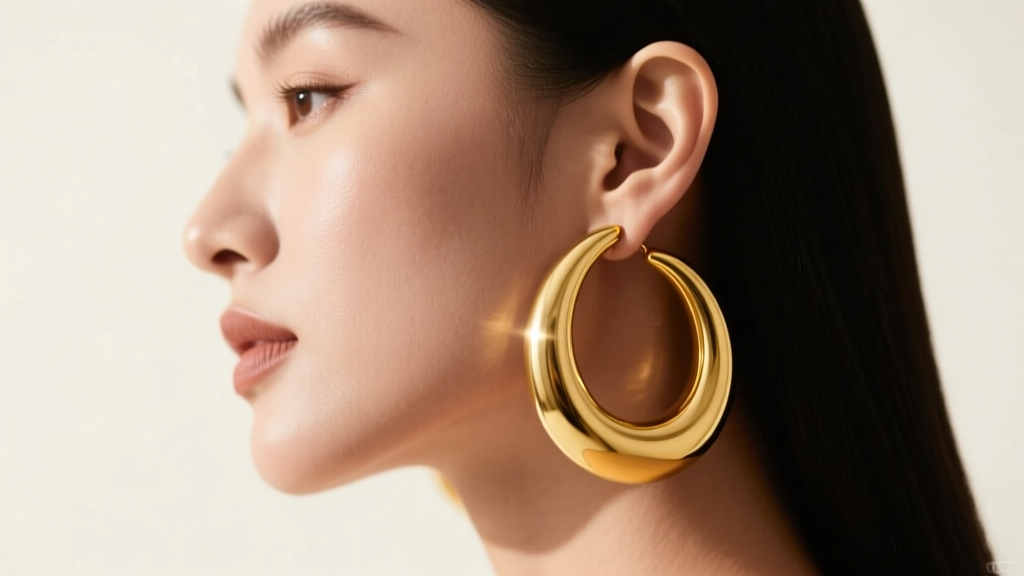
When consumers search for earrings big circle styles, they are usually drawn to the bold, face-framing drama of oversized hoops. Whether you are looking for a sleek 60mm minimalist circle or a dramatic 80mm statement piece, scaling up the diameter of an earring introduces complex structural challenges. A large hoop acts as a lever; any snag on clothing or hair applies multiplied torque directly to your earlobe piercing and the earring's weakest structural points. This buying guide moves beyond basic aesthetics to explore the engineering, material science, and ergonomic considerations you must evaluate before investing in large circular earrings.
Wire Gauge and Structural Integrity
The most common failure point in large hoop earrings is wire warping. Many mass-market jewelers use 20-gauge or 22-gauge wire to save on precious metal costs, but this is disastrous for big circle styles. A thin wire on a 50mm+ hoop lacks the shear strength to resist bending when pulled through a sweater or bumped. To ensure your oversized hoops remain perfectly circular, you must match the wire gauge to the diameter of the earring.
| Wire Gauge (AWG) | Thickness (mm) | Maximum Safe Diameter | Best Use Case |
|---|---|---|---|
| 20 Gauge | 0.81 mm | 30 mm | Small huggies, lightweight charm carriers |
| 18 Gauge | 1.02 mm | 45 mm | Medium everyday hoops, lightweight sleepers |
| 16 Gauge | 1.29 mm | 65 mm | Large statement circles, durable daily wear |
| 14 Gauge | 1.60 mm | 80+ mm | Oversized architectural hoops, heavy-duty wear |
For any earring exceeding 50mm in diameter, 16-gauge is the absolute minimum recommendation. If you are purchasing a hoop larger than 70mm, insist on 14-gauge wire or a structural tube design to prevent permanent deformation.
Closure Mechanisms: The Hidden Failure Points
The closure mechanism on a large hoop must withstand significant lateral tension. Here is how the most common closures perform on big circle earrings:
- Traditional Latch-Back (Hinged with a Catch): Common in mid-tier jewelry, this closure features a hinged front that clicks into a small notch on the back post. On hoops larger than 50mm, the leverage can easily bend the thin catch wire, causing the earring to pop open unexpectedly and get lost.
- Saddleback Closure: Often used in heavier, premium gold hoops. The back features a saddle-shaped piece that snaps over a central post. While secure, the snapping mechanism can pinch the earlobe if the tolerances are poorly machined, and it adds significant weight to the back of the ear.
- Continuous (Snap) Hoop: A seamless wire that features a hidden internal tension joint. This is the gold standard for large, minimalist wire hoops. According to guidelines referenced by the Association of Professional Piercers (APP), continuous hoops in 16G or 14G offer excellent security without the snag hazards of external hinges.
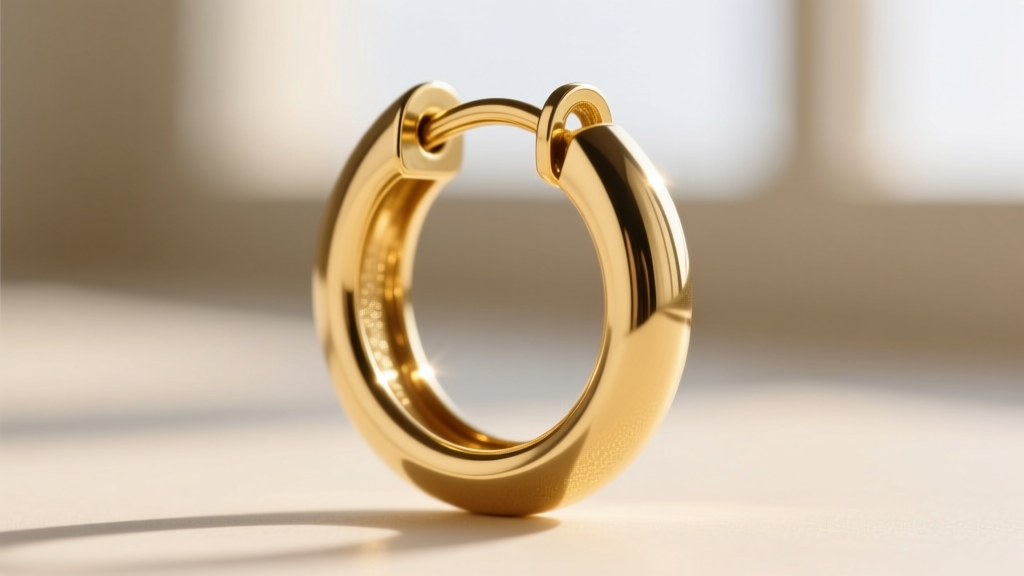
- Hinge-and-Click (Box Clasp): Used primarily on thick tube hoops. The front half hinges open and locks into a secure box clasp with an audible click. This is the most secure option for heavy, oversized tube hoops.
Material Science: Solid vs. Hollow Tube Construction
When shopping for thick, big circle hoops, you will encounter both solid wire and hollow tube constructions. Understanding the difference is critical for long-term satisfaction.
Hollow Tube (Electroformed)
Hollow hoops are created by electroplating gold over a wax or resin core, which is later melted or dissolved away. This results in a massive-looking hoop (often 3mm to 5mm thick) that is surprisingly lightweight. While excellent for preventing earlobe sagging, hollow tubes are highly susceptible to denting. If you drop a hollow 60mm hoop on a tile floor, it will likely crush inward, and it cannot be repaired by a jeweler.
Solid Wire and Solid Tube
Solid hoops are significantly heavier but offer lifelong durability. When selecting solid gold, the alloy mix matters. The Gemological Institute of America (GIA) notes that 14k gold contains a higher percentage of alloy metals (like copper and silver) compared to 18k gold. For large, solid hoops that are prone to being bumped or dropped, 14k gold is structurally superior and more resistant to scratching and bending than the softer 18k alternative.
Weight Distribution and Earlobe Health
The human earlobe can comfortably support approximately 6 to 8 grams of weight per earring for a full day without experiencing fatigue or micro-tearing. A solid 14k gold hoop with a 60mm diameter and a 2.5mm thickness can easily weigh 7.5 grams. Over time, the concentrated pressure of a thin wire cutting into the bottom of the piercing tract can lead to earlobe elongation, commonly known as 'cheese-cutter effect'.
The Solution: If you are purchasing heavy, big circle styles, invest in silicone earring stabilizers or O-ring backers. These small, discreet discs (usually 8mm to 10mm in diameter) sit behind the earlobe and distribute the downward force across a much wider surface area. This simple addition allows you to comfortably wear 12-gram statement hoops all day without tissue damage.
Proportion and Face Shape Mapping
The visual impact of a big circle earring changes dramatically depending on your facial geometry. Use this framework to select the most flattering diameter and proportion:
- Angular and Square Faces: Opt for perfectly round, oversized hoops (60mm+). The continuous curve of the big circle softens a strong jawline and adds visual balance to sharp cheekbones.
- Round Faces: Avoid perfectly circular hoops that sit exactly at the jawline, as they can emphasize facial width. Instead, look for slightly elongated big circles (ovals or teardrop-circles) that extend below the chin to create a lengthening illusion.
- Heart-Shaped Faces: Choose big circle hoops that are wider at the bottom than at the top, or styles that feature a thicker tube at the base. This adds visual weight to the lower half of the face, balancing a narrower chin.
- Oval Faces: You have the most versatility. You can pull off dramatic 80mm architectural circles or chunky, geometric oversized hoops without disrupting your natural facial harmony.
Final Pre-Purchase Checklist
Before adding that stunning oversized pair to your cart, run it through this expert checklist:
- Verify the Gauge: Is it at least 16G for hoops over 50mm? (If the listing doesn't state the gauge, assume it is a fragile 20G and proceed with caution).
- Check the Weight: Is it under 8 grams per earring, or does it come with silicone stabilizing backs?
- Assess the Closure: Does it use a secure hinge-and-click or a thick continuous snap joint rather than a fragile latch-back?
- Confirm the Construction: Are you buying hollow tube (lightweight but dents easily) or solid (heavy but durable)?
By prioritizing structural engineering alongside aesthetic appeal, you ensure that your big circle earrings remain a staple in your wardrobe for years to come, rather than ending up in the jewelry box with a bent wire and a broken closure.