Best Earrings for a Round Face: The Ultimate Styling Guide
Discover the best earrings for a round face. Learn how angular drops, geometric hoops, and specific lengths elongate your features in this beginner guide.

The Geometry of Face Shapes: Why Length and Angle Matter
When styling jewelry, understanding your underlying bone structure is the first step to curating a collection that genuinely flatters. A round face shape is characterized by equal proportions in width and length, paired with a soft, curved jawline and fuller cheeks. Unlike oval or heart-shaped faces, round faces lack sharp natural angles. Therefore, the primary styling objective when selecting the best earrings for a round face is to introduce vertical lines and geometric edges. This creates an optical illusion that elongates the face and adds structural definition.
Beginners often make the mistake of choosing earrings that simply look pretty on the display card without considering how they interact with the jawline. Earrings that hit exactly at the widest part of your cheek or jaw will emphasize that width. To counteract this, you must manipulate the visual weight through deliberate length and angularity.
Top 4 Earring Styles That Elongate Round Faces
1. Angular Drop and Dangle Earrings
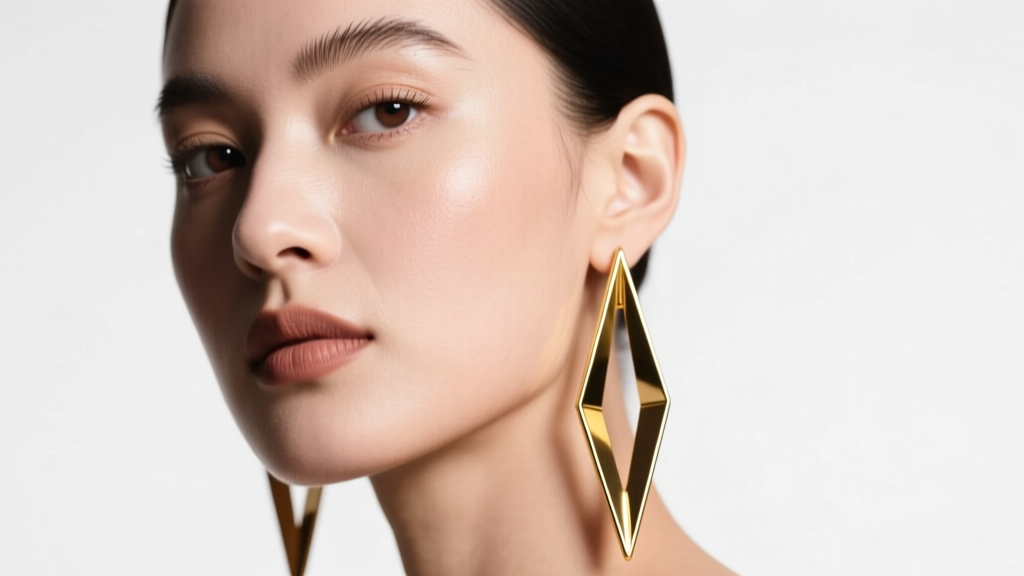
Drop earrings that feature sharp geometric shapes—such as rectangles, diamonds, or elongated hexagons—are your most powerful tool. The straight lines of a rectangular drop contrast beautifully with the soft curves of a round jawline. Aim for drops that measure between 1.5 and 2.5 inches in length. This specific range ensures the earring falls below the jawline, drawing the eye downward and creating a lengthening effect. Avoid teardrop shapes with rounded bottoms, as they mimic the face's natural curvature.
2. Geometric and Elongated Hoops
While standard circular hoops can widen the appearance of a round face, geometric variations like square hoops, cat-eye upswept hoops, and elongated oval hoops provide the necessary angles. An elongated oval hoop (often called a tube or stadium hoop) offers the movement of a traditional hoop but with a vertical orientation that slims the profile.
3. Linear Threader Earrings
Threader earrings consist of a delicate chain or wire that feeds through the piercing, dangling on both the front and back of the earlobe. They are exceptionally lightweight and create a striking, unbroken vertical line. For round faces, look for threaders that hang at least 2 inches below the lobe. Because they lack bulky hardware, they add length without adding unwanted horizontal volume.
4. Asymmetrical and Mismatched Designs
Asymmetry breaks up the bilateral symmetry that often emphasizes the roundness of a face. Wearing a long, angular drop on one side and a shorter, structural cuff or stud on the other draws the eye diagonally, disrupting the circular visual loop and adding a modern, edgy aesthetic to your styling.
Styles to Avoid: What Widens the Face
Just as important as knowing what to wear is knowing what to avoid. The following styles tend to emphasize width and should generally be bypassed if your goal is elongation:
- Large Circular Hoops: Hoops wider than 1.5 inches in diameter will mirror the roundness of your face, making it appear broader.
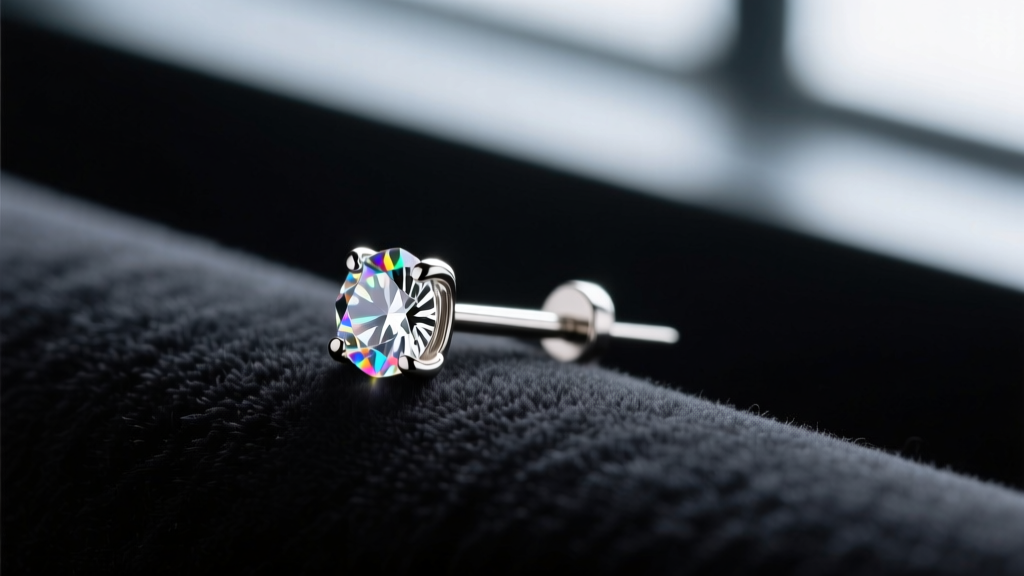
- Button Studs and Clusters: While a tiny solitaire stud is fine for minimal days, large button pearls or wide diamond clusters sit directly on the lobe and add horizontal bulk right at the jaw hinge.
- Chandelier Earrings: Unless they are exceptionally long and narrow, traditional chandelier earrings flare outward. This adds volume exactly where a round face already has it.
- Short, Wide Drops: Any drop earring that terminates at or just above the jawline will act as a visual stopper, cutting the face off and emphasizing its width.
Material, Gauge, and Hardware Considerations
Choosing the best earrings for a round face isn't just about aesthetics; it's also about structural integrity. Elongating earrings are inherently longer and often heavier than standard studs. This introduces specific mechanical challenges that beginners frequently overlook.
Wire Gauge and Lobe Health
Standard fashion earrings often use 20-gauge (0.81mm) or even 22-gauge (0.64mm) wire. When you attach a 2-inch geometric brass or silver drop to a 22-gauge wire, the metal will eventually bend under the leverage of its own weight, ruining the geometric shape and irritating the piercing. For elongated drops, always look for 18-gauge (1.02mm) wire or thicker. According to jewelry manufacturing standards referenced by the Gemological Institute of America (GIA), thicker gauge wires not only maintain their structural integrity but also distribute weight more evenly across the earlobe, preventing the cheese-cutter effect that can permanently stretch your piercing.
Securing Heavy Drops: Beyond the Friction Back
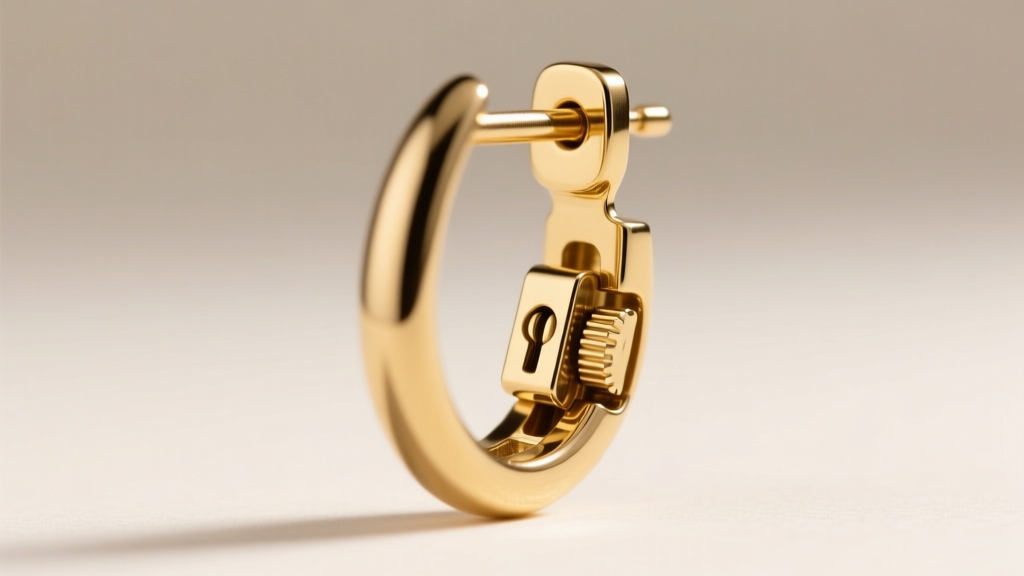
The standard butterfly friction back is the most common failure point for heavy dangles. As the earring swings, the friction back slowly loosens, causing the earring to tilt forward. A tilted drop earring loses its vertical elongating power and instead pulls uncomfortably on the lobe. For drops exceeding 10 grams, upgrade to a locking back. The La Pousette (push-pull) mechanism uses an internal spring-loaded clutch that snaps securely into a grooved post. Alternatively, high-density silicone stoppers provide superior grip and act as a cushion to support the weight of the earring against the back of the earlobe.
Hypoallergenic Metals for Stressed Piercings
Because elongated earrings exert constant downward tension on the fistula (the piercing hole), any metal sensitivity will be exacerbated. Avoid nickel-heavy white gold or cheap brass alloys. Opt for Implant-Grade Titanium (ASTM F136) or 14k/18k solid yellow gold. For comprehensive guides on metal purity and allergy-safe jewelry, resources like Blue Nile's Jewelry Education offer excellent baselines for understanding hallmark stamps and metal compositions.
Quick Reference Chart: Earring Lengths and Visual Effects
Use this chart to quickly determine how different earring lengths will interact with a round face shape.
| Earring Length | Termination Point | Visual Effect on Round Face | Recommended? |
|---|---|---|---|
| 0.25 - 0.5 inches | On the Earlobe | Adds horizontal width at the jaw hinge; emphasizes roundness. | No (unless tiny solitaire) |
| 1.0 - 1.25 inches | Just Above Jawline | Acts as a visual stopper; highlights cheek width. | No |
| 1.5 - 2.5 inches | Below the Jawline | Draws the eye downward; creates a slimming, elongating illusion. | Yes (Ideal Sweet Spot) |
| 3.0+ inches | Shoulder / Collarbone | Dramatic elongation; requires secure locking hardware due to weight. | Yes (For formal styling) |
Final Tips for Beginners
Interaction with Hairstyles
The visual impact of elongating earrings is heavily influenced by your hairstyle. When wearing hair down, ensure the elongated drops are long enough (at least 2 inches) to peek through the hair; otherwise, they will get tangled and lose their elongating effect. For updos, slicked-back buns, or short pixie cuts, you have the freedom to wear dramatic 3-inch linear threaders or bold geometric dangles, as the exposed jawline allows the vertical lines of the jewelry to work in harmony with your neck and facial structure.
Building Your Collection
Building a jewelry box that flatters a round face doesn't mean you must sacrifice personal style for geometry. Start by investing in two high-quality pairs of elongating earrings: one versatile 1.5-inch geometric drop in solid gold or titanium for daily wear, and one dramatic 2.5-inch linear threader for evening events. Pay close attention to the hardware—never let a cheap friction back ruin the drape of a beautifully designed earring. By prioritizing vertical lines, sharp angles, and structurally sound gauge sizes, you will effortlessly enhance your natural features and master the art of facial styling through jewelry.


