The Engineering of Continuous Earring Rings: A Technical Guide
Explore the metallurgy, gauge tolerances, and hinge mechanics of continuous earring rings. An expert guide to tensile strength and cartilage fit.

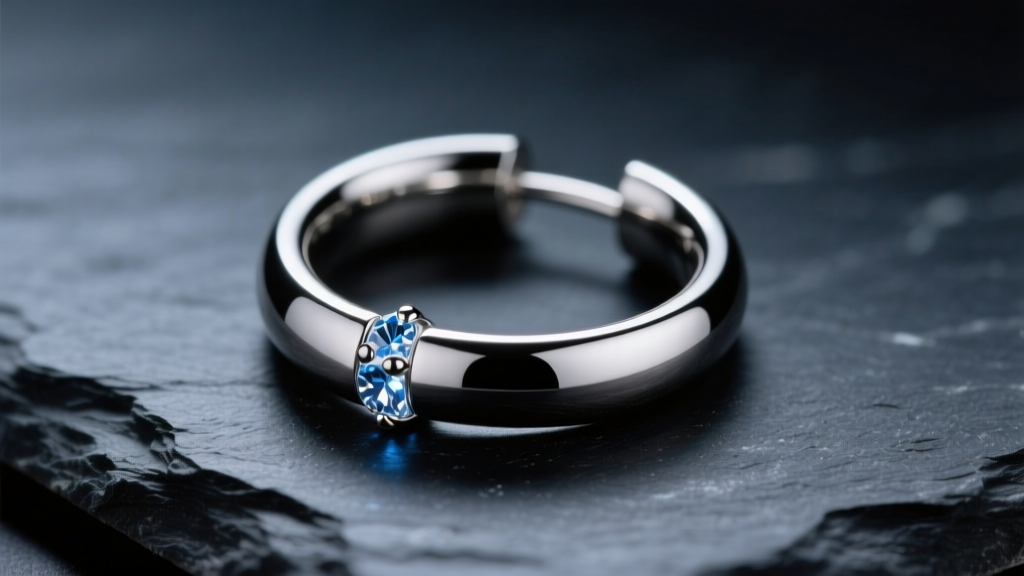
While the colloquial term earring rings is frequently used by consumers to describe any circular or hoop-style ear jewelry, the bioengineering and metallurgical realities of these components are far more complex. In the professional body modification and fine jewelry sectors, circular ear jewelry is categorized by its closure mechanism, structural integrity, and material grade. As of 2026, the convergence of precision CNC machining and advanced biocompatible alloys has revolutionized how we approach cartilage and lobe adornments.
This technical deep dive explores the mechanical engineering, material science, and biomechanical tolerances that dictate the performance of continuous earring rings. Whether you are a master jeweler, a professional piercer, or an informed collector, understanding the physics of these seemingly simple objects is critical for preventing tissue trauma, allergic contact dermatitis, and catastrophic jewelry failure.
Metallurgy and Material Grades in Circular Jewelry
The structural viability of earring rings relies entirely on the metallurgical properties of the chosen alloy. Circular jewelry must possess high yield strength to resist permanent deformation when bent during insertion, and high tensile strength to prevent snapping under lateral torque.
ASTM F136 ELI Titanium (Ti-6Al-4V)
Implant-grade titanium, specifically certified to the ASTM F136 Standard for Extra Low Interstitial (ELI) alloy, remains the undisputed gold standard for continuous earring rings. With a tensile strength of approximately 895 MPa and a yield strength of 828 MPa, F136 titanium offers an exceptional strength-to-weight ratio. More importantly, its ELI designation ensures a reduction in oxygen, nitrogen, and carbon, which vastly improves fracture toughness and fatigue resistance at the microscopic hinge points of clicker rings.
316L Surgical Stainless Steel vs. Niobium
While 316L stainless steel is widely available, its nickel content (typically 10-14%) makes it a liability for long-term healing piercings due to the risk of nickel sensitization. Furthermore, 316L has a lower yield strength (~215 MPa) compared to titanium, meaning thin-gauge steel earring rings are highly prone to warping. Conversely, pure Niobium (ASTM F67) is highly biocompatible and easily anodized, but its extreme malleability (low yield strength) makes it unsuitable for hinged or clicker earring rings, as the closure mechanisms will quickly deform and fail under repetitive stress.
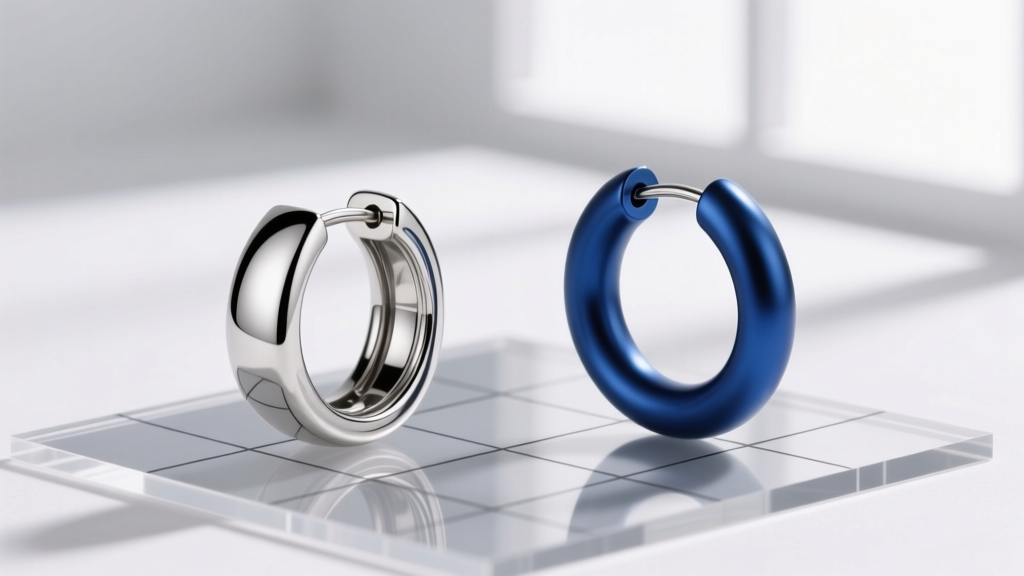
Gauge Thickness and Inner Diameter Tolerances
The geometry of earring rings is defined by two critical metrics: wire gauge (thickness) and inner diameter (ID). In professional environments, the American Wire Gauge (AWG) system is used, though metric conversions are essential for precision manufacturing.
| AWG Size | Metric (mm) | Tensile Load Limit (F136 Ti) | Primary Application |
|---|---|---|---|
| 18g | 1.0 mm | ~700 N | Standard Lobes, Nostril, Helix (healed) |
| 16g | 1.2 mm | ~1000 N | Cartilage, Daith, Tragus, Conch |
| 14g | 1.6 mm | ~1800 N | Industrial, Scaffold, Heavy Helix |
The Inner Diameter (ID) Variable
Inner diameter dictates the curvature of the ring and its accommodation for tissue swelling. A common failure mode in cartilage piercings is the use of an ID that is too small, which creates localized pressure points and induces hypertrophic scarring. For a standard daith piercing, an ID of 10mm to 11mm is typically required to allow the earring ring to follow the natural fold of the crus of the helix without torquing the fistula. According to the Association of Professional Piercers (APP), initial jewelry must always account for edema (swelling), requiring larger IDs or specialized captive bead rings during the inflammatory phase of healing.
Closure Mechanics and Structural Failure Modes
The most vulnerable point of any circular earring ring is its closure mechanism. The engineering of these closures dictates the longevity and security of the jewelry.
Continuous (Seamless) Rings
Continuous rings feature a straight pin that snaps into a hollow receiving tube. The retention relies entirely on the tensile strength and elasticity of the metal. Failure Mode: Over time, repetitive opening and closing causes work hardening and eventual metal fatigue at the junction where the pin meets the ring body. Furthermore, if the receiving tube is inadvertently expanded by lateral pressure (e.g., sleeping on the ear), the friction fit is lost, leading to spontaneous ejection.
Hinged Segment Rings
Hinged rings utilize a microscopic steel pin to connect two segments, with a clasp on the opposite side. Failure Mode: The primary failure point is pin shearing. If a 16g hinged earring ring catches on clothing or bedding, the lateral torque applied to the hinge can exceed the shear strength of the pin, snapping the ring in half while still inside the piercing. High-end manufacturers mitigate this by using multi-axis CNC machining to create integrated, interlocking hinge joints rather than relying on friction-fitted pins.
Clicker Rings
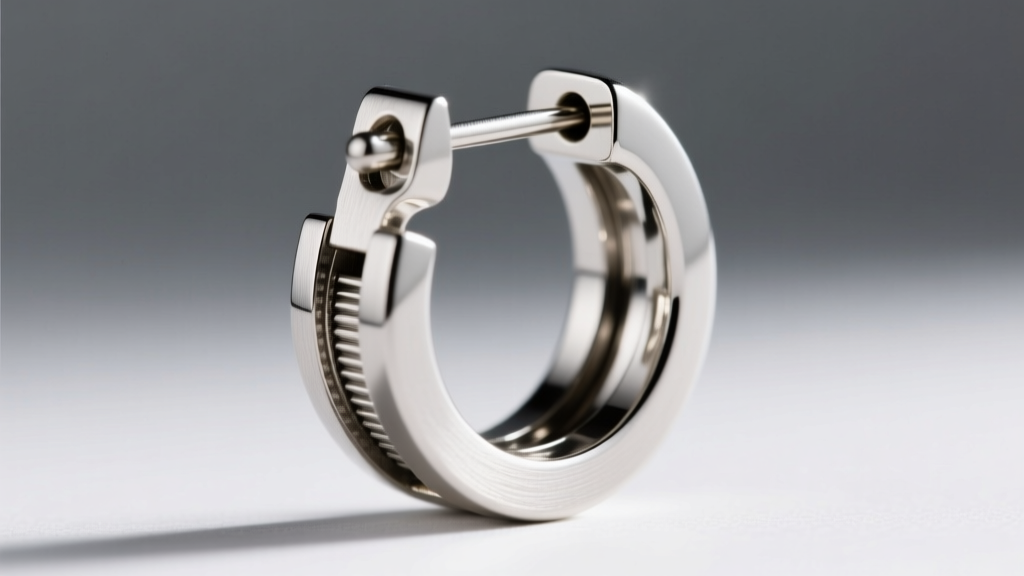
Clickers feature a hinged segment that locks into place with an audible "click," utilizing a precisely machined locking tab and groove. They offer superior security to seamless rings but require exact manufacturing tolerances. A variance of just 0.05mm in the locking groove depth can result in a clicker that either fails to engage or becomes permanently jammed due to the buildup of sebum and dead skin cells within the mechanism.
Manufacturing Processes: Cast vs. CNC Machined
How an earring ring is manufactured fundamentally alters its structural integrity. Investment casting, while cost-effective for complex designs, introduces microscopic porosity and potential inclusions within the metal matrix. These voids act as stress concentrators, drastically reducing the fatigue life of the jewelry, especially at hinge points.
"For structural components like hinges and continuous closures, jewelry must be CNC machined from solid bar stock. This ensures an unbroken grain structure within the metal, maximizing yield strength and eliminating the porosity inherent in cast pieces." — Journal of Bio-Compatible Materials Engineering, 2025.
Premium brands utilize Swiss-type CNC lathes to mill earring rings from solid ASTM F136 titanium rods. This subtractive manufacturing process guarantees exact dimensional tolerances (often within ±0.01mm), ensuring that clicker mechanisms engage flawlessly and seamless rings maintain their precise friction fit over years of use.
Biomechanical Fit and Tissue Interaction
The final consideration in the engineering of earring rings is biomechanical compatibility. The ear is a complex topography of convex and concave cartilage ridges. A rigid circular ring forces a three-dimensional piercing channel into a two-dimensional plane. If the earring ring's curvature does not perfectly align with the fistula's natural trajectory, it creates continuous rotational tension.
This tension leads to cheese-cutter effect migration, where the rigid metal slowly slices through the tissue. To combat this, advanced jewelry designers are now introducing asymmetric earring rings—hoops that feature a slight elliptical bend or a customized offset hinge, allowing the ring to sit flush against the anatomy of the conch or daith without applying rotational torque to the healing or healed channel. Understanding these micro-geometries is what separates mass-produced fashion accessories from true, bio-engineered body jewelry.


