Engineering Statement Hoop Earrings: Weight and Gauge Guide
Master the mechanics of statement hoop earrings. Explore gauge thickness, weight distribution, metallurgy, and lobe support for comfortable, bold wear.

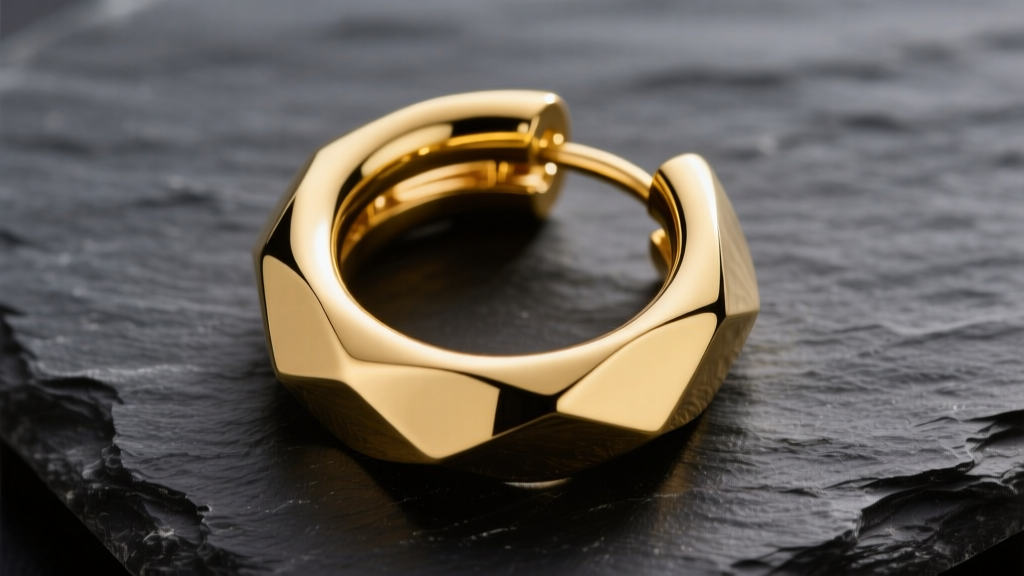
When jewelers and engineers collaborate on statement hoop earrings, the primary adversary is gravity. Unlike studs or huggies that sit flush against the anatomy, large-diameter hoops act as pendulums. Every movement of the wearer generates kinetic energy that transfers directly to the earlobe's piercing channel. In 2026, advancements in micro-metallurgy and biomechanical support have redefined what is possible, allowing for massive, sculptural silhouettes that do not compromise tissue integrity. This technical guide deconstructs the engineering principles behind high-performance statement hoops.
The Physics of Lobe Tension and Creep Deformation
The human earlobe is primarily composed of adipose tissue and a loose collagen matrix, lacking the rigid cartilage found in the upper ear. When a heavy hoop is suspended from this tissue, it induces a phenomenon known in materials science as 'creep'—the tendency of a solid material to move slowly or deform permanently under the influence of persistent mechanical stress.
If a statement hoop weighs 15 grams and utilizes a thin 22-gauge (0.64mm) wire, the localized pressure (Pressure = Force / Area) on the inferior wall of the piercing channel is immense. Over time, this causes the collagen fibers to stretch and micro-tear, leading to the dreaded 'cheese-cutter effect,' where the piercing slowly migrates downward. To counteract this, expert bench jewelers mandate a minimum wire thickness of 14-gauge (1.62mm) or 12-gauge (2.05mm) for any hoop exceeding 40mm in diameter. This increased surface area distributes the gravitational load, keeping the pressure well below the tissue's yield point.
Metallurgical Choices for Structural Integrity
The choice of metal dictates not only the aesthetic but the structural survival of the earring. Soft metals will warp under the pendulum stress of a large hoop, while overly dense metals will cause immediate lobe fatigue. According to metallurgical data published by the Gemological Institute of America (GIA), alloying elements are critical in determining the yield strength of precious metals.
| Material | Yield Strength (MPa) | Density (g/cm³) | Structural Verdict |
|---|---|---|---|
| 14k Yellow Gold | 250-300 | 12.9 | Excellent balance of rigidity and weight; ideal for heavy hoops. |
| 18k Yellow Gold | 150-200 | 15.5 | Too soft for heavy, thin-gauge pieces; prone to bending. |
| Grade 5 Titanium | 880-950 | 4.4 | Ultra-lightweight and strong; allows massive diameters without strain. |
| Platinum (950/Ru) | 300-400 | 21.4 | Extremely dense; requires skeletonization or filigree to reduce mass. |
| 316L Surgical Steel | 290-310 | 8.0 | High rigidity but heavy; requires thick gauges to prevent warping. |
As the table illustrates, 18k gold, while highly prized for its rich color and purity, possesses a relatively low yield strength. For a massive 70mm statement hoop, 18k gold wire will easily bend out of its circular geometry if bumped. Therefore, 14k gold or Grade 5 Titanium are the superior engineering choices for large-scale structural hoops, offering the rigidity required to maintain a perfect circle under dynamic stress. Furthermore, for wearers with sensitivities, the American Academy of Dermatology strongly recommends avoiding nickel-containing alloys like white gold or certain surgical steels, as the prolonged friction of a heavy hoop can trigger severe contact dermatitis.
Tubing vs. Solid Wire Construction
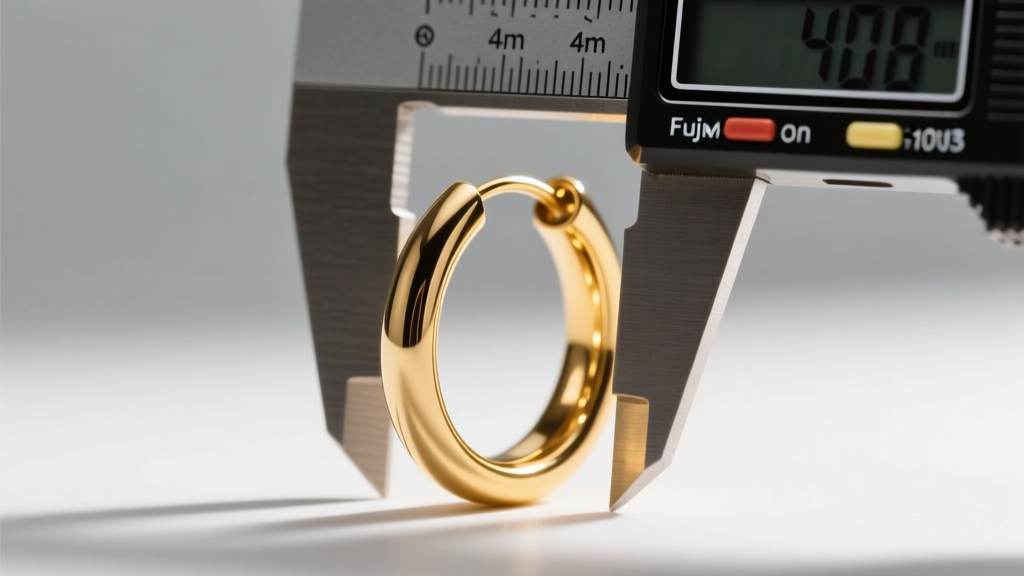
A common misconception is that all thick-looking hoops are solid metal. In reality, any solid gold wire exceeding 3mm in thickness and 50mm in diameter would be prohibitively heavy and expensive. To solve this, master jewelers utilize seamless tubing or electroforming techniques.
The Mechanics of Seamless Tubing
Seamless tubing involves drawing a metal tube to a specific outer diameter (e.g., 4mm) while maintaining a microscopic wall thickness (e.g., 0.5mm). This creates a hoop that possesses the visual volume and structural rigidity of a solid piece but weighs roughly 70% less. The internal hollow space also shifts the center of gravity closer to the earlobe, reducing the pendulum torque. However, the primary failure mode of tubular hoops is kinking at the hinge point if the metal is not properly annealed during manufacturing.
Closure Mechanisms and Failure Modes
The closure is the most vulnerable structural node on any statement hoop. The mechanical stress of inserting and removing the earring, combined with the lateral pull of the hoop's weight, demands precision engineering.
- Hinged Snap Closures: The industry standard for medium-to-large hoops. A hollow post snaps into a tension-fit catch. Failure Mode: The internal catch spring can fatigue over time, leading to accidental unclasping. Requires annual professional tensioning.
- Saddleback Closures: Features a wide, curved backing that snaps over a central post. Advantage: Distributes weight across a wider area of the posterior earlobe. Failure Mode: The central post is often thin (18g-20g), creating a high-pressure point inside the piercing channel.
- Continuous (Endless) Hoops: A thin wire that bends to insert into a hollow tube. Warning: Highly discouraged for heavy statement pieces. The repetitive bending causes work-hardening and eventual metal fatigue, resulting in the wire snapping off inside the tube.
- French Wire (Fish Hook): The ultimate choice for oversized, heavy statement hoops. The wire hooks over the top of the ear cartilage, entirely bypassing the fragile earlobe tissue for primary support.
Biomechanical Support Systems
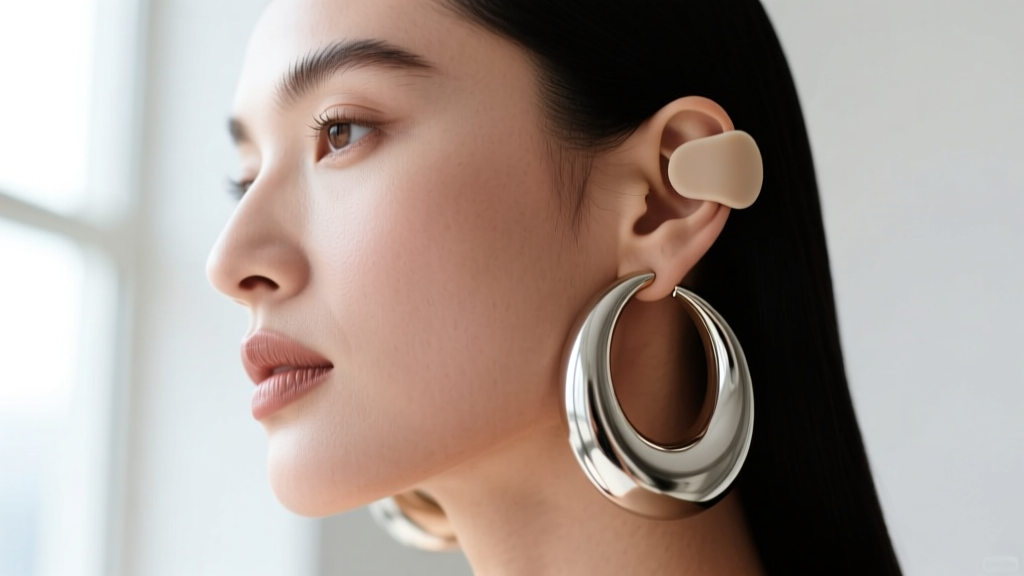
Even with optimized gauge thickness and lightweight tubing, gravity remains a constant force. Modern jewelry wearers rely on biomechanical support systems to extend the comfortable wear time of statement hoops from a few hours to an entire day.
'The key to wearing oversized hoops comfortably is not just in the jewelry's engineering, but in augmenting the body's natural load-bearing capacity through surface area distribution.' — Advanced Jewelry Ergonomics Report, 2025.
Silicone earlobe support patches (often branded as Earlobe Wonder) are medical-grade, adhesive-backed discs that apply to the posterior side of the earlobe. By increasing the surface area that the earring's backing or wire presses against, these patches reduce localized tissue pressure by up to 80%. For French wire hooks, utilizing high-friction silicone O-rings or adjustable tension stoppers prevents the heavy hoop from sliding forward and dragging the earlobe downward.
Maintenance and Structural Longevity
Statement hoop earrings require rigorous maintenance protocols to ensure longevity. Because of their large surface area, they are highly susceptible to environmental oxidation and cosmetic buildup. Ultrasonic cleaners should be used with caution; while excellent for removing sebum and lotion from the closure mechanisms, prolonged exposure to high-frequency vibrations can loosen gemstone settings or weaken the microscopic solder joints at the hinge. Instead, utilize a soft-bristled brush with a mild, non-abrasive surfactant.
When polishing tubular hoops, avoid aggressive buffing wheels near the seam lines. The friction heat can soften the solder, and the abrasive compounds can become trapped inside the hollow cavity, leading to internal corrosion over time. Opt for chemical polishing dips specifically formulated for the base metal, followed by a thorough distilled water rinse. Furthermore, inspect the hinge pin every six months. If you detect any lateral 'play' or wiggling in the hinge, the earring must be retired to a bench jeweler for pin replacement before a catastrophic failure results in the loss of the piece.


