How to Choose Extra Long Rhinestone Earrings: A Buyer's Guide
Discover what to look for when buying extra long rhinestone earrings. Learn about crystal grades, weight distribution, and secure backing mechanisms.

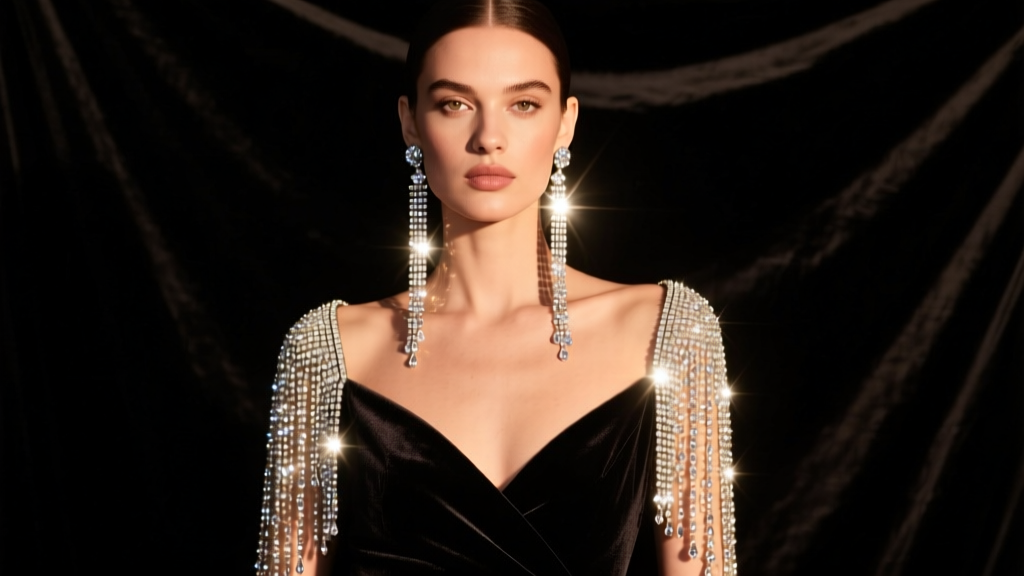
Maximalism has firmly cemented its place in contemporary jewelry, and nothing captures this bold aesthetic quite like extra long rhinestone earrings. Often referred to as shoulder dusters or chandelier drops, these statement pieces typically range from three to eight inches in length. However, buying a pair that looks spectacular on the display stand is entirely different from finding a pair that is comfortable, durable, and optically brilliant in real life. As a buyer, you must navigate a minefield of cheap acrylics, flimsy wire gauges, and poorly engineered clasps. This comprehensive guide breaks down the exact specifications, material grades, and structural requirements you need to evaluate before investing in your next pair of dramatic drops.
The Anatomy of Extra Long Rhinestone Drops
To understand what makes a high-quality pair of extra long rhinestone earrings, you first need to understand their anatomy. A well-constructed long drop consists of four main components: the anchor (the post or hook that sits on the ear), the connector (the jump ring or articulated hinge), the body (the cascading tiers of crystals), and the terminus (the final weighted drop). In cheaper manufacturing, these elements are glued or loosely wire-wrapped, leading to frequent snagging and stone loss. In premium jewelry, tiers are linked via soldered jump rings or micro-pavé settings, ensuring the earring moves fluidly as a single, cohesive unit without catching on hair or fabrics.
Crystal Quality: Glass vs. Acrylic vs. Leaded Crystal
The term "rhinestone" originally referred to quartz crystals gathered from the Rhine River, but today it encompasses a wide variety of faceted materials. The brilliance of your earrings depends entirely on the material's Refractive Index (RI)—a measure of how much the material bends and reflects light. According to optical standards referenced by institutions like the Gemological Institute of America (GIA), the cut and material density dictate a stone's fire and scintillation.
- Acrylic (RI ~1.49): Extremely lightweight, making it ideal for massive, 8-inch shoulder dusters that won't tear your earlobes. However, acrylic lacks optical depth. The facets will look glassy and dull under indoor lighting, and the material scratches easily.
- Standard Glass (RI ~1.52): A step up from acrylic, offering better clarity but still lacking the "rainbow" dispersion of true crystal. Often used in mid-tier fast fashion.
- Leaded Crystal (RI ~1.70): Historically, adding 24% lead oxide (PbO) to glass increased its density and refractive index, creating unparalleled sparkle. However, due to modern health and environmental regulations, leaded crystal is largely being phased out of wearable jewelry.
- Advanced Lead-Free Crystal (RI ~1.70+): Pioneered by brands like Swarovski, modern premium rhinestones use barium, zinc, and titanium oxides to achieve the optical brilliance of lead crystal without the toxicity. When buying high-end extra long rhinestone earrings, always look for "lead-free advanced crystal" or precision-cut cubic zirconia (CZ) for maximum light return.
Weight Distribution and Lobe Health
The most critical failure point of extra long earrings is not the clasp—it is your earlobe. Heavy, elongated jewelry creates a pendulum effect. Every time you turn your head, the momentum pulls downward on the piercing fistula. Over time, this causes micro-tears, stretching, and the dreaded "cheese-cutter" effect, where the earring wire slowly slices through the lobe tissue. Master jewelers and piercing experts, such as those at Calla Gold Jewelry, warn that prolonged wear of heavy drops can cause irreversible lobe sagging.
The 14-Gram Rule: For prolonged wear (more than 4 hours), an earring should ideally weigh no more than 14 grams. If your chosen extra long rhinestone earrings exceed this, you must use structural support.
If you fall in love with a heavy, 25-gram pair of crystal chandeliers, you must invest in earring support patches (like Blister Bandits or LobeWonder). These are discreet, medical-grade adhesive patches that sit behind the earlobe, distributing the weight of the earring across a wider surface area of skin and cartilage, completely neutralizing the downward pull on the piercing hole.
Choosing the Right Backing Mechanism
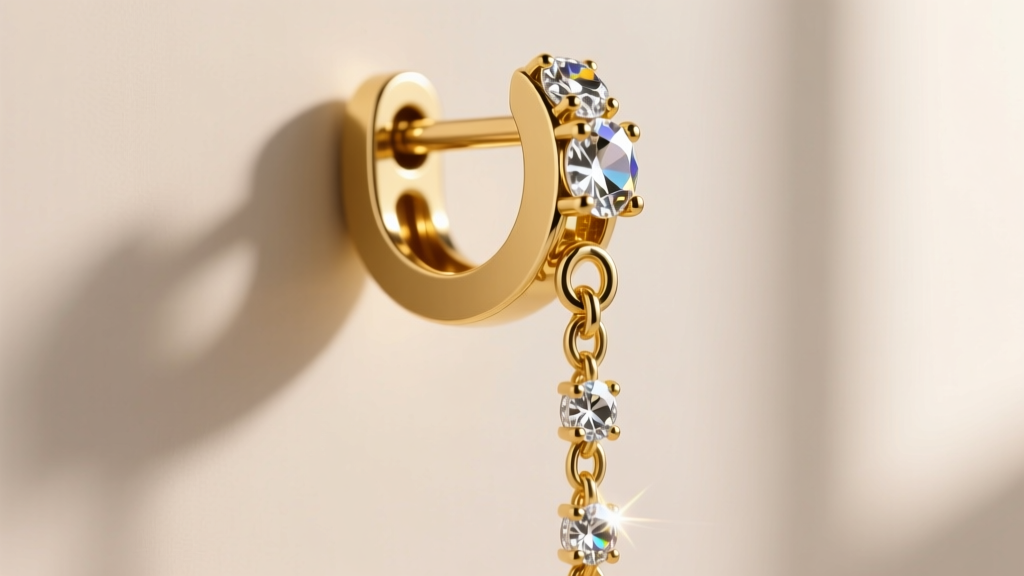
The anchor of an extra long earring dictates both its security and its comfort. A standard butterfly push-back is entirely insufficient for drops longer than three inches, as the leverage of the long body will cause the post to tilt downward, pressing the metal uncomfortably into the side of your neck or jaw. Here is how the primary backing mechanisms compare for heavy, elongated styles:
| Backing Type | Max Weight Capacity | Security Level | Best Use Case |
|---|---|---|---|
| French Wire (Fishhook) | Low (Under 10g) | Low | Lightweight acrylic or hollow-glass dangles. Requires silicone stoppers. |
| Leverback | High (Up to 25g) | Very High | Heavy crystal chandeliers. The hinged closure locks securely and supports weight. |
| Post with Omega Clip | Very High (30g+) | Maximum | Massive shoulder dusters. The wide clip hugs the lobe, preventing forward tilt. |
| Ear Wire with Coil | Medium (Up to 15g) | Medium | Bohemian or artisan wire-wrapped long drops. |
Gauge Thickness and Wire Tensile Strength
Beyond the clasp type, the thickness of the wire (gauge) is vital. Standard earrings use 20-gauge (0.81mm) wire. However, for extra long rhinestone earrings that carry significant weight, a 20-gauge French hook will easily bend out of shape when catching on a sweater or hair. You should actively seek out 18-gauge (1.02mm) or even 16-gauge (1.29mm) wire for the primary hooks of heavy drops. Furthermore, consider the metal's tensile strength: sterling silver is relatively soft and prone to bending, whereas 14k gold-filled wire or spring-hardened brass offers vastly superior structural memory, ensuring the hook returns to its original shape after being stressed.
Styling for Face Shapes and Necklines
Extra long rhinestone earrings are an architectural choice; they physically alter the perceived proportions of your face and neck. Because they draw the eye vertically, they must be balanced against your natural bone structure and the neckline of your garment.
Face Shape Pairings
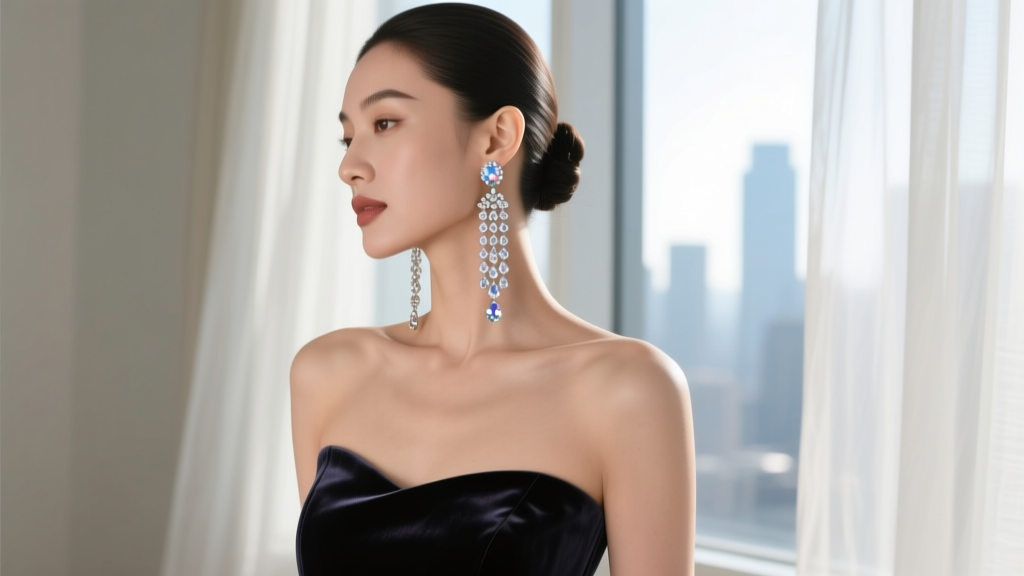
- Round Faces: Extra long, linear drops (like a straight line of baguette-cut rhinestones) are highly recommended. They create an optical illusion that elongates the face and sharpens the jawline. Avoid wide, circular chandelier shapes.
- Oblong/Long Faces: Proceed with caution. A 6-inch linear drop will exaggerate the length of your face. Instead, opt for extra long styles that feature horizontal volume—such as wide, tiered chandeliers or tassel-style rhinestone fringe that flares outward at the bottom.
- Heart-Shaped Faces: Look for extra long earrings that are top-heavy or feature a teardrop-shaped terminus. The width at the bottom of the earring will balance a narrower chin.
Neckline Synergy
The golden rule of styling shoulder dusters is to avoid competition. If your earrings extend past the collarbone, they should ideally be worn with a strapless, sweetheart, or deep V-neckline. High necklines, turtlenecks, or halter tops will cause the rhinestones to tangle with the fabric, scratching the crystals and creating a visually cluttered silhouette. The skin acts as a neutral canvas, allowing the refractive index of the crystals to truly pop.
Price Tiers and What to Expect
When shopping for extra long rhinestone earrings, pricing is a direct reflection of the base metal, the crystal origin, and the labor involved in setting the stones.
- Fashion Tier ($15 - $40): Expect cast brass or pewter bases with thin silver or gold plating. The "rhinestones" will be acrylic or machine-pressed glass, often glued into place rather than prong-set. These are fine for occasional costume wear but will tarnish quickly and lack optical fire.
- Bridge / Mid-Tier ($50 - $150): The sweet spot for most buyers. You will find sterling silver or heavy gold vermeil bases. The stones will be precision-cut cubic zirconia (CZ) or lead-free advanced crystal, securely prong-set or micro-pavé. Backings will feature sturdy leverbacks or omega clips.
- Luxury / Designer ($300 - $1,000+): Solid 14k/18k gold or platinum settings featuring hand-cut, AAA-grade CZ or genuine white sapphires. Every jump ring is soldered, and the articulation is engineered by master jewelers to ensure the drops move like liquid glass.
Final Verdict: Caring for Your Investment
Extra long rhinestone earrings require specialized storage. Never toss them into a standard jewelry box where the long chains or tiers can become hopelessly knotted. Store them hanging from a dedicated jewelry rack or lay them completely flat in a lined drawer. Furthermore, because the oils from your skin and hair products can create a cloudy film on the facets of the rhinestones, gently wipe the crystals with a microfiber cloth and a drop of isopropyl alcohol after every wear to maintain that maximum, light-catching brilliance.


