Why Do I Look SM Better With Earrings? Face Framing Guide
Discover why do i look sm better with earrings. Learn the science of face-framing, ideal shapes for your jawline, and 2026 expert buying tips.


The Phenomenon: Why Do I Look 'SM' Better With Earrings?
If you have ever caught your reflection in a store window and wondered, 'why do i look sm better with earrings' (using the popular internet shorthand 'sm' for 'so much'), you are experiencing the real-time effects of visual weight manipulation and facial framing. Earrings are not merely decorative accents; they are architectural tools that alter the perceived proportions of your face. When you remove them, your features might suddenly appear wider, flatter, or less defined. This is not an illusion—it is the science of the facial golden ratio in action.
In this comprehensive 2026 buying guide, we break down the exact mechanics of face-framing jewelry. We will explore how specific silhouettes interact with your bone structure, why the gauge of your earring wire dictates the 'drape' and elegance of the piece, and what materials you must prioritize to ensure your earrings sit flawlessly against your skin without causing irritation or tissue fatigue.
The Architecture of Face Framing and Visual Gravity
To understand why certain earrings make you look 'so much' better, we must look at facial thirds. Aestheticians and plastic surgeons divide the face into three horizontal sections: the upper third (hairline to brow), the middle third (brow to base of the nose), and the lower third (base of the nose to the chin). Earrings primarily interact with the middle and lower thirds.
When you wear a drop earring that terminates exactly at the jawline, you create a horizontal visual anchor that emphasizes the mandible. If you wear a long, linear dangle that drops below the chin, you artificially elongate the lower third of the face, creating a slimming, balancing effect. The 'glow up' you experience is simply the result of redirecting the observer's eye to your most symmetrical or defined features while softly masking areas of visual width.
The Face Shape & Silhouette Matrix
Choosing the right earring is about creating equilibrium. The goal is never to perfectly mirror your face shape, but rather to provide a contrasting silhouette that pulls your proportions toward the universally flattering oval ideal. Below is a decision matrix for matching earring geometry to your underlying bone structure.
| Face Shape | Ideal Earring Silhouette | Styles to Avoid | Visual Goal |
|---|---|---|---|
| Round | Linear drops, angular geometric dangles, long French wire chandeliers. | Large circular hoops, wide button studs, clustered spheres. | Elongate the lower third; add vertical length and sharp angles. |
| Square | Curved hoops, teardrop dangles, oval cabochon drops, soft huggies. | Square geometric studs, sharp linear drops, heavy angular cuffs. | Soften the jawline; introduce curvature and movement. |
| Heart | Teardrops, chandeliers wider at the bottom, bottom-heavy dangles. | Inverted triangles, top-heavy studs, extreme wide hoops at the cheek. | Add visual weight to the lower jaw to balance a wider forehead. |
| Oval | Virtually all styles; bold geometric studs, medium hoops, ear cuffs. | Extreme elongated drops that over-stretch the face. | Maintain natural balance; highlight cheekbones and ear curvature. |
| Diamond | Studs, small huggies, teardrops that do not extend past the jaw. | Wide, dramatic chandeliers that sit exactly at the cheekbone width. | Softly frame the upper ear without adding width to the cheekbones. |
The Physics of Drape: Gauge, Weight, and Findings
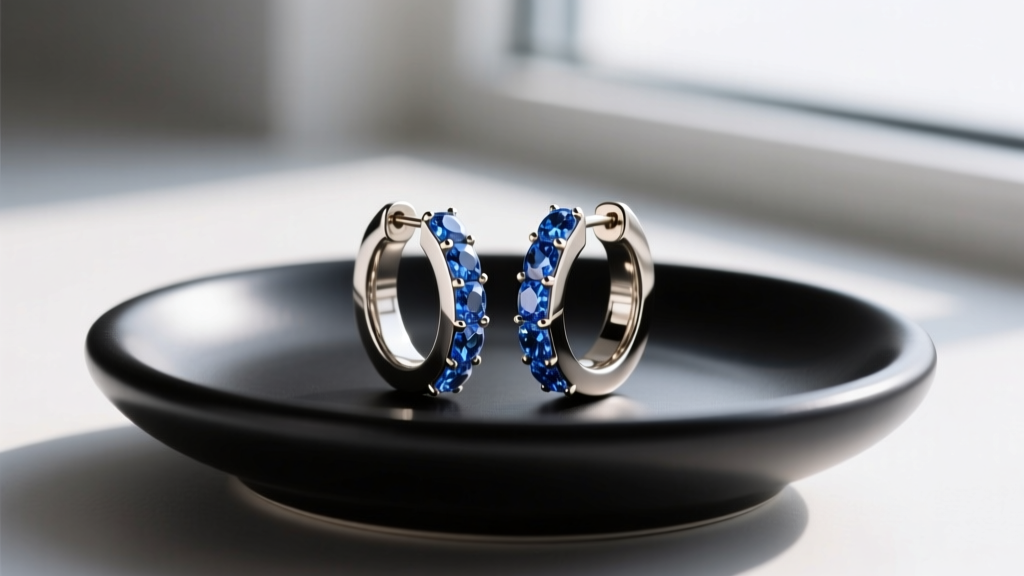
A common mistake buyers make is focusing entirely on the decorative front of the earring while ignoring the structural mechanics of the finding (the part that goes through the ear). This is why a cheap drop earring often hangs awkwardly, pulling the lobe forward and ruining the intended silhouette.
Understanding Wire Gauge and Tissue Support
Standard lobe piercings are typically performed at 20-gauge (0.81mm) or 18-gauge (1.02mm). However, if you are purchasing a heavy statement drop or a solid gemstone dangle, an 18g or even 16g (1.29mm) wire is vastly superior. A thicker wire provides structural rigidity, ensuring the earring hangs straight down rather than tilting forward under the weight of the gemstone. According to the Association of Professional Piercers (APP), matching the jewelry gauge to the tissue capacity and weight of the ornament is critical for preventing lobe migration and tearing over time.
Friction Backs vs. Leverbacks vs. Flat-Backs
- Friction Backs (Butterfly Clutches): Best for lightweight studs (under 3 grams). If tightened too much, they push the earring head into the lobe, making the design look 'swallowed' and dulling the sparkle of the gemstone.
- Leverbacks and French Wires: Ideal for dangles. The open curve allows the earring to swing freely, catching the light. Look for leverbacks with a secure snap closure to prevent loss of heavy 14k gold pieces.
- Threadless Flat-Backs: The gold standard for cartilage, helix, and conch piercings. A flat titanium disc sits flush against the back of the ear, allowing the front bezel or prong setting to sit perfectly perpendicular to the viewer, maximizing light return.
Material Grades: What to Actually Buy in 2026
The material of your earrings affects not only your skin's health but also the visual warmth and reflectivity of the metal against your undertones. In 2026, informed consumers are moving away from mystery-metal 'gold-plated' brass and demanding verifiable alloys.
Implant-Grade Titanium (ASTM F136)
For sensitive ears, newly healed piercings, or heavy daily-wear hoops, ASTM F136 titanium is non-negotiable. It is completely nickel-free, highly polished to a mirror finish (which reduces bacterial adhesion), and incredibly lightweight. Brands like Anatometal and Industrial Strength offer precision-machined titanium pieces that will not weigh down your lobes, preserving the natural lift of your ear.
Solid 14k and 18k Gold
When investing in face-framing drops or huggies, solid gold is essential. The Gemological Institute of America (GIA) notes that 14k gold offers the best balance of rich color and structural durability for intricate earring clasps, while 18k gold provides a deeper, warmer yellow hue that beautifully complements olive and deep skin tones. Avoid gold vermeil for pieces you wear in the shower or sleep in; the sterling silver core can oxidize and warp over time, altering the way the earring sits in your ear.
The Ultimate Buying Checklist
Before adding a new pair of face-framing earrings to your cart, run them through this expert checklist to ensure they will deliver that 'so much better' aesthetic effect:
- Check the Drop Length: Hold a ruler to your earlobe. If you have a round face, ensure the drop terminates at least 1.5 inches below the lobe to elongate the neck. If you have a long face, look for drops that stop right at the jaw hinge.
- Verify the Alloy: Look for 'Solid 14k/18k', 'ASTM F136 Titanium', or 'Niobium'. If the listing says 'gold dipped' or 'plated over brass', expect the visual weight to shift as the plating wears off and the base metal oxidizes.
- Assess the Center of Gravity: Look at the earring from the side. Does the decorative element hang directly below the post, or does it jut outward? Outward-jutting earrings will catch on hair and scarves, constantly twisting the earring and hiding the design from the front view.
- Evaluate the Clasp Security: For heavy geometric dangles, a standard friction back is a liability. Opt for screw-backs, secure leverbacks, or locking ear wires to ensure the earring maintains its perfect vertical alignment throughout the day.
Conclusion
The reason you look 'sm' better with earrings is that the right pair acts as a optical illusion, guiding the eye, balancing your facial thirds, and adding a deliberate, curated focal point to your profile. By understanding the geometry of your face shape, respecting the physics of wire gauges, and investing in high-integrity materials like solid gold and implant-grade titanium, you can curate a collection that doesn't just accessorize your outfit, but actively enhances your natural architecture.


