How to Fix a Closing or Shifting Hole for Earring
Learn how to troubleshoot a closing, shifting, or lost hole for earring. Expert guide on fistula repair, tapers, and piercing migration.

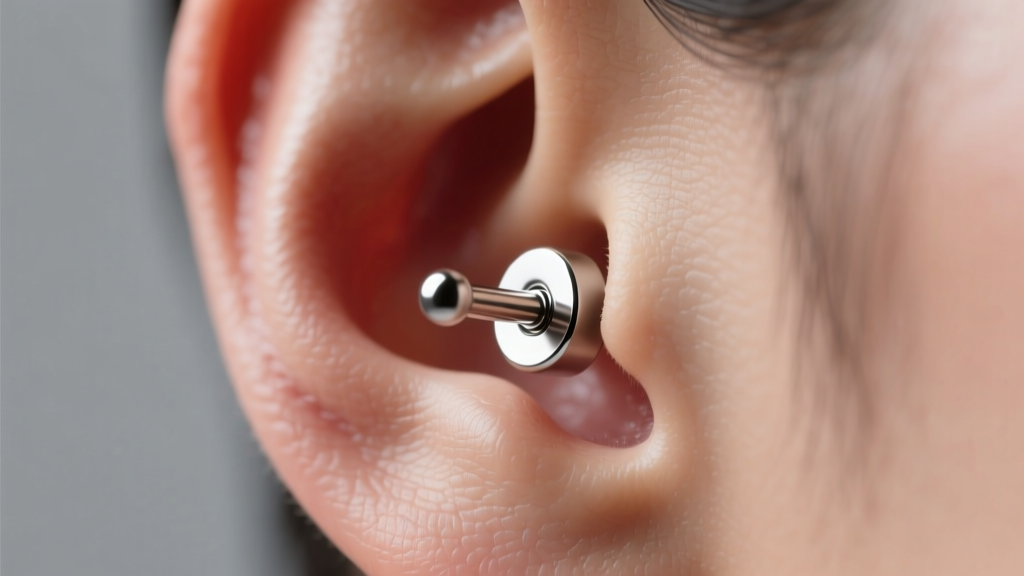
The Anatomy of a Piercing Fistula
When you first get your ears pierced, the body treats the puncture as an open wound. Over the next six to twelve months, the body generates a fistula—a permanent, tube-like structure of epithelial tissue that lines the piercing channel. This biological sleeve is what keeps your hole for earring open and protected. However, the fistula is not invincible. It is highly susceptible to mechanical stress, allergic reactions, and prolonged periods without jewelry. When a client or reader complains that their "hole is closing," they are usually experiencing one of three distinct biological reactions: rapid epithelialization (shrinking), angle migration (shifting), or inflammatory swelling that mimics closure. Troubleshooting these issues requires a clinical understanding of gauge mathematics, tissue behavior, and material science.
Scenario 1: The Hole is Rapidly Closing or Shrinking
If you remove your jewelry for even a few hours during the first year of healing, the fistula can begin to contract. Epithelial cells multiply rapidly to bridge gaps in the skin, and the inner diameter of your hole for earring will shrink. Forcing standard jewelry back into a contracted fistula causes micro-tears, leading to scar tissue buildup (hypertrophic scarring) and potential infection.
Gauge Math and Tapering Techniques
To safely stretch a shrunk hole back to its original size, you must use a sterilized piercing taper. You must understand exact gauge conversions to avoid tissue trauma:
- 20 Gauge (0.81mm): Standard for basic fashion earrings and thin studs.
- 18 Gauge (1.02mm): Common for healed lobe piercings and cartilage studs.
- 16 Gauge (1.29mm): The gold standard for initial lobe piercings done by professionals to prevent the "cheese-cutter" effect.
- 14 Gauge (1.63mm): Often used for stretched lobes or heavy structural jewelry.
If your 18G hole has shrunk to accommodate a 20G wire, do not jump straight back to 18G. Apply a water-based lubricant or pure jojoba oil to a polished steel 20G-to-18G taper. Gently slide the taper through the fistula until the 1.02mm end rests comfortably at the exit. Leave the taper in place for 10 to 15 minutes to allow the collagen fibers to relax before inserting your actual jewelry. Never use petroleum-based products like Vaseline, as they trap bacteria inside the fistula and degrade silicone O-rings.
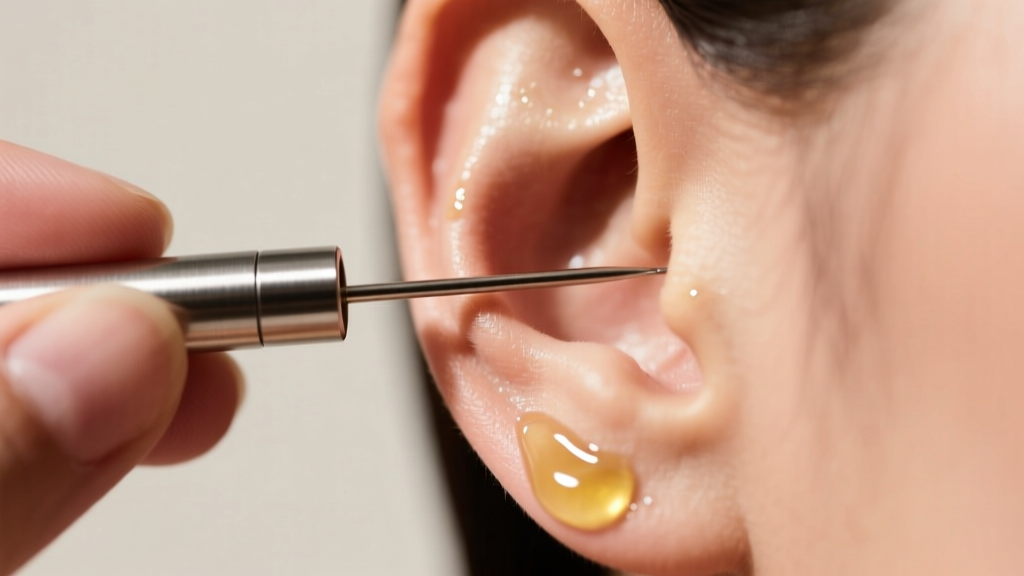
Scenario 2: You Cannot Find the Exit Hole
A common and highly frustrating problem occurs when the front of the hole for earring is visible, but the exit on the back of the lobe seems to have vanished. This happens when the earlobe shifts due to gravity, aging, or sleeping heavily on one side, causing the fistula to bend at a sharp angle. Alternatively, a small flap of skin (a tissue bridge) may have healed over the back exit.
Step-by-Step Probing Protocol
Do not use brute force or sharp objects to find the back of the piercing. Follow these steps to safely navigate a shifted fistula:
- Step 1: Warm Compress. Apply a warm, sterile saline compress to the earlobe for five minutes. This increases blood flow, softens the epithelial tube, and reduces minor inflammatory swelling.
- Step 2: Use an Insertion Pin. Take a sterilized, blunt-ended 20G insertion pin (never a sharp needle or safety pin). Insert it gently from the front.
- Step 3: Angle Adjustment. As the pin reaches the middle of the lobe, gently massage the back of the earlobe with your opposite thumb and index finger. You will feel the blunt tip of the pin pressing against the tissue bridge.
- Step 4: The Pop. Apply incredibly gentle forward pressure while manipulating the back tissue. The pin will eventually slip through the microscopic layer of healed skin with a faint "pop."
If you encounter hard, dense resistance, you are pushing against solid scar tissue or cartilage. Stop immediately. Forcing the pin will create a false passage, leading to severe inflammation and permanent lobe deformation. According to the APP Aftercare Guidelines, any significant resistance during re-insertion warrants a visit to a professional piercer who can use specialized tapering tools under optimal lighting.
Scenario 3: Migration and the "Cheese-Cutter" Effect
Migration occurs when the body slowly rejects the jewelry, pushing it toward the surface of the skin. In earlobes, this is almost always caused by the "cheese-cutter effect." This mechanical failure happens when heavy dangle earrings or thin wire hoops (20G or 22G) are worn for extended periods. The weight of the jewelry acts like a wire cheese slicer, slowly dragging the hole for earring downward through the tissue.
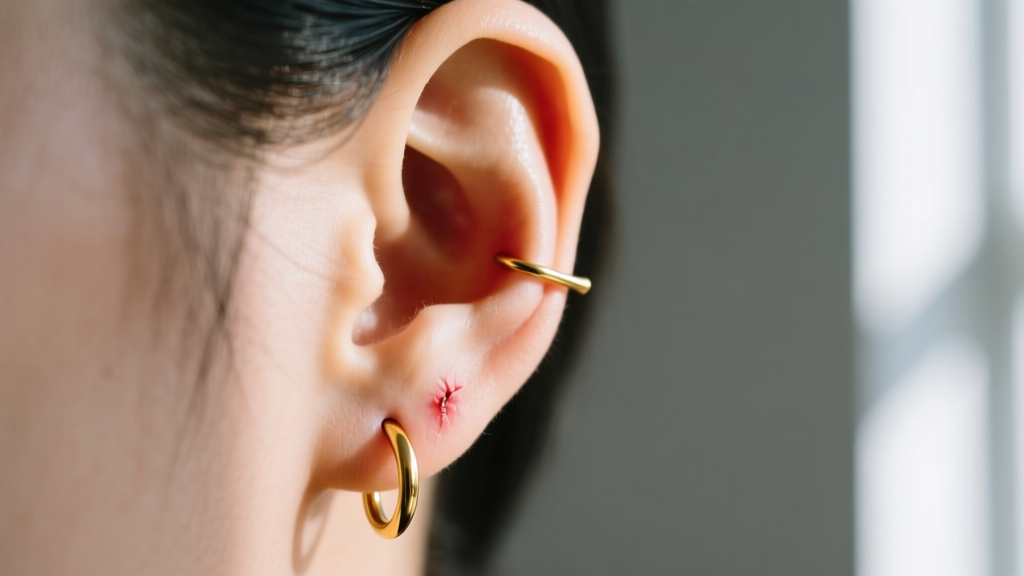
You can identify early migration if the jewelry sits at an extreme tilt, if the skin between the hole and the bottom edge of the lobe looks thin and translucent, or if the piercing is frequently tender. To halt migration, you must immediately remove the heavy or thin jewelry. Replace it with a lightweight, 16G or 14G implant-grade titanium flat-back labret. The thicker gauge distributes the weight over a wider surface area of the fistula, while the flat back prevents the jewelry from tilting and pulling on the lower tissue margin. If the skin at the bottom of the lobe has already torn through, the fistula is compromised, and the lobe must be allowed to heal entirely before a professional repiercing can be considered.
Troubleshooting Matrix: Symptom to Solution
Use this diagnostic table to quickly identify the root cause of your piercing issues and apply the correct intervention.
| Symptom | Root Cause | Immediate Troubleshooting | Long-term Prevention |
|---|---|---|---|
| Hole feels tight; jewelry won't pass | Rapid epithelialization (shrinking) | Use a lubricated steel taper; do not force jewelry. | Wear continuous jewelry; use glass retainers during surgeries. |
| Exit hole is hidden or blocked | Angle shift or tissue bridge overgrowth | Warm compress; gently probe with a blunt insertion pin. | Sleep on a travel pillow to prevent lobe compression and shifting. |
| Jewelry tilts forward; lobe edge thins | Cheese-cutter effect from heavy/thin jewelry | Switch to a 14G or 16G flat-back titanium labret. | Reserve heavy dangles for short-term wear; use 16G+ for daily hoops. |
| Hole is weeping clear fluid; feels hot | Contact dermatitis (Nickel allergy) | Switch to ASTM F-136 Titanium; use sterile saline soaks. | Avoid "surgical steel"; only purchase verified implant-grade metals. |
Material Science: When Swelling Mimics Closure
Frequently, clients believe their hole for earring is closing when, in reality, the fistula is severely inflamed and swollen shut due to a metal allergy. The term "surgical steel" is largely a marketing gimmick; many commercial steel alloys contain up to 10% nickel. When nickel leaches into the moist environment of the fistula, it triggers contact dermatitis. The tissue swells inward, effectively choking the channel and making it impossible to insert or remove the jewelry.
"For initial piercings and healing fistulas, only implant-grade titanium (ASTM F-136), niobium, or solid 14k/18k gold should be worn to prevent allergic tissue reactions that compromise the piercing channel." — Association of Professional Piercers (APP)
If you cannot remove an earring due to allergic swelling, apply a cold compress to the exterior of the lobe to reduce vascular engorgement. Lubricate the jewelry post with sterile saline and gently twist while pulling. If the tissue is too swollen, a professional piercer or dermatologist may need to use specialized ring-opening pliers to safely cut the jewelry out without tearing the fistula.
When to Abandon the Hole and Repierce
Not every compromised hole for earring can be salvaged. If the fistula has developed a blowout (where the internal tissue pushes out of the exit hole like a small donut), or if the channel has hardened with dense, raised keloid scar tissue, tapering will only cause further trauma. In these cases, the most medically sound decision is to remove the jewelry, allow the lobe to heal completely for a minimum of three to six months, and undergo a professional repiercing. A certified piercer will use a hollow, single-use tri-bevel needle to cleanly excise the old scar tissue, creating a fresh, perfectly angled channel for a new fistula to form.


