Expert Repair for Heavy Crystal Chandelier Earrings
Learn how to fix sagging, tangled, and cloudy crystal chandelier earrings. Expert troubleshooting for wire repair, lobe support, and safe cleaning.

The Physics of Chandelier Earring Failures
Crystal chandelier earrings are a staple of formal and editorial jewelry, but their intricate, multi-tiered designs introduce unique structural vulnerabilities. Unlike a simple stud or huggie hoop, a chandelier earring acts as a lever. A standard 2.5-inch drop earring weighing just 14 grams exerts disproportionate torque on the earlobe fistula (the piercing hole). Over time, this leverage causes the piercing to stretch, the earring post to droop forward, and the delicate wire-wrapped components to tangle or snap.
As a senior jewelry stylist, I see these failure modes constantly. In 2026, the market has largely shifted toward lead-free crystal alternatives, which possess slightly different hardness and scratch-resistance profiles than vintage leaded glass. This means your troubleshooting and maintenance protocols must evolve. Below is a comprehensive, expert-level guide to diagnosing and repairing the most common issues plaguing heavy crystal chandelier earrings.
Troubleshooting Earlobe Sag and Tearing
The most frequent complaint regarding heavy drop earrings is 'the droop'—when the weight of the crystals pulls the earring post downward, causing the decorative face to point at the floor rather than sitting flush against the lobe. Worse, chronic wear of heavy chandeliers can lead to irreversible lobe tearing.
Upgrading the Ear Wire Gauge
Most mass-produced chandelier earrings utilize 22-gauge or even 24-gauge French wires to save on metal costs. This is far too thin for heavy crystal clusters. According to jewelry supply experts at Rio Grande, structural ear wires for heavy drops should be crafted from 20-gauge or 18-gauge half-hard wire. If your earring hooks are bending or pulling through the lobe, take them to a bench jeweler to have the hooks replaced with 18-gauge sterling silver or niobium, which offer superior tensile strength without causing nickel allergies.
Utilizing Lobe Support Patches
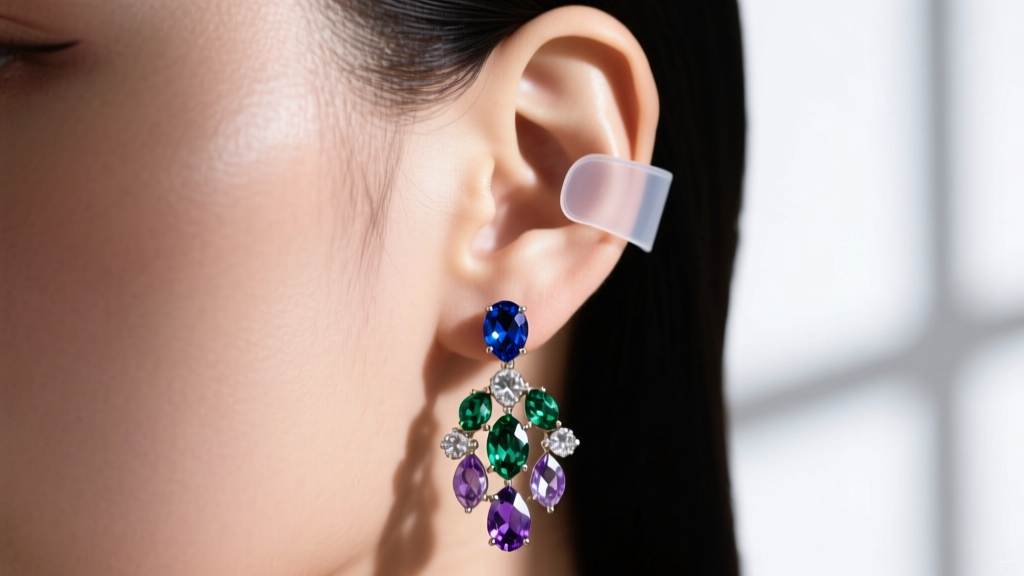
If the earring wire is thick enough but your lobe is still sagging, the issue is tissue fatigue. Adhesive earlobe support patches (such as LobeWonder) are essential. These transparent, medical-grade adhesive shields feature a reinforced center hole that distributes the earring's weight across a wider surface area of the lobe, neutralizing the downward torque and keeping the chandelier face perfectly upright.
Fixing Tangled Wires and Weak Jump Rings
Chandelier earrings are constructed using a network of jump rings and wire-wrapped loops. When stored improperly or subjected to friction, these components tangle. Worse, the constant swinging motion can cause 'work hardening' in dead-soft wires, eventually leading to metal fatigue and structural failure.
The Jump Ring Replacement Protocol
If a jump ring has warped open, do not simply squeeze it shut with your fingers; this will warp the circle into an oval and weaken the metal. Instead, use two pairs of chain-nose pliers. Grip the ring on either side of the split and twist one hand toward you and the other away, opening it laterally. To close, twist back until the ends click together flush. For heavy crystal tiers, replace standard 24-gauge jump rings with 22-gauge or 20-gauge jump rings, ensuring the outer diameter is small enough to prevent the crystal beads from slipping through.
Untangling Without Bending
Never pull tangled wire frames apart with brute force. Lay the earring on a flat, well-lit surface and use a pair of fine-tipped tweezers or a single beading awl to gently tease the wire loops apart. If a wire loop has bent out of its original geometric shape, use round-nose pliers to gently coax it back into a perfect circle, maintaining the structural symmetry of the chandelier tiers.
Restoring Cloudy Crystals and Stripped Coatings
Crystals lose their brilliance due to skin oils, cosmetic buildup, and improper cleaning. The most catastrophic mistake owners make is tossing coated crystals into an ultrasonic cleaner. According to the Gemological Institute of America (GIA), ultrasonic vibrations and harsh chemical solvents will instantly strip delicate surface treatments like Aurora Borealis (AB) or Dorado coatings, leaving the crystal permanently cloudy and patchy.

Crystal Material and Cleaning Matrix
Understanding your crystal's composition is critical for safe restoration. Modern lead-free crystals from manufacturers like Preciosa are highly durable but still require careful handling to preserve optical coatings.
| Crystal Type | Common Coatings | Safe Cleaning Protocol | Ultrasonic Safe? |
|---|---|---|---|
| Leaded Glass (Vintage) | AB, Golden Shadow | Mild pH-neutral soap, distilled water, soft baby toothbrush | Strictly No |
| Lead-Free Crystal (Modern) | AB, Vitrail, None | Isopropyl alcohol (70%) on a microfiber swab for uncoated; soapy water for coated | Uncoated Only |
| Acrylic / Resin | Metallic paints | Damp microfiber cloth only; no solvents | Strictly No |
The Distilled Water Wash
For heavily soiled, coated crystals, mix a drop of pH-neutral dish soap (like Dawn) into a bowl of distilled water. Tap water contains minerals that can leave microscopic water spots on faceted surfaces, dulling the light refraction. Dip a soft baby toothbrush into the solution, gently agitate the facets, and rinse with distilled water. Immediately pat dry with a lint-free microfiber cloth to prevent water marks.
Securing Heavy Earrings: Backs and Converters
The standard butterfly friction back is entirely inadequate for crystal chandelier earrings. The heavy pendulum motion of the crystals will quickly work a standard friction back loose, resulting in a lost earring.
Jumbo Silicone Stoppers
Upgrade to jumbo silicone earring backs. These feature a wide, flat base that grips the post securely and provides a secondary cushion against the back of the earlobe, reducing pressure points. Ensure the post gauge of your earring (usually 20g or 18g) matches the internal diameter of the silicone stopper's metal insert.
Locking Leverback Converters
If your chandelier earrings feature a post and you want maximum security, consider taking them to a jeweler to have the posts snipped off and replaced with locking leverback hooks. Leverbacks feature a hinged, snapping closure that completely encloses the ear wire, making it physically impossible for the earring to fall off during wear, regardless of how heavy the crystal drops are.
Quick Diagnostic Checklist
Before wearing or storing your crystal chandelier earrings, run through this rapid troubleshooting checklist:
- The Shake Test: Hold the earring by the top loop and give it a gentle shake. Listen for metallic clicking. If you hear excessive rattling, a jump ring is loose and needs lateral tightening with chain-nose pliers.
- The Profile Check: Put the earring on and look in a side-profile mirror. If the crystal face points downward by more than 15 degrees, you need an 18-gauge wire upgrade or an adhesive lobe support patch.
- The Light Test: Hold the crystals under a direct LED light. If the AB coating looks patchy or the facets appear foggy, they require a distilled water and pH-neutral soap wash—never an ultrasonic bath.
- The Friction Test: Tug gently on the earring back. If the standard metal butterfly back slides off with minimal resistance, discard it and replace it with a jumbo silicone stopper with a reinforced metal core.
By addressing the mechanical leverage, structural wire integrity, and chemical sensitivities of your crystals, you can ensure your chandelier earrings remain secure, brilliant, and comfortable for years of continuous wear.


