Fix Drooping Gold Teardrop Hoop Earrings: Expert Guide
Solve common fit and clasp issues with gold teardrop hoop earrings. Expert troubleshooting for lobe droop, weight distribution, and metal care.


The Physics of the Droop: Why Teardrop Hoops Fail
Gold teardrop hoop earrings are celebrated for their elegant, elongated silhouettes that beautifully frame the jawline. However, their unique geometry introduces a specific set of structural challenges. Unlike standard circular hoops where the center of mass aligns closely with the earlobe piercing, the teardrop shape shifts the center of gravity downward and forward. When paired with a standard 20-gauge (0.81mm) post, this asymmetrical weight distribution almost guarantees a forward tilt, commonly known as the 'earring droop.'
To troubleshoot this, we must first look at the wire gauge and the post thickness. Many mass-market gold teardrop hoops utilize thin 20G or even 22G (0.64mm) posts to save on precious metal costs. According to the Association of Professional Piercers (APP), while 20G is standard for lightweight studs, it lacks the shear strength required to support elongated, bottom-heavy hoops. Upgrading to custom 18-gauge (1.02mm) or 16-gauge (1.29mm) ear wires is the first critical step in stabilizing heavy gold teardrop hoop earrings.
Diagnosing Clasp and Hinge Failures
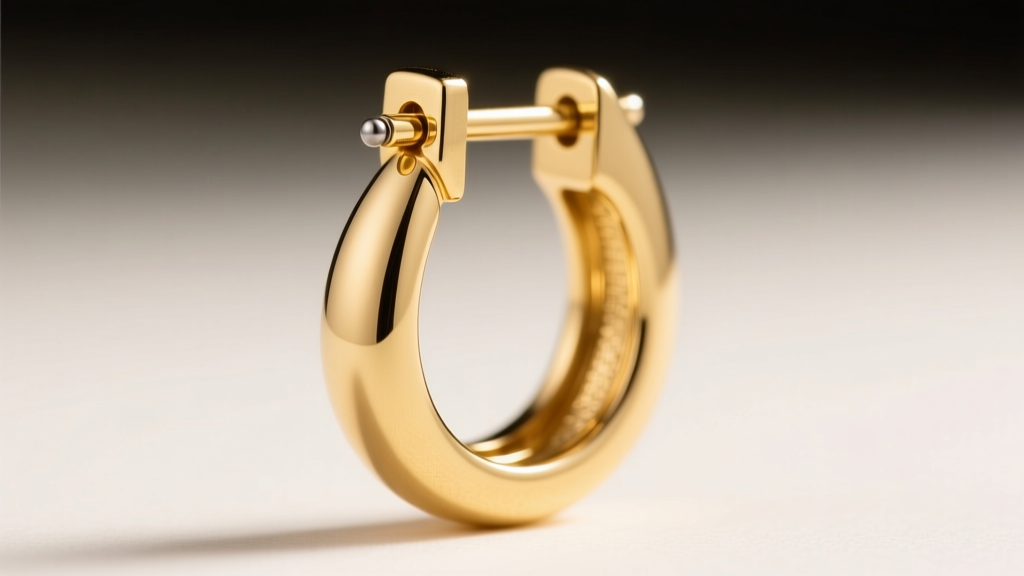
The clasp mechanism on a teardrop hoop endures disproportionate stress due to the pendulum effect created by the elongated bottom curve. Every time you turn your head, the kinetic energy transfers directly to the hinge or post. Below is a troubleshooting matrix for the most common clasp types found on these earrings:
| Clasp Type | Common Failure Mode | Troubleshooting Solution |
|---|---|---|
| Hinge with Snap | Worn groove prevents secure 'click' | Clean debris with isopropyl alcohol; gently squeeze the U-shaped catch with nylon pliers. |
| Saddleback | Saddle bar warms and bends outward | Reshape using a raw-hide mallet on a steel mandrel; avoid metal-on-metal contact. |
| Friction Post | Butterfly clutch loosens from weight | Replace standard clutches with silicone 'O-rings' or secure-lock screw backs. |
| Omega Back | Tension loss causes earring to slide down | Adjust the tension wire inside the omega clip using fine-tipped jewelry tweezers. |
If your gold teardrop hoop earrings feature a hinged snap closure that refuses to stay shut, the issue is rarely a broken hinge pin. Instead, the microscopic interlocking groove on the receiving end is often clogged with skin oils, lotion, or microscopic debris. A three-minute ultrasonic bath followed by a gentle compression of the catch using nylon jaw pliers usually restores the satisfying snap.
Preventing Earlobe Strain and Tearing
The concentrated weight at the base of a teardrop hoop acts as a lever against your earlobe tissue. Over time, this continuous downward pull can stretch the piercing fistula, leading to irreversible lobe thinning or, in extreme cases, tearing. If you notice your piercing hole elongating into a slit, immediate intervention is required.
Support Patches and O-Rings
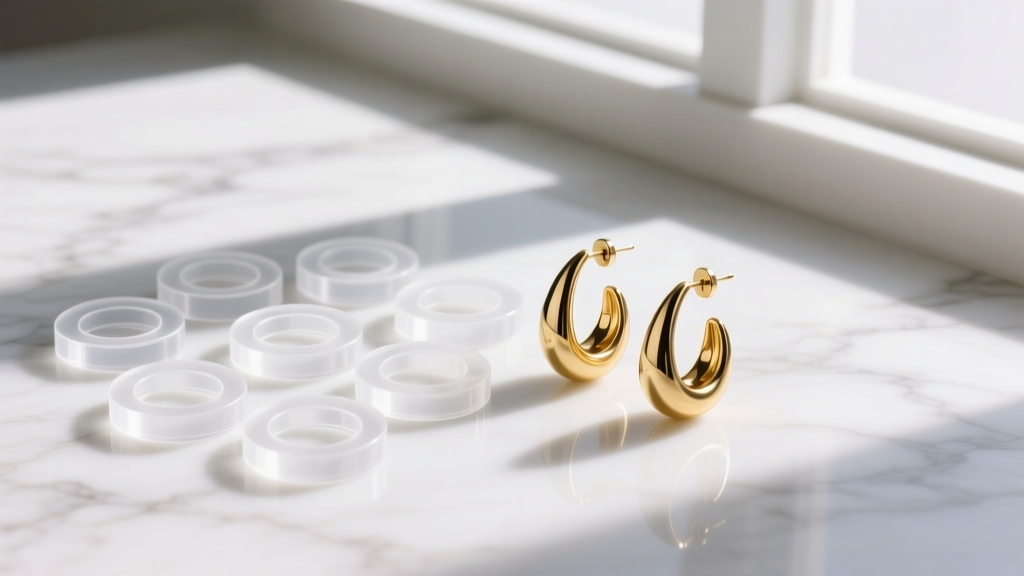
For heavy solid gold designs exceeding 8 grams per earring, rely on clear silicone support discs (often branded as EarLifts or invisible earring patches). These adhesive-backed polyurethane discs distribute the leveraged weight across a 12mm surface area on the back of the lobe, neutralizing the downward pull. Alternatively, stacking two thick silicone O-rings on the back of a friction post creates a wider fulcrum point, reducing localized tissue compression by up to 60%.
The Hollow Hoop Compromise
If lobe strain is a chronic issue, consider switching to hollow-formed (electroformed) gold teardrop hoop earrings. Electroforming allows jewelers to create voluminous, thick-walled teardrop silhouettes that are up to 70% lighter than their solid cast counterparts, preserving the visual impact without the structural penalty to your earlobes.
Reshaping Warped 14k and 18k Gold Frames
Because teardrop hoops are frequently grabbed or snagged on clothing, frame warping is inevitable. However, the repair strategy depends entirely on the karat purity of the gold. As detailed by the Gemological Institute of America (GIA), the alloy composition drastically alters the metal's Vickers hardness (HV) and malleability.
- 14k Gold (58.5% pure gold): With a Vickers hardness of roughly 140-150 HV, 14k gold is highly resilient. If your 14k teardrop hoop bends, you can safely reshape it using nylon jaw pliers. Never use standard steel pliers, as they will mar the high-polish finish and leave permanent gouges.
- 18k Gold (75%% pure gold): Softer and more ductile (approx. 120-130 HV), 18k gold is prone to work-hardening. If you repeatedly bend an 18k teardrop frame back and forth to fix a warp, the metal will become brittle and eventually snap at the stress point. Reshaping 18k gold requires a single, smooth, calculated motion over a curved steel mandrel, followed by professional annealing if the metal shows signs of stress whitening.
Expert Warning: Never attempt to reshape gold-plated or gold-vermeil teardrop hoops using pliers. The mechanical stress will cause the microscopic gold layer to flake and micro-crack, exposing the base brass or sterling silver core to rapid oxidation.
Troubleshooting Skin Irritation and Alloy Reactions
Many wearers mistakenly attribute skin redness or contact dermatitis to the weight of the earring, when the true culprit is the alloy composition reacting to trapped moisture in the elongated curve of the teardrop. The bottom loop of a teardrop hoop rests against the neck and jawline, an area prone to sweat and perfume accumulation.
In 14k yellow gold, the remaining 41.5% of the alloy is typically a mix of copper and silver. When exposed to the acidic pH of human sweat or the alcohol in perfumes, the copper can oxidize, leaving a harmless but unsightly green or black smudge on the skin. To troubleshoot this without abandoning your favorite gold teardrop hoop earrings, adopt a strict maintenance protocol: wipe the lower curve of the hoop with a microfiber cloth dampened with mild dish soap and warm water after every wear. This removes the acidic salts that catalyze the copper oxidation process.
For those experiencing actual allergic contact dermatitis (characterized by itching, flaking, and blistering), the issue is likely nickel. While reputable US and EU jewelers adhere to strict nickel-release directives, vintage or internationally sourced 14k white gold teardrop hoops frequently contain nickel as a whitening agent. If you suspect a nickel allergy, have a local jeweler apply a micro-thin layer of rhodium plating to the ear wire and the inner curve of the hoop. This creates an inert, hypoallergenic barrier that typically lasts 12 to 18 months before requiring re-plating.
Final Thoughts on Longevity
Troubleshooting gold teardrop hoop earrings requires an understanding of both jewelry engineering and human anatomy. By addressing the physics of the droop with thicker gauge wires, maintaining the integrity of the clasp mechanisms, and respecting the metallurgical limits of your specific karat weight, you can ensure your teardrop hoops remain a flawless, comfortable staple in your collection for decades.


