Troubleshooting Emerald Cut Earrings Studs: Fit & Sparkle Fixes
Learn how to fix drooping, dullness, and prong snags in your emerald cut earrings studs. Expert troubleshooting for fit, sparkle, and setting security.

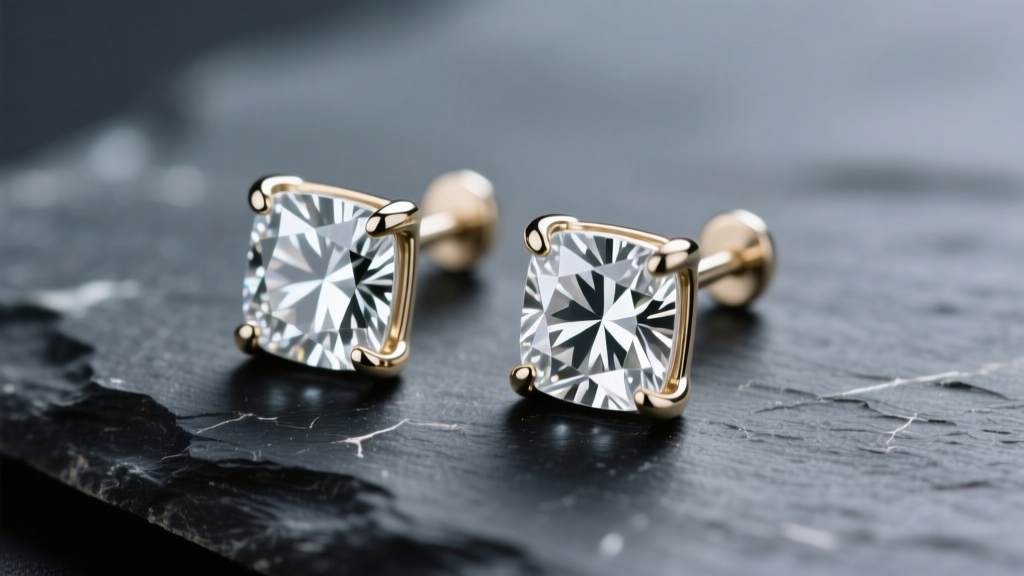
The emerald cut is a masterclass in geometric elegance, offering a sophisticated, hall-of-mirrors effect that appeals to lovers of understated luxury. However, sourcing and wearing emerald cut earrings studs comes with a unique set of structural and optical challenges. Unlike round brilliant cuts, which distribute weight and light symmetrically, the elongated, step-cut nature of the emerald shape creates specific center-of-gravity issues, corner vulnerabilities, and strict cleaning requirements.
Whether you are dealing with a frustrating forward tilt, a lackluster 'dead' stone, or snagging prongs, this 2026 troubleshooting guide provides actionable, expert-level solutions to optimize your step-cut studs.
The Gravity Problem: Why Your Studs Droop
The most frequent complaint we see with elongated step-cuts is 'drooping'—where the top of the earring tilts forward, pressing the bottom edge into the earlobe. This is not necessarily a flaw in your ear anatomy; it is a physics issue related to the stone's vertical center of mass.
An emerald cut with a high length-to-width ratio (e.g., 1.50) is top-heavy. If a jeweler solders the earring post at the exact geometric center of the setting, the elongated top half will pull the stud downward. Furthermore, standard friction posts are typically 20-gauge (0.81mm). For an emerald cut over 1.50 carats (approximately 8x6mm), the lever-action of the heavy stone will physically bend a 20G post over time, exacerbating the droop.
How to Fix the Droop
- Post Placement: Have a bench jeweler re-tack or solder the post 1.0mm to 1.5mm above the true geometric center. This counteracts the top-heavy lever effect.
- Upgrade the Post Gauge: Request an 18-gauge (1.02mm) or even a 16-gauge (1.29mm) threaded post. The added rigidity prevents metal fatigue and bending.
- Ditch Butterfly Backs: Standard friction backs slip under the weight of elongated stones. Upgrade to La Pousette (locking) backs or use high-density silicone O-ring stoppers to lock the stud flush against the lobe.
Diagnosing 'Dead' Stones: Windowing and Extinction
Step cuts do not possess the scintillation (sparkle) of round brilliants. They rely on clarity, symmetry, and light return. If your emerald cut earrings studs look like dull glass or have a see-through center, you are dealing with cut-quality issues.
Windowing occurs when the pavilion (bottom) of the stone is cut too shallow. Light leaks out the bottom instead of reflecting back to your eye, creating a transparent 'window' in the center of the table. Extinction happens when the stone is cut too deep, causing dark, lifeless bands across the facets. According to GIA's diamond cut grading guidelines, achieving the perfect hall-of-mirrors effect requires strict adherence to depth and table percentages.
| Cut Parameter | Ideal Range (Optimal Sparkle) | Problematic Range (Windowing/Extinction) |
|---|---|---|
| Length-to-Width Ratio | 1.30 to 1.50 | < 1.20 (Boxy) or > 1.60 (Noodle-like) |
| Depth Percentage | 60.0% to 68.0% | < 58% (Windowing) or > 72% (Extinction) |
| Table Percentage | 61.0% to 65.0% | > 69% (Loss of crown dispersion) |
Fix: If you have already purchased a shallow stone with windowing, setting it in a closed-back or bezel setting with a highly polished white gold interior can sometimes bounce ambient light back through the stone, artificially reducing the appearance of the window.
Corner Vulnerabilities: Prong Selection and Snagging
The defining feature of the emerald cut is its four sharp, 90-degree corners. These corners are the most fragile points of the crystal lattice and are highly susceptible to chipping from everyday impacts, such as knocking your ear against a car window or a desk.

Many mass-market jewelers use standard round prongs on all four corners to save on casting costs. This leaves the microscopic tip of the gemstone exposed. For optimal security, Jewelers of America recommends specialized prong settings for step-cut stones with sharp points.
The V-Prong Solution
Always insist on V-prongs for the corners of your emerald cut. A V-prong wraps a triangular shield of metal entirely around the sharp point, protecting it from blunt force trauma while visually elongating the stone. If your current studs feature round prongs on the corners and you travel frequently or lead an active lifestyle, take them to a master setter to have the corners re-tipped with V-prongs.
Sizing Mismatches: Carat Weight vs. Face-Up Spread
A common troubleshooting scenario involves a client feeling their newly purchased 1.00-carat emerald cut studs look 'too small.' This happens because emerald cuts hide a significant amount of their carat weight in the 'belly' (the deep pavilion) rather than spreading it across the face-up table.
When shopping for replacements or upgrades, never shop by carat weight alone. Shop by millimeter dimensions to ensure the physical footprint matches your expectations.
- 0.50 ct each: ~ 5.0 x 3.5 mm (Delicate, minimalist spread)
- 1.00 ct each: ~ 6.5 x 4.5 mm (Standard, elegant footprint)
- 1.50 ct each: ~ 7.5 x 5.5 mm (Bold, requires 18G posts for support)
- 2.00 ct each: ~ 8.5 x 6.5 mm (Statement size, requires locking backs)
Maintenance: Cleaning Step-Cut Facets Without Damage
Because the emerald cut features a large, open table facet and broad, flat step facets, it acts like a magnet for fingerprints, hairspray, and natural skin oils. Even a microscopic layer of grease will completely destroy the stone's light return, making it look cloudy and gray.
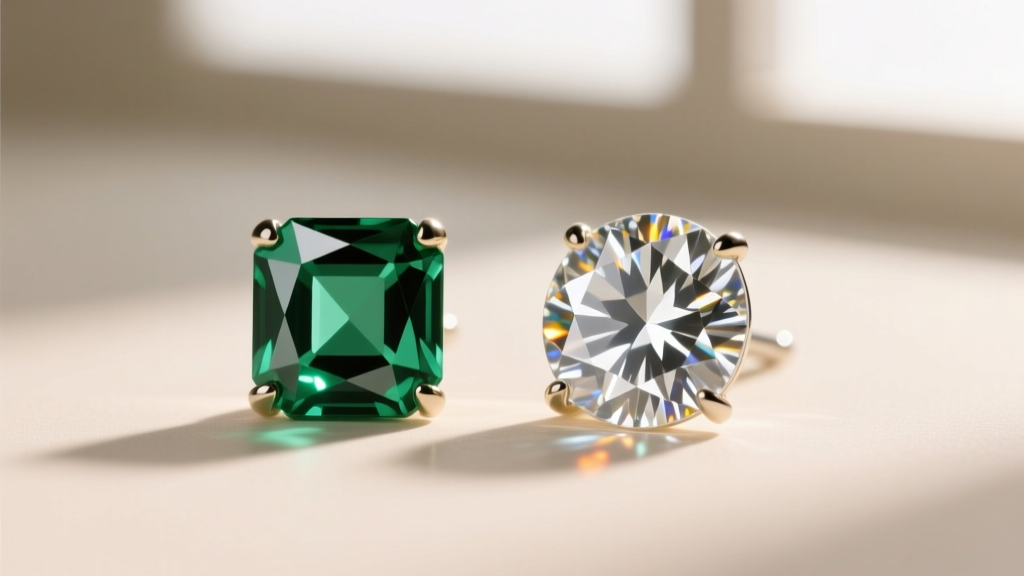
While ultrasonic cleaners are the industry standard for diamond maintenance, they can be catastrophic depending on the exact material of your earrings.
Critical Warning: If your earrings feature natural green emeralds (cut in the emerald style) rather than colorless diamonds, never use an ultrasonic cleaner or steam. Natural emeralds are almost universally treated with cedar oil or synthetic resins to mask surface-reaching fractures. Ultrasonic vibrations and heat will boil the oil out, leaving the stone looking heavily fractured and cloudy. According to GIA diamond and gem care protocols, treated emeralds should only be cleaned with warm water, mild dish soap, and a soft baby-hair brush.
For emerald-cut diamonds or moissanite, an ultrasonic cleaner is highly effective. However, if your diamond has been 'fracture-filled' (a clarity enhancement process using glass-like resins), ultrasonics will dissolve the filler. Always verify your stone's enhancement status with your jeweler before utilizing high-frequency cleaning methods. For daily maintenance, a simple wipe with a lint-free microfiber cloth and a quick dip in isopropyl alcohol will keep the broad step facets pristine and optically sharp.


