Fordite Earrings: The Technical Guide to Detroit Agate Jewelry
Discover the material science behind fordite earrings. Learn about Mohs hardness, bezel setting requirements, and how to authenticate Detroit agate.

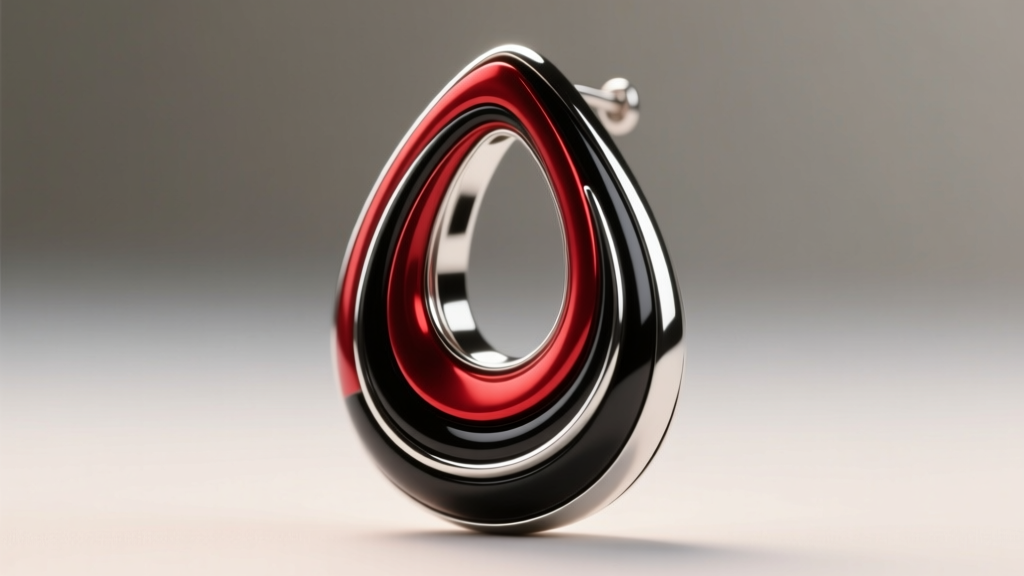
The Material Science of Fordite (Detroit Agate)
Often mistakenly categorized alongside organic gems or traditional agates, fordite—colloquially known as Detroit agate or motor agate—is an anthropogenic material born from mid-century automotive manufacturing. According to historical analyses featured by Smithsonian Magazine, fordite is the result of decades of overspray from hand-painted car bodies accumulating on the tracks, skids, and hangers of automotive assembly lines. As these racks were repeatedly sent through baking ovens at temperatures ranging from 130°C to 150°C (266°F to 302°F), the layers of alkyd enamel, lacquer, and eventually acrylic paints underwent thermal cross-linking, creating a dense, hardened polymer matrix.
For jewelry designers and metallurgists, understanding this chemical composition is critical. Pre-1980s fordite consists primarily of solvent-based lacquers and melamine-crosslinked enamels, which yield a harder, more brittle structure. Post-1990s fordite, heavily reliant on waterborne acrylics and polyurethane clear coats, exhibits a slightly softer, more thermoplastic behavior. This distinction directly dictates how the material must be cut, polished, and ultimately set into earring mounts.
Hardness, Durability, and Setting Engineering
On the Mohs scale of mineral hardness, genuine fordite registers between 3.0 and 4.0. To contextualize this, it is significantly softer than turquoise (5.0-6.0) and opal (5.5-6.5), and vastly softer than quartz-based agates (7.0). This relative softness introduces specific failure modes in jewelry engineering, particularly for earrings which are subject to accidental impacts, hair-snagging, and friction.
| Material | Mohs Hardness | Cleavage/Fracture | Recommended Earring Setting |
|---|---|---|---|
| Genuine Fordite | 3.0 - 4.0 | Conchoidal / Splintery | Full Bezel (0.75mm lip) |
| True Agate (Quartz) | 7.0 | None (Cryptocrystalline) | Prong, Bezel, or Tension |
| Turquoise | 5.0 - 6.0 | Uneven / Brittle | Bezel or Channel |
| Poured Resin (Fake) | 2.0 - 2.5 | N/A (Thermoplastic) | Glue-in / Bezel |
Because of its low hardness and layered structure, prong settings are strictly contraindicated for fordite earrings. The localized point-pressure exerted by prongs will inevitably cause the polymer layers to delaminate, chip, or crack over time. Expert bench jewelers exclusively utilize full bezel settings fabricated from 14k or 18k gold, or platinum. The bezel wall must be burnished over the edge of the fordite cabochon with a minimum lip overlap of 0.75mm to 1.0mm. This lip protects the vulnerable lateral edges of the paint layers from peeling while securing the stone without applying destructive downward clamping force.
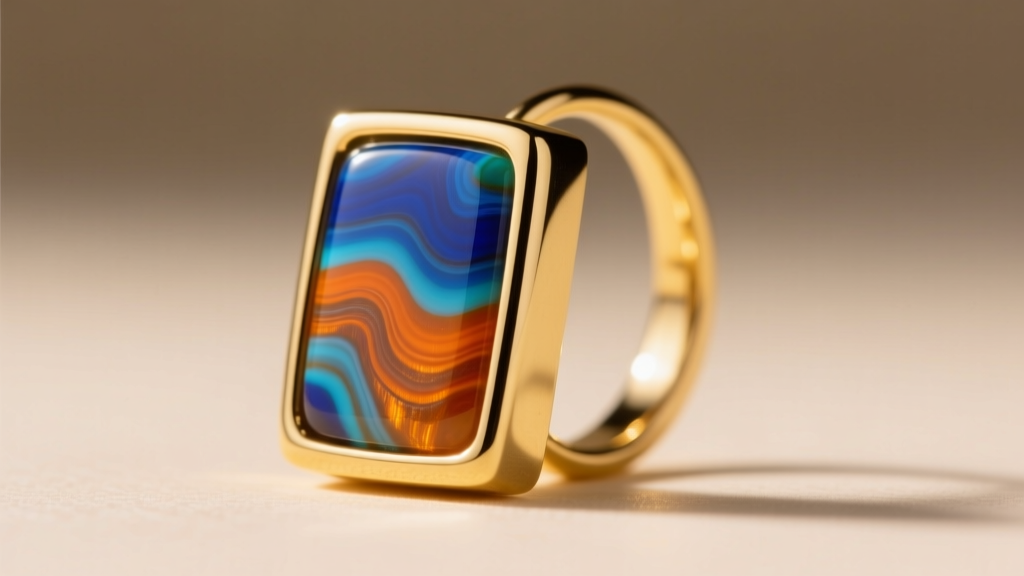
Hardware Specifications: Posts, Gauges, and Backings
Fordite is a dense material. A standard 15mm x 10mm teardrop cabochon, when backed by a sterling silver or gold base plate, can weigh between 6 and 12 grams per earring. This mass requires specialized hardware to prevent earlobe trauma.
Lobe vs. Cartilage Considerations
For standard lobe piercings, an 18-gauge (1.02mm) or 16-gauge (1.29mm) post is mandatory. Standard 20-gauge (0.81mm) posts lack the tensile strength to support the pendulum effect of a heavy fordite drop earring, leading to post bending and the notorious 'cheese-cutter' effect, where the thin metal slowly slices through the earlobe tissue. Furthermore, standard butterfly friction backs are insufficient for fordite drops exceeding 8 grams. The localized pressure of a small metal backing will cause ischemia (restricted blood flow) and severe discomfort in the earlobe. Experts mandate the use of wide-base silicone O-rings or specialized 14k gold screw-backs with broad, flat clutch plates to distribute the weight across a wider surface area of the posterior lobe.
Cartilage piercings (such as the helix or tragus) are entirely unsuitable for heavy fordite dangles. The rigid cartilage structure cannot absorb the kinetic energy of a swinging polymer mass, which will lead to piercing migration, irritation bumps, and eventual rejection. If fordite is to be worn in cartilage, it must be limited to lightweight, low-profile bezel studs weighing under 3 grams, secured with flat-back labret posts.
Authentication: Spotting Synthetic Fordite Fakes
As the popularity of motor agate has surged, the market has been flooded with synthetic imitations. These fakes are typically created by pouring tinted epoxy or polyester resins into molds and artificially swirling them to mimic the layered effect of automotive overspray. According to the authentication guidelines published by Fordite.com, the premier authority on the material, gemologists and buyers must look for specific microscopic markers.
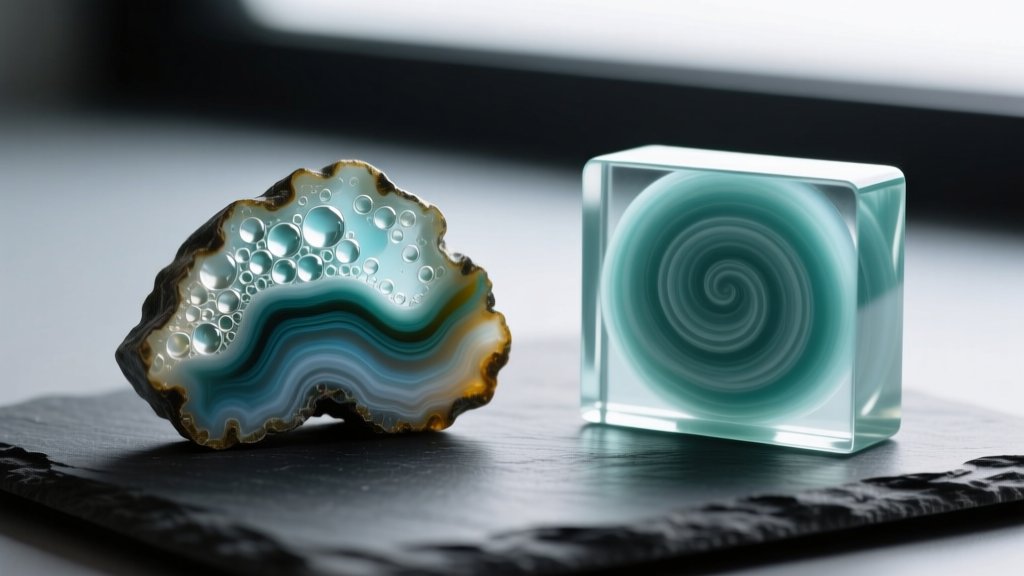
- Micro-Bubbles and Inclusions: Genuine baked fordite almost always contains microscopic air bubbles, dust particles, or metallic flakes trapped between the paint layers during the spray process. Poured resin fakes are typically degassed in vacuum chambers and appear unnaturally flawless.
- Layer Adhesion and Separation: Under 10x loupe magnification, real fordite will show distinct, sometimes uneven separation lines between color shifts, representing the physical boundary of different paint batches. Fakes exhibit soft, bleeding gradients where the liquid resins mixed before curing.
- Thermal Reaction: When subjected to a hot point test (which should only be performed on an inconspicuous area by a professional), genuine alkyd fordite emits a faint, acrid chemical smell reminiscent of a vintage auto body shop. Modern epoxy fakes will melt quickly and smell distinctly of burning plastic.
Solvent Sensitivity and Long-Term Maintenance
The most common failure mode in vintage fordite earrings is not physical impact, but chemical degradation. Because fordite is essentially a collection of thermoset and thermoplastic polymers, it is highly reactive to common household solvents.
Expert Warning: Never clean fordite earrings with alcohol, acetone, ammonia, or commercial jewelry dips. These solvents will break down the acrylic binders in the paint layers, causing the surface to haze, craze, and eventually peel.
Furthermore, ultrasonic cleaners are strictly forbidden. The high-frequency cavitation bubbles generated in an ultrasonic bath will penetrate the microscopic fissures between the paint layers, forcing water and heat into the stone and causing rapid delamination. Steam cleaners are equally destructive, as the sudden thermal shock can melt the acrylic clear-coat layers found in newer fordite specimens.
The only approved cleaning protocol involves room-temperature distilled water, a drop of pH-neutral dish soap, and a soft, lint-free microfiber cloth. For polishing, traditional jeweler's rouge is too abrasive for post-1990s acrylic fordite and will leave micro-scratches. Instead, use a plastic-specific polish, such as Novus No. 2, applied with a soft cotton buffing wheel at low RPMs to restore the high-gloss factory finish without generating excessive friction heat.
Pricing Tiers and Sourcing Authentic Pieces
The market value of fordite earrings is dictated by the provenance of the material, the complexity of the color layering, and the precious metal content of the setting. Because the original Detroit assembly lines have transitioned to electrostatic powder coating and robotic spraying—which produce virtually zero harvestable overspray—genuine vintage Detroit fordite is a finite, non-renewable resource.
- Entry-Level ($45 - $120): Small, sterling silver bezel studs featuring fordite with less distinct color contrast (heavy on primer greys and black undercoats).
- Mid-Tier ($150 - $350): 14k gold drop or dangle earrings showcasing vibrant, high-contrast layers (classic 1960s automotive reds, blues, and metallic golds).
- Collector/Provenance ($400 - $800+): Large, museum-quality statement earrings featuring rare color combinations (such as 1970s psychedelic custom paint overspray) set in 18k or 22k gold, often accompanied by a certificate of authenticity detailing the specific decade and manufacturing plant of origin.
When investing in high-tier fordite earrings, always request documentation from the lapidary or jeweler verifying the material's origin. True Detroit agate represents a fascinating intersection of industrial history and wearable art, but its unique polymer chemistry demands a rigorous, technical approach to jewelry design, wear, and preservation.


