Gold Earrings Male: 2026 Budget & Value Buying Guide
Discover the true value of gold earrings for men in 2026. Compare 10k, 14k, and 18k pricing, gauge sizes, and styles to maximize your jewelry budget.


The 2026 Gold Market: Assessing True Value in Men's Jewelry
The landscape of men's jewelry has shifted dramatically. As we navigate 2026, with gold spot prices frequently testing the $2,150 per ounce mark, the search for gold earrings male buyers can trust requires a sharp eye for metallurgy and manufacturing quality. The days of blindly trusting a karat stamp are over. Today, assessing the budget and true value of men's gold earrings means understanding the delta between raw melt value, structural integrity, and retail markup.
Whether you are looking for a subtle 4mm stud, a rugged 12-gauge sleeper hoop, or a heavy Cuban link dangle, the financial principles remain the same. This guide strips away the marketing fluff and provides a硬核 (hardcore) breakdown of how to evaluate pricing, avoid hollow-manufacturing traps, and select gauge sizes that won't bend under the pressure of daily wear.
Karat Breakdown: 10K vs. 14K vs. 18K Value Matrix
Gold purity is the primary driver of cost, but higher karat does not always equal higher value for men's daily-wear earrings. Pure 24K gold is far too soft for ear jewelry; it will bend, warp, and lose its shape within weeks. Therefore, alloy metals like copper, zinc, and silver are added. According to the Gemological Institute of America (GIA), these alloys dictate both the color and the tensile strength of the piece.
| Karat | Gold Content | Avg. Price (5mm Stud Pair) | Durability | Best Use Case |
|---|---|---|---|---|
| 10K | 41.7% | $85 - $130 | Extremely High | Manual laborers, gym-goers, budget-first buyers |
| 14K | 58.3% | $140 - $220 | High | Daily wear, standard hoops, best overall value |
| 18K | 75.0% | $250 - $400+ | Moderate | Special occasions, luxury gifting, sensitive skin |
Expert Insight: If you work with your hands, lift weights, or frequently sleep in your earrings, 14K is the undisputed champion of value. It offers the rich yellow hue of gold while maintaining enough alloyed hardness to resist scratching and bending. 10K is highly durable but contains more nickel and copper, which can trigger contact dermatitis in some wearers, a risk well-documented by the American Academy of Dermatology.

The Hollow Hoop Trap: Solid vs. Tubular Manufacturing
One of the most common ways retailers inflate margins on men's gold hoops is through hollow tubing. A 15mm diameter, 3mm thick hoop looks substantial on the display card, but if it weighs only 1.2 grams, it is hollow.
Why Hollow Gold Fails
- Denting: Hollow tubes dent easily if dropped on a tile floor or slept on.
- Irreparable: Once a hollow hoop kinks or cracks, it cannot be soldered back together by a jeweler without leaving a massive, visible seam.
- False Value: You are paying for the volume of the jewelry, not the actual gold weight.
The Fix: Always check the gram weight. A solid 14K gold huggie or sleeper hoop of moderate size should weigh between 2.5 and 4.5 grams. If a large hoop feels as light as a feather, walk away. Die-struck solid wire hoops cost roughly 30% more upfront but offer a lifetime of wearability and can be easily polished or repaired.
Gauge Sizing: Thickness Dictates Longevity
When evaluating gold earrings, male buyers often overlook the gauge (thickness) of the post or wire. The standard women's earring post is 20-gauge (0.81mm), which is entirely too thin for most men's earlobes, especially if the lobe has been slightly stretched by heavier jewelry over time.
"A 20-gauge post in a heavy men's gold earring acts like a lever. The weight of the earring will slowly slice through the bottom of the earlobe or permanently bend the post. Always opt for 18G or 16G for structural stability."
Standard Gauge Chart for Men
- 20G (0.8mm): Avoid for men's jewelry, unless it is a tiny, lightweight 2mm stud.
- 18G (1.0mm): The baseline standard for quality men's studs and lightweight huggies.
- 16G (1.2mm): The sweet spot for durability. Ideal for sleeper hoops and medium-weight dangles.
- 14G (1.6mm): Heavy-duty. Used for thick gauge clickers, shield earrings, and stretched lobe jewelry.
Clasp Mechanics: The Hidden Cost of Security
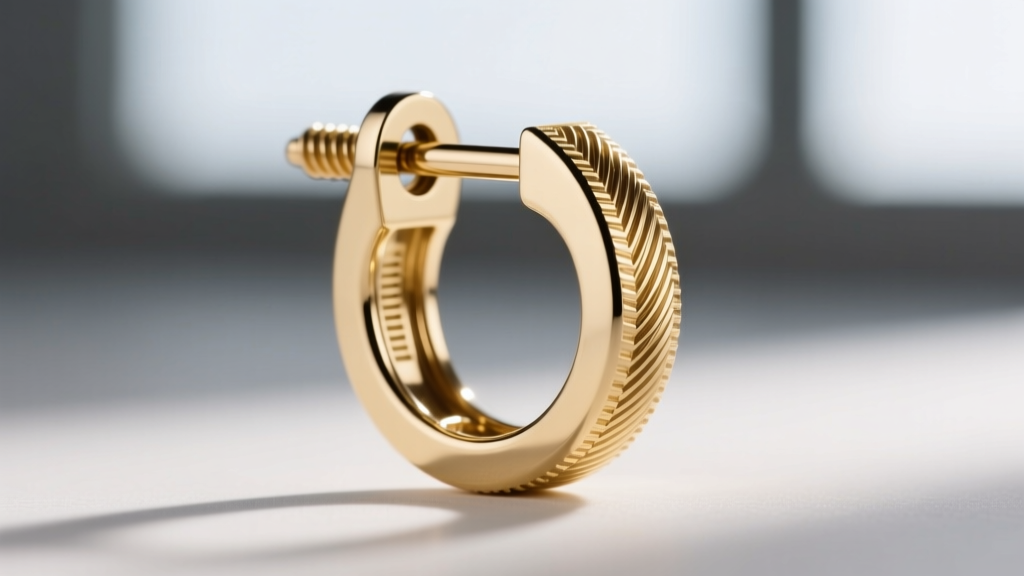
The clasp is the most frequent point of failure on any earring. Budget manufacturers use cheap friction backs (butterfly clasps) that lose their tension over time, leading to lost earrings. When budgeting for gold earrings, male consumers should factor in the premium for secure locking mechanisms.
Screw-Backs: These feature a threaded post and a nut that screws on. They add about $15 to $25 to the manufacturing cost of a pair of studs, but they make losing the earring virtually impossible. For high-value 18K gold or diamond-accented pieces, screw-backs are mandatory.
Hinged Snap Clickers: For hoops and huggies, a hinged segment with a satisfying 'click' closure is superior to the traditional thin wire and latch-back, which easily snags on towels and hoodies.
Calculating Melt Value vs. Retail Markup
To truly assess if you are getting a fair deal, you need to understand the 'melt value'—the raw cost of the gold in the earring. You can track daily spot prices via resources like Kitco.
The Formula:
(Spot Price per Ounce / 31.1) * Karat Multiplier * Gram Weight = Melt Value
For example, if gold is $2,150/oz, one gram of pure 24K gold is roughly $69.13. One gram of 14K gold (0.583) is worth about $40.30 in raw material. If you are buying a pair of 14K solid gold studs that weigh 2 grams total, the raw gold value is $80.60.
What is a fair markup?
A direct-to-consumer or wholesale jeweler will typically apply a 1.5x to 2.5x markup to cover labor, polishing, and overhead. A $160 price tag for those $80 studs is a phenomenal value. A $450 price tag from a luxury mall brand is a 5.5x markup—you are paying for the blue box, not the gold.
Final Verdict: Maximizing Your 2026 Jewelry Budget
Investing in gold earrings requires a pragmatic approach. Skip the hollow hoops and ultra-thin 20-gauge wires that will end up in a jeweler's scrap bin. Focus your budget on 14K solid gold, prioritize 16-gauge thickness for hoops, and always pay the slight premium for screw-back clasps on studs. By understanding the math behind the metal, you can build a collection that retains its value, withstands daily abuse, and elevates your personal style without falling victim to retail inflation.


