The Technical Guide to Gold Knot Hoop Earrings: Gauge & Alloy
Discover the technical details of gold knot hoop earrings. We analyze alloy grades, wire gauges, clasp mechanics, and structural integrity for daily wear.

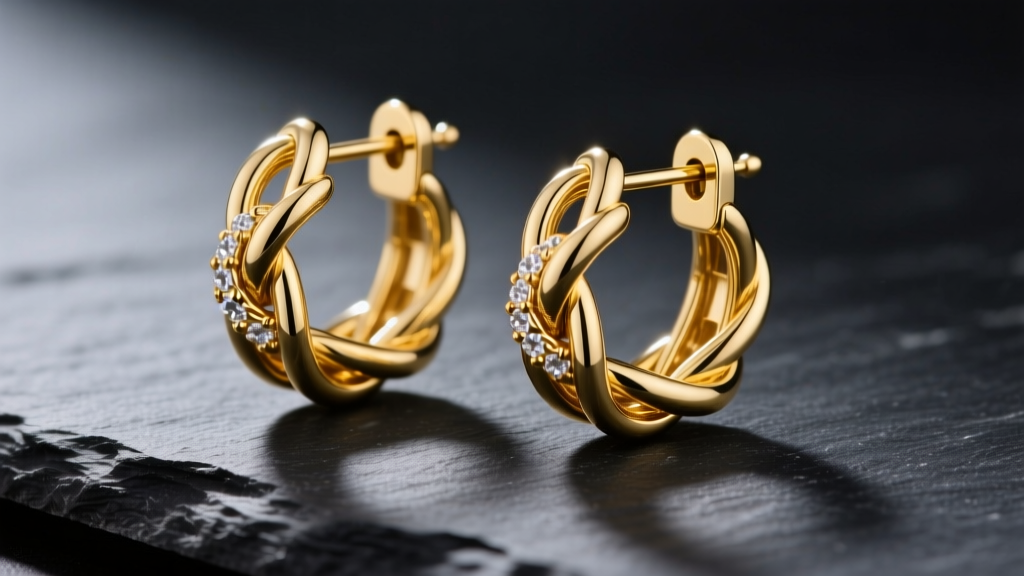
The Metallurgy of Knot Hoops: 14K vs. 18K Gold
Gold knot hoop earrings represent a fascinating intersection of metallurgical science and structural jewelry design. Unlike standard continuous hoops, the introduction of a knot creates severe stress concentrators along the wire's axis. When a jeweler bends gold wire into an overhand or Celtic knot, the metal undergoes plastic deformation. If the alloy lacks sufficient tensile strength and Vickers hardness (HV), the knot will collapse under the circular memory of the hoop, leading to a distorted, asymmetrical profile.
According to the Gemological Institute of America (GIA), pure 24-karat gold possesses a Vickers hardness of approximately 25 HV, making it entirely unsuitable for knot hoops; it would deform under the weight of its own clasp. 18-karat gold (75% pure gold) increases this hardness to roughly 120 HV, offering a richer yellow hue but remaining susceptible to bending if the wire gauge is thin. For structural knot hoops, 14-karat gold (58.5% pure gold, alloyed with copper, silver, and zinc) is the technical optimum. It achieves a Vickers hardness of 140-160 HV, providing the necessary rigidity to maintain the knot's geometric integrity during daily wear while resisting the tensile forces exerted by the earlobe.
Wire Gauge and Geometric Integrity
The diameter of the wire dictates both the knot's readability and the hoop's structural memory. Standard hoop earrings typically range from 20-gauge (0.81mm) to 14-gauge (1.63mm). For gold knot hoop earrings, the ideal gauge sweet spot is 16-gauge (1.29mm) to 18-gauge (1.02mm).
- 18-Gauge (1.02mm): Ideal for intricate, multi-loop Celtic knots or figure-eight designs. The thinner wire allows for tighter bends without overlapping bulk, but requires a smaller inner diameter (ID) to prevent the hoop from warping into an oval shape under the knot's weight.
- 16-Gauge (1.29mm): The industry standard for single overhand or square knots. This thickness provides enough mass to support a hinged clicker clasp while maintaining a comfortable weight for standard lobe piercings.
- 14-Gauge (1.63mm): Rarely used for complex knots due to the extreme torque required to bend the wire, which often results in micro-fractures if the gold is not properly annealed during fabrication. Reserved for heavy, minimalist single-loop designs.
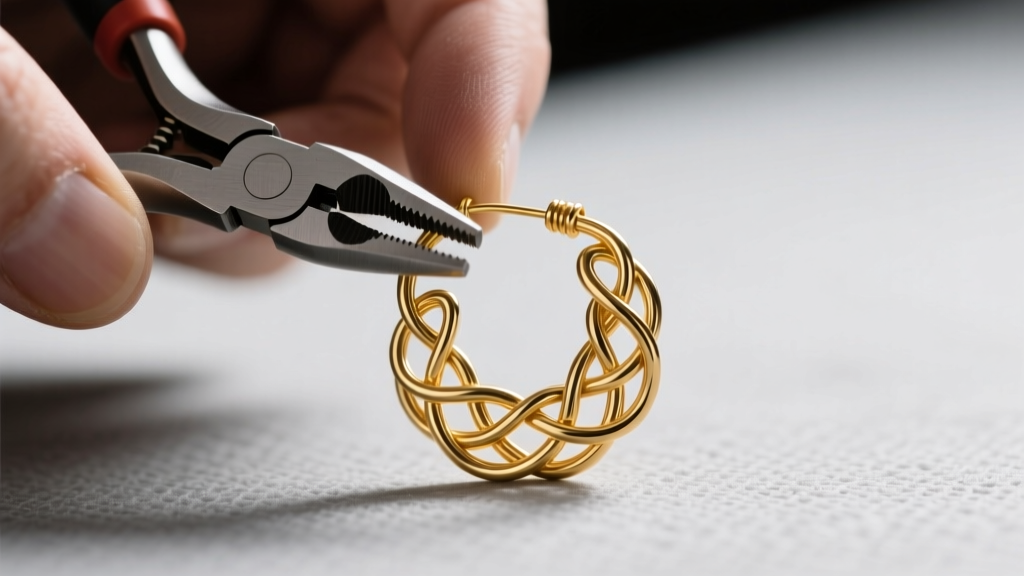
The Danger of Work-Hardening
During the fabrication of gold knot hoop earrings, the wire must be repeatedly annealed (heated to a specific temperature and quenched) to relieve internal stresses. If a jeweler attempts to tie a complex knot in a single pass without annealing, the gold will work-harden, becoming brittle and prone to catastrophic snapping at the apex of the tightest bend. As a consumer, you can identify poorly annealed knot hoops by inspecting the inner curve of the knot; visible micro-cracking or a dull, matte finish on the bend indicates structural compromise.
Clasp Mechanics and Weight Distribution
Knots add asymmetric weight to the anterior (front) portion of the hoop. This shifts the center of gravity forward, placing upward torque on the posterior earlobe or cartilage. Standard friction posts or thin wire latches are mechanically inadequate for knot hoops, as the forward weight will cause the earring to tilt, leading to piercing migration or tissue tearing over time.
'In asymmetric hoop designs, the clasp must act as a counterbalance. A secure, flush-fitting hinge with a tolerance of less than 0.05mm is critical to prevent the earring from rotating and stressing the fistula.' — Journal of Jewelry Manufacturing Technology
| Clasp Type | Mechanism | Weight Tolerance | Best Application |
|---|---|---|---|
| Hinged Clicker | Spring-loaded internal pin snapping into a machined groove | High (up to 8g per earring) | Heavy 14k knot hoops, cartilage |
| Latch-Back | Hinged wire snapping over a captured saddle | Medium (up to 5g per earring) | Standard 18k lobe knot hoops |
| Continuous/Endless | Friction-fit tube and pin | Low (under 3g per earring) | Lightweight 20g minimalist knots |
Biomechanical Considerations: Lobe vs. Cartilage
The placement of gold knot hoop earrings drastically alters the required inner diameter (ID) and wire gauge. The earlobe is composed of soft tissue and adipose fat, allowing it to stretch and accommodate the dynamic movement of a heavy knot hoop. For lobe piercings, an ID of 12mm to 15mm is standard, allowing the knot to rest naturally on the lower curve of the hoop without pressing against the neck.
Cartilage piercings (such as the helix or forward helix), however, are rigid and highly sensitive to pressure. A knot hoop in a helix piercing requires a precise ID of 8mm to 10mm. If the hoop is too large, the weight of the knot will pull the wire downward, creating a lever effect that irritates the cartilage fistula. Furthermore, cartilage hoops should strictly utilize 16-gauge or 14-gauge wire to prevent the wire from bending and pinching the cartilage ridge during sleep.
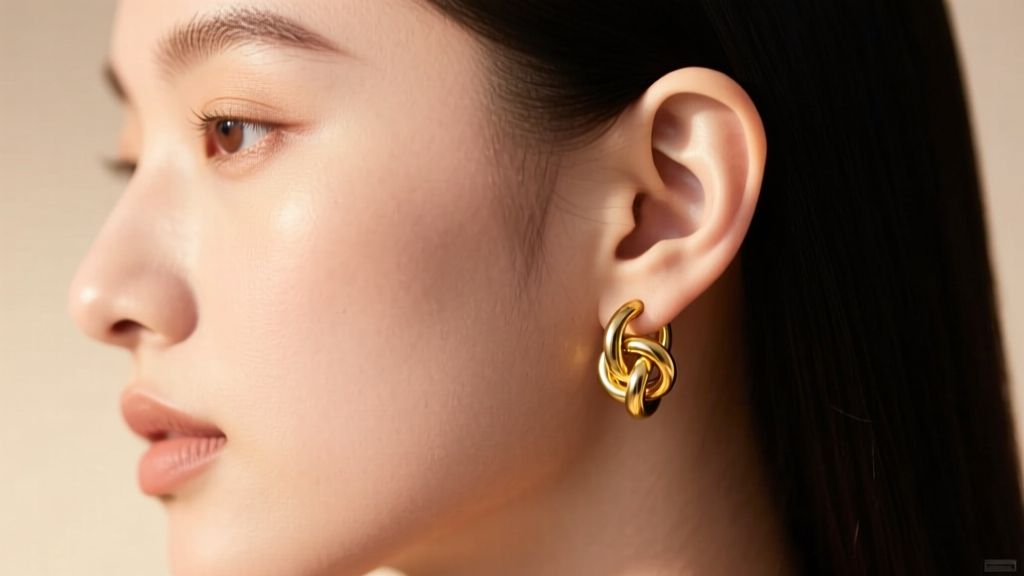
Pricing Framework: Melt Value vs. Fabrication
When evaluating the pricing of gold knot hoop earrings in 2026, consumers must separate the intrinsic melt value of the gold from the fabrication labor. Knot tying is a highly specialized bench skill that cannot be easily automated via CAD/CAM casting; true knot hoops are formed from solid drawn wire, not cast from molds (cast knots are brittle and prone to porosity).
To calculate a fair retail price, use the following framework based on World Gold Council market data:
- Calculate Melt Value: Weigh the earrings in grams. Multiply by the purity factor (0.585 for 14k, 0.750 for 18k). Multiply by the current spot price of gold per gram.
- Apply Fabrication Multiplier: For simple overhand knots, expect a retail multiplier of 2.5x to 3.5x the melt value. For complex, multi-loop Celtic knots requiring multiple annealing cycles and precision soldering, the multiplier can reach 5x to 8x.
- Clasp Premium: Machined hinged clickers add approximately $30-$50 to the wholesale cost due to the precision milling required.
If a retailer is selling solid 14k gold knot hoops at a price near the raw melt value, the earrings are likely hollow-tube construction or cast with high porosity, both of which will fail structurally within months.
Maintenance and Structural Longevity
To maintain the structural integrity of gold knot hoop earrings, avoid 'dry manipulation' of the knot. If the knot shifts out of alignment, do not attempt to bend it back into place with your bare fingers; the oils and uneven pressure can induce micro-fractures. Instead, use nylon-jaw pliers to gently adjust the wire, or return them to a bench jeweler for a professional steam-clean and structural check. Regularly inspect the clasp hinge for debris accumulation, as trapped sebum and skin cells can compromise the clicker mechanism, leading to accidental loss of the earring.


