What Type of Earrings for Sensitive Ears? A Step-by-Step Guide
Discover what type of earrings for sensitive ears actually work. Follow our step-by-step guide to choosing hypoallergenic metals and styles.


Why Finding What Type of Earrings for Sensitive Ears is Tricky
If your earlobes turn red, itch, or swell within hours of wearing a new pair of earrings, you are likely dealing with allergic contact dermatitis. According to the American Academy of Dermatology, nickel allergy is the most common cause of this reaction, affecting roughly 36% of women. The jewelry industry often slaps the term "hypoallergenic" on packaging, but this is an unregulated marketing term, not a metallurgical guarantee. Figuring out exactly what type of earrings for sensitive ears will actually work requires looking past the marketing and understanding metal alloys, post gauges, and earring anatomy. This step-by-step guide will help you build a curated, irritation-free jewelry collection in 2026.
Step 1: Decode the Metal Grades (The "Hypoallergenic" Trap)
The first step in solving your sensitivity issues is eliminating reactive metals. Many commercial "sterling silver" or "white gold" pieces contain hidden nickel or copper alloys that trigger immune responses. To guarantee safety, you must look for specific, verifiable metal grades.
Implant-Grade Titanium (ASTM F136)
Not all titanium is created equal. Commercial titanium jewelry may still contain trace nickel. You must look for ASTM F136 certified implant-grade titanium. This is the exact same metal used in medical joint replacements and surgical pins. It is entirely nickel-free, highly resistant to corrosion, and lightweight, making it the gold standard for fresh piercings and hyper-sensitive lobes.
Niobium
Niobium is a highly malleable, nickel-free elemental metal. Because it is an element rather than an alloy, it cannot contain hidden nickel impurities. It is slightly heavier than titanium but can be anodized to create vibrant colors without using reactive paints or platings.
14k and 18k Yellow Gold (Nickel-Free)
Pure 24k gold is too soft for earring posts. Therefore, it is alloyed. Yellow gold is typically alloyed with silver, copper, and zinc, which are generally safe for sensitive ears. However, white gold is frequently alloyed with nickel to achieve its silver color and then plated with rhodium. Once the rhodium plating wears off (usually within 6 to 12 months), the nickel is exposed directly to your skin, causing severe flare-ups.
| Material Grade | Nickel Content | Average Price Range | Best Use Case |
|---|---|---|---|
| ASTM F136 Titanium | 0% | $25 - $85 | Fresh piercings, hyper-sensitive lobes, cartilage |
| Niobium | 0% | $30 - $90 | Colorful hoops, huggies, cartilage rings |
| 14k/18k Yellow Gold | 0% (Usually) | $150 - $600+ | Everyday studs, heirloom pieces, formal wear |
| Platinum (950) | 0% | $400 - $1,500+ | Luxury diamond studs, permanent jewelry |
| Surgical Steel (316L) | 8% - 12% | $10 - $40 | Avoid if highly sensitive (contains trapped nickel) |
Step 2: Choose the Right Post Gauge and Thickness
When researching what type of earrings for sensitive ears to buy, most guides ignore the physical dimensions of the post. The "gauge" refers to the thickness of the metal wire that passes through your piercing. Standard fashion earrings are often 20-gauge (0.81mm) or 22-gauge (0.64mm), which are extremely thin.
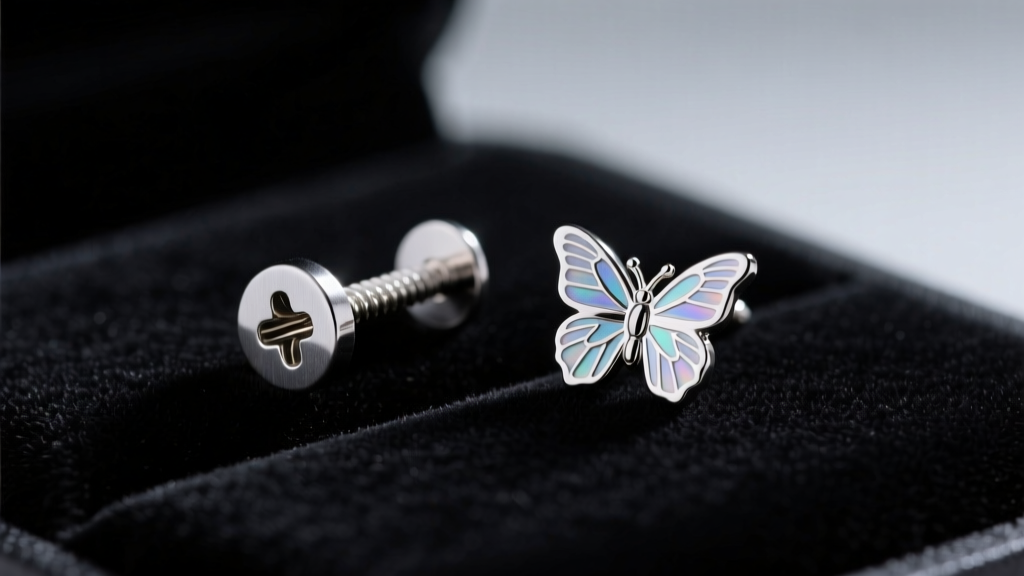
Thin posts can cause a phenomenon known as the cheese-wire effect. If you wear a heavy drop earring or a solid gold hoop on a thin 22-gauge wire, the weight of the earring will pull downward, slicing through the delicate tissue of your earlobe. This micro-tearing causes inflammation that is frequently misdiagnosed as a metal allergy. For sensitive ears, especially those prone to tearing or migration, opt for 18-gauge (1.0mm) or 16-gauge (1.2mm) posts. The thicker metal distributes the weight of the earring more evenly, reducing mechanical stress on the fistula (the piercing hole).
Step 3: Select the Right Earring Backing
Your earring backing is just as critical as the front of the earring. The standard "butterfly" friction back is a primary culprit for localized ear irritation. The intricate grooves of a butterfly back trap sebum (skin oils), dead skin cells, and hair products. This creates a breeding ground for bacteria, leading to low-grade infections that mimic allergic reactions.
"If your earlobe feels tender and swollen specifically at the back where the earring rests, you are likely dealing with a bacterial buildup from a butterfly back, not a metal allergy. Switching to a smooth, threadless flat-back often resolves the issue within 48 hours."
For sensitive ears, upgrade your backings to one of the following:
- Screw-Backs: These feature a threaded post and a backing that screws securely into place. They eliminate the need for tight friction, allowing you to leave space for the earlobe to breathe and swell naturally.
- Threadless Flat-Backs (Push-Pin): Utilizing a bent pin that creates tension inside a hollow post, these offer a completely smooth backing that sits flush against the ear, eliminating pressure points and trapping zero debris.
- Lever-Backs or Continuous Hoops: For dangling styles, avoid fish-hook wires that can easily catch and tear. Lever-backs click securely into place, while continuous (endless) hoops feature a seamless wire that passes entirely through the lobe.
Step 4: Match the Style to Your Piercing Location
The anatomy of your ear dictates how it heals and reacts to jewelry. Cartilage piercings (like the helix, conch, or tragus) have significantly less blood flow than earlobes. According to the Mayo Clinic, areas with poor circulation take much longer to heal and are more susceptible to prolonged contact dermatitis and perichondritis (cartilage inflammation).
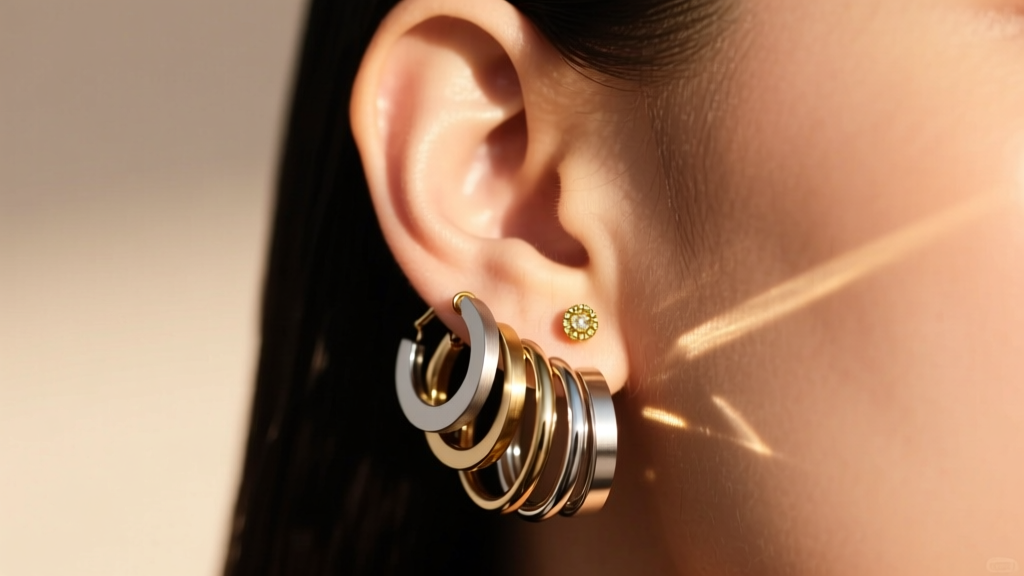
Because of this, standard butterfly-back studs should never be worn in cartilage piercings. The post is often too short to accommodate cartilage thickness and natural swelling, and the backing will press into the back of the ear, causing painful pressure necrosis. For cartilage, the only acceptable style is a flat-back labret post made of ASTM F136 titanium or solid 14k gold. The flat disc rests flush against the back of the ear, distributing pressure evenly and preventing the post from embedding into the tissue while you sleep.
Step 5: The 48-Hour Patch Test & Maintenance Protocol
Even when you have selected the correct metal, gauge, and backing, introducing new jewelry requires a careful protocol to ensure your ears remain calm.
The Patch Test
Before wearing a new pair of 14k gold or niobium earrings for a full day, perform a 48-hour patch test. Wear the earrings for just two hours in the evening, then remove them and clean your lobes with a sterile saline solution. Wait 24 hours. If no redness, itching, or flaking occurs, wear them for four hours the next day. This gradual introduction allows your skin's microbiome to adjust to the new object.
The Maintenance Routine
Sensitive ears require meticulous hygiene to prevent false-allergy flare-ups. Follow this weekly routine:
- Remove and Soak: Once a week, remove your earrings and soak them in a small glass bowl filled with warm water and a few drops of mild, fragrance-free castile soap for 10 minutes.
- Brush the Threads: If you use screw-backs or threaded flat-backs, use a brand-new, ultra-soft baby toothbrush to gently scrub the threading. This removes microscopic sebum buildup that can harbor bacteria.
- Polish Gold Carefully: If you wear 14k or 18k gold, avoid harsh chemical dips or ultrasonic cleaners, which can degrade the alloy over time and expose underlying metals. Use a dedicated, untreated jewelry polishing cloth.
- Sanitize the Earlobe: Before reinserting the earring, wipe the front and back of your earlobe with a 70% isopropyl alcohol wipe, allowing it to air dry completely before inserting the post.
Final Thoughts on Curating a Safe Collection
Determining what type of earrings for sensitive ears will work for you is a process of elimination and education. By rejecting unregulated "hypoallergenic" labels and demanding ASTM F136 titanium, pure niobium, or verified nickel-free yellow gold, you take control of your ear health. Combine these premium metals with thicker 18-gauge posts, debris-free screw or flat-back closures, and a strict cleaning protocol, and you will never have to sacrifice style for comfort again.


