The Technical Fit Guide for Guys With Hoop Earrings
Discover the technical fit, gauge sizing, and best hypoallergenic metals for guys with hoop earrings. Expert advice on anatomy and mechanics.


The landscape of men's jewelry has evolved significantly, and as we navigate the style and technical landscape in 2026, the conversation has shifted from mere aesthetics to biomechanical compatibility. When it comes to guys with hoop earrings, the margin for error is remarkably slim. Unlike studs, which sit statically within the piercing channel, hoops introduce kinetic movement, rotational friction, and variable weight distribution. Choosing the wrong gauge, metal alloy, or closure mechanism doesn't just result in an awkward fit—it can lead to tissue migration, galvanic skin reactions, and structural jewelry failure.
This expert deep dive bypasses generic style advice to examine the exact anatomical, metallurgical, and mechanical specifications required for men's hoop earrings. Whether you are curating a minimalist daily driver or a heavy statement piece, understanding the engineering behind the jewelry is non-negotiable.
The Anatomy of Men's Earlobes and the Fistula
Men's earlobes typically present a denser fibro-fatty tissue matrix and a thicker overall profile compared to women's. When a standard lobe piercing is performed, the resulting fistula (the healed tube of tissue surrounding the jewelry) adapts to the initial jewelry's gauge and weight.
The primary biomechanical risk for guys with hoop earrings is the cheese cutter effect. This occurs when a hoop is too thin (high gauge number) and too heavy. The downward force of gravity concentrates on a microscopic surface area of the tissue inside the fistula. Over months or years, the jewelry slowly migrates downward, slicing through the lobe and resulting in a permanent, elongated slit. To counteract this, we must increase the surface area by dropping to a thicker gauge (lower gauge number), effectively distributing the kinetic load across a wider band of tissue.
"A hoop earring is a dynamic lever. The longer the diameter and the thinner the wire, the greater the torque applied to the inferior edge of the fistula during sleep or physical activity." — Association of Professional Piercers (APP)
Decoding Gauge and Diameter: The Exact Measurements
Wire thickness (gauge) and the inner circumference (diameter) must be perfectly calibrated to the individual's lobe thickness. A hoop that is too tight will cause localized edema (swelling) and embedding, while a hoop that is too large will catch on clothing and hair, increasing the risk of traumatic tearing.
The Gauge and Diameter Matrix for Men
| Gauge (AWG) | Thickness (mm) | Ideal Inner Diameter | Best Use Case & Biomechanics |
|---|---|---|---|
| 18G | 1.0mm | 8mm - 10mm | Minimalist huggies. Low weight prevents migration, but unsuitable for heavy pendants or thick lobes. |
| 16G | 1.2mm | 10mm - 12mm | The structural sweet spot for standard daily wear. Provides excellent shear strength without requiring stretching. |
| 14G | 1.6mm | 12mm - 15mm | Ideal for statement hoops and heavier metals (like solid gold). Eliminates the cheese cutter effect entirely. |
| 12G | 2.0mm | 15mm+ | Requires a professionally stretched piercing. Used for heavy, architectural, or tribal-inspired hoop designs. |
For men with standard piercings (usually done at 18G or 16G), transitioning to a 14G hoop requires a professional taper. Forcing a 1.6mm wire through a 1.0mm fistula will cause micro-tears, introducing bacteria and leading to hypertrophic scarring.
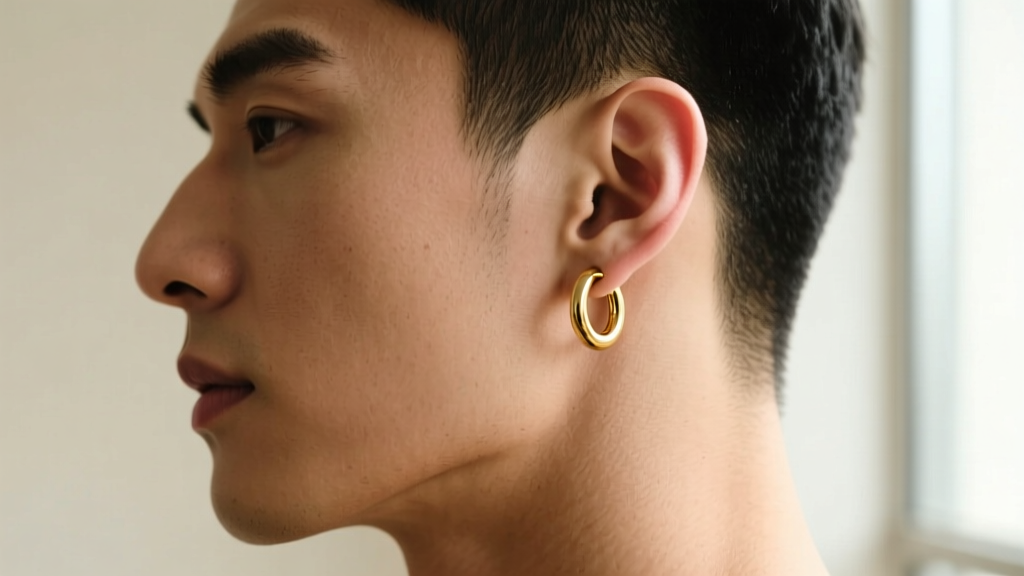
Metallurgy Matters: Implant-Grade vs. Commercial Steel
The men's jewelry market is saturated with misleading marketing terms like "surgical steel" and "hypoallergenic alloys." When selecting hoops—which move constantly and trap sweat, sebum, and dead skin cells against the fistula—metallurgical purity is a matter of biological safety.
The Nickel Trap in 316L Surgical Steel
316L stainless steel is the most common material in commercial jewelry, but it contains between 8% and 10% nickel. While the nickel is bound within the steel matrix, the acidic pH of human sweat, combined with the friction of a moving hoop, causes galvanic corrosion. This microscopic degradation leaches nickel salts directly into the piercing channel. For the 15-20% of the male population with nickel sensitivities, this results in contact dermatitis, characterized by itching, weeping, and dark discoloration of the tissue.
The Titanium Standard (ASTM F136)
The undisputed gold standard for body jewelry is ASTM F136 Ti-6Al-4V ELI (Extra Low Interstitial) titanium. According to ASTM International, this specific alloy is engineered for surgical implants. It is entirely nickel-free, non-magnetic, and boasts a vastly superior strength-to-weight ratio compared to steel.
- Biocompatibility: Titanium forms a passive oxide layer when exposed to oxygen, making it completely inert to human tissue and bodily fluids.
- Tensile Strength: F136 titanium can withstand the torsion required to open and close continuous rings without suffering from metal fatigue or permanent warping.
- Anodization: Unlike steel, titanium can be anodized using electrical currents to create vibrant, non-toxic surface colors (like deep blues or golds) without using chemical plating that can chip off inside the ear.

Closure Mechanisms: Durability and Failure Modes
The closure mechanism is the weakest point of any hoop earring. Men generally require low-profile, high-durability closures that can withstand active lifestyles, gym sessions, and rough handling.
1. Hinged Clickers (The Modern Standard)
Clickers feature a machined hinge on one side and a tension-based snap closure on the other. They are the preferred choice for guys with hoop earrings due to their ease of use and secure lock. Failure Mode: Cheaply manufactured clickers use soft brass hinges that bend over time, causing the seam to gap open. Always source clickers where the hinge pin is crafted from the same titanium alloy as the body of the ring.
2. Continuous (Endless) Rings
These feature a hollow tubing design where a solid wire post slides seamlessly into the opposite end. They offer the cleanest, most minimalist aesthetic. Failure Mode: Opening a continuous ring requires lateral torsion (twisting it side-to-side). Repeated twisting eventually warps the circular geometry of the hoop, causing the post to misalign and scrape the interior of the fistula upon insertion.
3. Captive Bead Rings (CBR)
The classic CBR relies on the tensile strength of the metal ring to hold a small bead in place via compression. Failure Mode: The tension required to keep a 14G or 12G CBR closed is immense. Over time, the metal relaxes, and the bead pops out unexpectedly, usually resulting in the permanent loss of the bead.
Troubleshooting Common Hoop Failures
Even with perfect sizing and premium metals, environmental factors can cause issues. Here is a clinical approach to troubleshooting the most common problems encountered by men wearing hoops:
- Localized Swelling (Edema): If the lobe swells and the hoop feels tight, the inner diameter is too small. Do not attempt to stretch the metal outward with pliers, as this creates microscopic burrs that will tear the tissue. Swap immediately to a larger diameter or a flat-back labret stud until the swelling subsides.
- Snagging and Trauma: Hoops larger than 15mm are highly susceptible to catching on towels, hoodies, and headphones. If a snag occurs, do not yank the jewelry. Apply a sterile saline spray to lubricate the area, gently massage the tissue to release the tension, and carefully unhook the closure.
- Sebum Buildup in Hinges: The hinge of a clicker hoop is a trap for dead skin cells and sebum, which can cause a foul odor and degrade the mechanism. Clean the hinge weekly using a soft-bristled toothbrush and an ultrasonic jewelry cleaner filled with warm, mild castile soap.
Expert Sourcing and Final Verdict
When investing in hoop earrings, bypass fast-fashion retailers and mall kiosks. Seek out specialized body jewelry manufacturers that provide mill certificates verifying their ASTM F136 titanium or 14k/18k solid gold alloys. Brands that specialize in anatomical body jewelry offer the precise tolerances required for seamless closures and polished seams that won't harbor bacteria.
Ultimately, the key for guys with hoop earrings lies in respecting the biomechanics of the ear. By prioritizing a 16G or 14G thickness, insisting on implant-grade titanium, and selecting a precision-machined clicker closure, you ensure that your jewelry remains a permanent, comfortable, and structurally sound extension of your personal style.


