Hoop Earrings History: Ancient Gold Origins to Modern Titanium Tech
Explore the rich hoop earrings history, tracing metallurgical evolution from ancient Sumerian gold to modern implant-grade titanium huggies.

The Metallurgical Dawn: Sumerian and Egyptian Origins
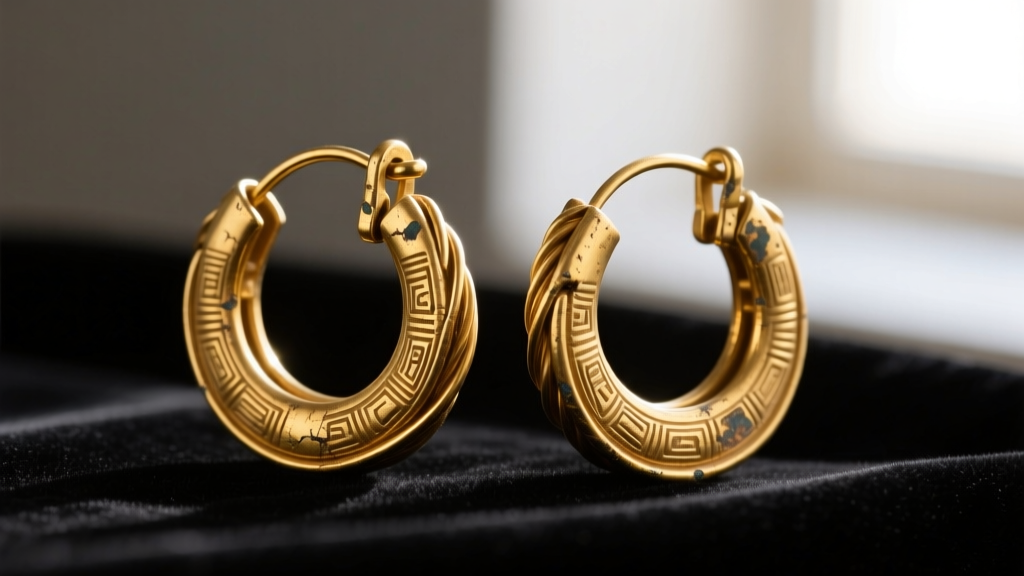
When examining the hoop earrings history, one must look past mere aesthetics and delve into the realm of ancient materials science. The earliest documented hoop earrings originate from the Royal Cemetery of Ur in ancient Sumer, dating back to roughly 2500 BCE. According to the British Museum Collection, early Mesopotamian and Egyptian jewelers primarily utilized native gold, which was largely unalloyed and exceptionally pure (often 22k to 24k). While this high-karat gold offered unparalleled luster and resistance to tarnish, it presented a significant structural challenge: pure gold has a Vickers hardness (HV) of merely 25 to 30, making it incredibly soft and malleable.
To prevent the jewelry from deforming under its own weight or tearing through the earlobe, ancient artisans were forced to use remarkably thick wire. Excavated specimens frequently feature wire gauges ranging from 8-gauge (3.26mm) to 6-gauge (4.11mm). Because they lacked the metallurgical knowledge to harden the gold through alloying or work-hardening, the sheer mass and thickness of the metal were the only mechanisms available to maintain the hoop's circular geometry. The closures of this era were primitive, typically consisting of a simple tapered wire end that wedged into a hollow tube or hooked over a thick loop, resulting in high failure rates and frequent snagging on textiles.
Hellenistic and Roman Advancements: Alloying and Wire Drawing
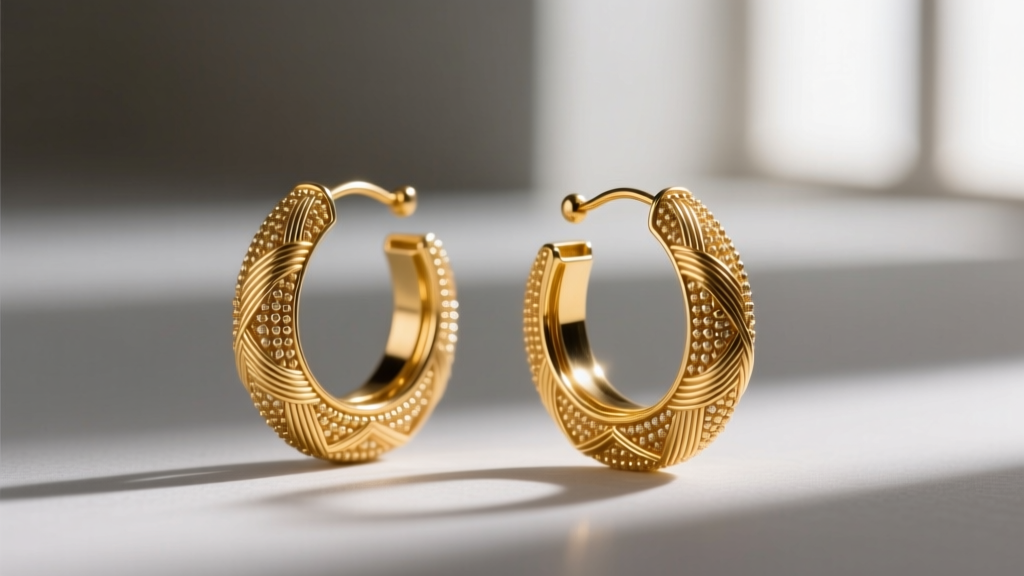
The trajectory of hoop earrings history shifted dramatically during the Hellenistic period and into the Roman Empire. Metallurgists began to intentionally alloy gold with copper and silver. By reducing the gold purity to 18k (75% gold) or 14k (58.3% gold), the introduction of these base metals disrupted the crystalline lattice of the gold, increasing its Vickers hardness to over 100 HV. The World Gold Council notes that this era also saw the refinement of wire drawing techniques, where gold rods were pulled through progressively smaller holes in hardened bronze or iron plates.
This combination of alloying and mechanical work-hardening allowed Roman jewelers to produce significantly thinner, yet structurally superior, hoop earrings. Wire diameters shrank to the 14-gauge (1.63mm) and 12-gauge (2.05mm) range. This reduction in thickness drastically decreased the overall weight of the earring, reducing the gravitational pull on the earlobe and allowing for the introduction of elaborate surface decorations, such as granulation and filigree, without compromising the structural integrity of the hoop itself.
The Industrial Revolution: Standardization and the Hinged Saddleback
Fast forward to the 19th century, and the hoop earrings history becomes inextricably linked with the Industrial Revolution. The invention of the Brown & Sharpe (B&S) wire gauge system in 1857 brought mathematical precision to jewelry manufacturing. For the first time, a 16-gauge wire in New York was exactly the same diameter (1.29mm) as a 16-gauge wire in London. This standardization allowed for the mass production of interchangeable earring components and the development of complex, standardized closure mechanisms.
The most significant mechanical leap of this era was the popularization of the hinged saddleback (or snap) closure. Unlike the ancient hook-and-eye, the saddleback utilized a precisely machined hinge on one side and a tension-based snap closure on the other. This distributed the mechanical stress evenly across the earlobe and provided a secure, flush finish that minimized snagging. However, early steel tooling often resulted in tolerances of +/- 0.1mm, meaning cheaper mass-produced hoops frequently suffered from loose clasps that would pop open under minor tension.
Evolution of Hoop Closures and Wire Gauges
| Historical Era | Typical Alloy / Material | Average Gauge Size | Dominant Closure Mechanism |
|---|---|---|---|
| Sumerian (2500 BCE) | 22k-24k Native Gold | 8G - 6G (3.2mm - 4.1mm) | Tapered Wire Wedge / Hook |
| Roman (100 BCE - 200 CE) | 18k Gold / Electrum | 14G - 12G (1.6mm - 2.0mm) | S-Loop / Interlocking Wire |
| Industrial (1850s - 1920s) | 14k Gold / Rolled Gold Plate | 18G - 16G (1.0mm - 1.3mm) | Hinged Saddleback / Snap |
| Modern (2000s - 2026) | ASTM F136 Titanium / Niobium | 20G - 16G (0.8mm - 1.3mm) | CNC Clicker / Segment Ring |
The Modern Era: Implant-Grade Titanium and CNC Machining
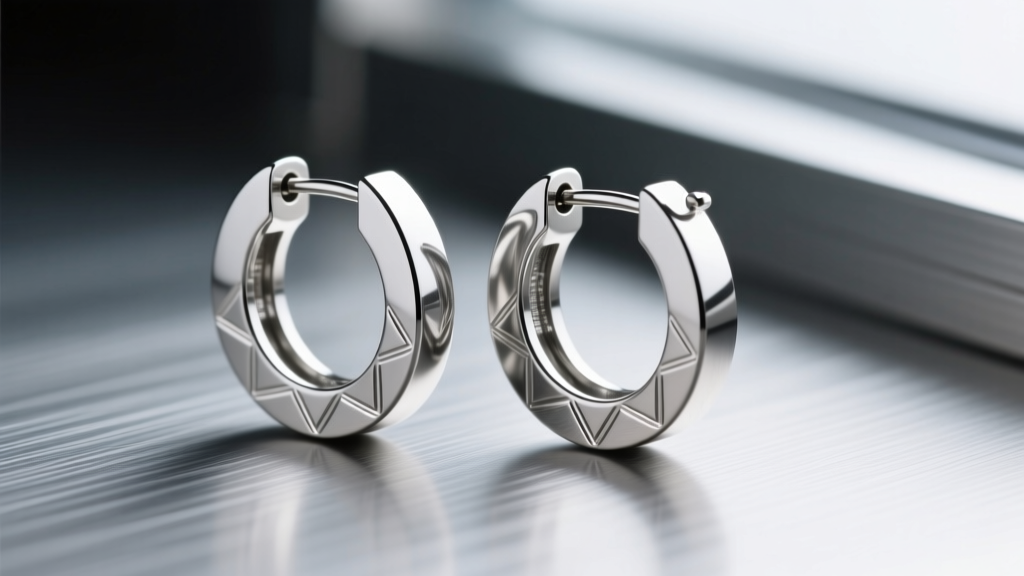
As we navigate the jewelry landscape of 2026, the hoop earrings history has culminated in the widespread adoption of aerospace and medical-grade materials. The industry standard for high-quality, hypoallergenic hoops is now ASTM F136 Ti-6Al-4V ELI (Extra Low Interstitial) titanium. This specific alloy boasts a yield strength of roughly 830 MPa and a Vickers hardness of 349 HV, making it exponentially stronger and harder than even 14k gold, while remaining entirely biocompatible and nickel-free.
Modern manufacturing relies on 5-axis CNC (Computer Numerical Control) machining to create the "clicker" closure. Unlike the stamped saddlebacks of the 20th century, a CNC-milled clicker features a tension-based hinge and a precisely calculated locking groove with tolerances held to +/- 0.02mm. When the closure snaps shut, it produces an audible "click" and creates a seamless, continuous circle that is virtually impossible to pull apart without intentional lateral manipulation. This level of precision ensures that the earring remains securely fastened during high-impact activities, from sleeping to intense athletic training.
Technical Framework: Selecting Hoops Based on Historical Durability
Understanding the metallurgical and mechanical evolution of hoops provides a distinct advantage when selecting pieces today. Rather than relying solely on visual design, apply this expert framework to evaluate the technical merits of your next purchase:
- Match Gauge to Tissue Thickness: Standard lobe piercings are typically done at 20G (0.81mm) or 18G (1.02mm), while cartilage piercings (like the helix or conch) are usually 16G (1.29mm) or 14G (1.63mm). Inserting a 20G hoop into a healed 16G cartilage piercing will cause the "cheese-cutter effect," where the thin wire exerts excessive localized pressure, slowly migrating through the tissue. Always match or exceed the gauge of your original piercing needle.
- Evaluate Closure Tolerances: When buying modern clicker hoops, inspect the seam where the hinge meets the locking post. Run your fingernail over the joint; it should feel completely flush. Any catching indicates poor CNC calibration or low-quality casting, which will eventually lead to the hinge pin shearing under repetitive stress.
- Calculate Pendulum Weight and Diameter: For huggies and small-diameter hoops (under 12mm), material density matters less. However, for large statement hoops (30mm+), avoid solid 18k gold or heavy brass. The gravitational torque on the earlobe fistula will cause stretching over time. Opt for hollow-tube construction or lightweight anodized niobium, which offers the visual mass of thick wire with a fraction of the density.
- Beware of Work-Hardening in Continuous Rings: If you prefer seamless segment rings, understand that repeatedly twisting the metal open and closed causes work-hardening. Over time, the titanium or gold will become brittle at the stress point and snap. Always use proper ring-opening pliers that distribute torque evenly, rather than pulling the ends apart with your bare fingers.
By viewing the hoop earrings history not just as a timeline of fashion, but as a continuous progression of materials engineering, you can make highly informed, technically sound decisions that prioritize both longevity and tissue health.


