How to Wear Rhinestone Chandelier Earrings Without Earlobe Stretching
Learn how to style and support heavy rhinestone chandelier earrings without stretching your earlobes. Expert tips on gauge sizes, cleaning, and face shapes.


Rhinestone chandelier earrings are the ultimate statement piece. With their cascading tiers of faceted crystals and intricate metalwork, they catch the light and draw immediate attention to the face. However, their dramatic visual impact comes with a physical drawback: weight. When worn for extended periods, heavy dangle earrings can cause micro-tears in the earlobe, leading to permanent stretching, sagging, and the dreaded 'cheese cutter' effect. In this comprehensive guide, we will break down the exact physics of earring gauges, provide step-by-step support methods, and share professional maintenance routines to keep your rhinestone chandelier earrings looking pristine and your earlobes completely intact.
The Physics of Dangle: Weight vs. Gauge Size
To understand why chandelier earrings cause earlobe damage, you must look at the intersection of jewelry wire gauges and tissue pressure. Standard lobe piercings are typically done at 20-gauge (0.81mm) or 18-gauge (1.02mm). To keep manufacturing costs down and overall weight slightly reduced, many mass-market rhinestone chandelier earrings are fitted with thin 20-gauge French wire hooks.
When a chandelier earring weighing just 15 grams hangs from a 20-gauge wire, the pressure exerted on the bottom of the piercing hole is immense. Over a four-hour event, this concentrated downward force restricts blood flow to the lower lobe tissue, causing ischemia (tissue starvation) and eventual collagen breakdown. According to dermatological guidelines on earlobe trauma, any earring exceeding 7 to 10 grams requires structural support to prevent gradual elongation of the piercing fistula. If your vintage or designer rhinestone drops feel heavy in the hand, they are actively working against your earlobe's structural integrity when worn unsupported.
Step-by-Step: 3 Methods to Support Heavy Drops
You do not need to sacrifice style for comfort. By utilizing modern jewelry hacks and structural modifications, you can safely wear heavy rhinestone chandelier earrings all night. Here are three proven methods to distribute the weight.
Method 1: Silicone Earring Support Discs
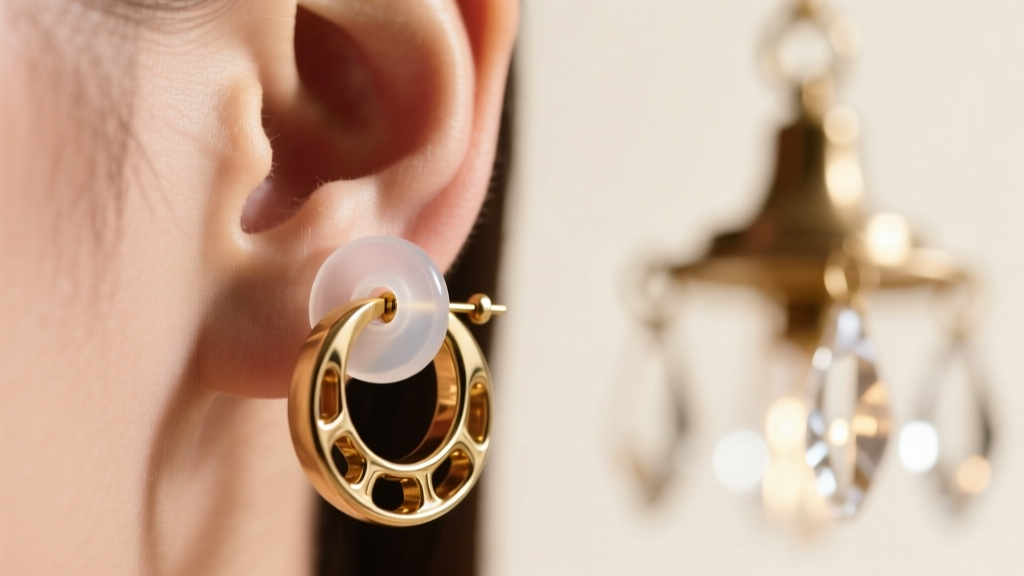
Silicone support discs (often sold under brand names like LobeWonder or BlingWraps) are the most accessible solution. These are small, flower-shaped silicone pads that slide onto the earring post or hook behind the earlobe.
- Step 1: Insert your chandelier earring through the piercing.
- Step 2: Take a 10mm silicone support disc and stretch the center hole slightly.
- Step 3: Slide the disc up the earring wire until it rests flush against the back of your earlobe.
- Step 4: Secure with a standard earring back or a silicone stopper over the disc to lock it in place.
The broad surface area of the silicone pad distributes the 15-gram load across the entire back of the earlobe rather than concentrating it on the 0.81mm piercing hole.
Method 2: Earlobe Patches for Hook-Style Earrings
If your rhinestone chandelier earrings use a shepherd's hook rather than a post, silicone discs will not work. Instead, use invisible earlobe support patches. These are medical-grade, matte-finish adhesive tapes designed specifically to bear the weight of heavy jewelry.
- Step 1: Clean the back of your earlobe with an alcohol wipe to remove natural oils and let it dry completely.
- Step 2: Apply the adhesive patch directly over the piercing hole on the back of the lobe.
- Step 3: Using a sterilized piercing needle or a tiny awl, carefully poke a hole through the patch exactly where your piercing is.
- Step 4: Thread the chandelier hook through both the patch and the earlobe. The adhesive patch will bear up to 80% of the earring's downward pull.
Method 3: French Wire to Leverback Conversion
For a permanent, professional fix, take your chandelier earrings to a bench jeweler and ask them to swap the standard French wire hooks for 18-gauge leverback findings. Leverbacks feature a hinged closure that snaps shut, creating a continuous circle of metal through the ear. This structural loop prevents the earring from shifting forward and pulling aggressively on the bottom of the piercing hole, drastically reducing the cheese-cutter effect.
Face Shape Matching Guide for Chandelier Silhouettes
Beyond structural support, styling rhinestone chandelier earrings requires an understanding of facial geometry. The cascading nature of chandelier designs can either balance or exaggerate your natural bone structure. Use the framework below to select the ideal silhouette for your face shape.
| Face Shape | Ideal Chandelier Silhouette | Design Elements to Avoid |
|---|---|---|
| Round | Long, linear drops with rectangular or teardrop rhinestones to create vertical elongation. | Wide, circular, or overly clustered hoops that add horizontal volume to the cheeks. |
| Square | Curved, teardrop-heavy designs with soft, sweeping lines to soften a strong jawline. | Geometric, sharp-edged square or triangular chandeliers that mirror the jaw's angles. |
| Heart | Bottom-heavy designs (wider at the base than the top) to add visual weight to a narrower chin. | Inverted triangles or top-heavy clusters that exaggerate a wider forehead. |
| Oval | Versatile; almost any silhouette works, from Art Deco geometric to bohemian fringe. | Extremely long drops that exceed the length of the neck, disrupting natural proportions. |
Cleaning and Maintaining Rhinestone Foil Backings
The brilliant sparkle of high-quality rhinestone chandelier earrings (such as those using vintage Swarovski or Preciosa crystals) relies on a delicate metallic foil backing applied to the underside of the glass. This foil acts as a mirror, reflecting light back through the faceted top. Improper cleaning will strip this foil, leaving the stones looking dull, gray, and lifeless.
Expert Warning: Never use ultrasonic jewelry cleaners or commercial silver dips on rhinestone jewelry. The high-frequency sound waves in ultrasonic baths will shatter the adhesive bond holding the stones in their prong settings, and the harsh chemicals in silver dips will instantly dissolve the metallic foil backings.
According to the Gemological Institute of America (GIA), treated and backed gemstones require gentle, non-chemical cleaning protocols. Follow this step-by-step cleaning method:
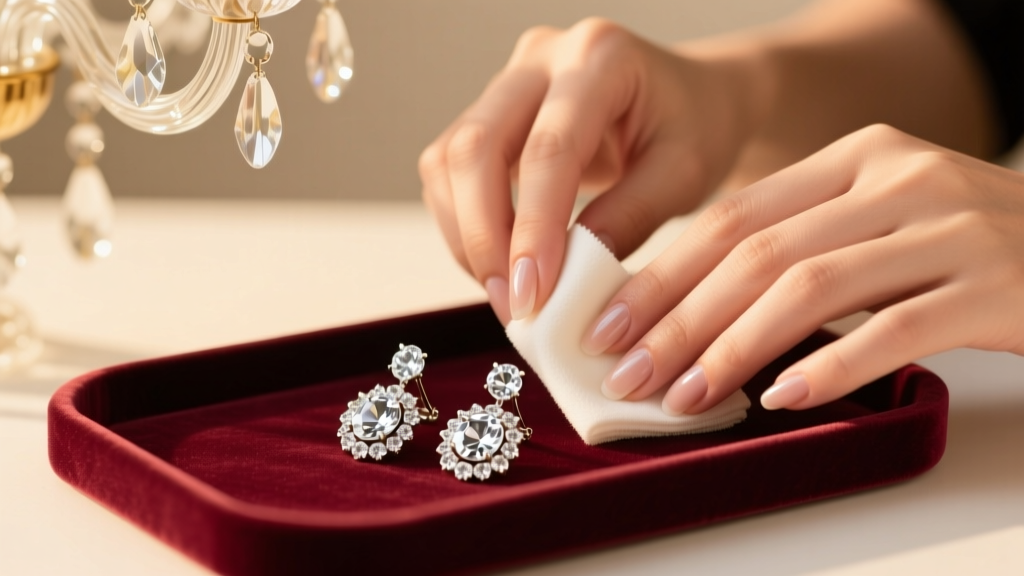
- Dry Dusting: Use a clean, dry, soft-bristled makeup brush (like a fluffy eyeshadow brush) to gently sweep away dust, skin cells, and hairspray residue from between the prongs and crystal facets.
- Spot Cleaning: If the stones have lost their luster due to skin oils, dampen a microfiber cloth with a tiny drop of mild, ammonia-free dish soap and distilled water. Wring the cloth out until it is barely damp—not wet.
- Wipe Gently: Wipe the top faceted surfaces of the rhinestones. Avoid getting moisture near the metal settings where the foil backing is exposed.
- Dry Immediately: Use a second, completely dry microfiber cloth to buff the glass and metalwork immediately, ensuring no water spots form on the brass or pewter settings.
Troubleshooting Common Chandelier Failures
Because chandelier earrings are essentially miniature, wearable sculptures composed of dozens of moving parts, they are prone to specific mechanical failures. Understanding how to troubleshoot these issues will save your favorite pieces from the trash bin.
Jump Ring Separation
The tiers of a chandelier earring are connected by tiny metal jump rings. If a tier falls off, do not pull the ring apart laterally (side-to-side), as this warps the metal and prevents it from closing flush. Instead, use two pairs of flat-nose jewelry pliers. Grip the jump ring on either side of the seam and twist one hand forward and the other backward. This opens the ring along its natural circular plane, allowing you to reattach the dropped tier and twist it shut with perfect tension. For added security, apply a microscopic drop of jeweler's epoxy to the seam after closing.
Loose Prong Settings
Rhinestones are typically held in place by metal prongs folded over the stone's girdle. Over time, these prongs can catch on clothing and lift. If you notice a stone rattling, do not use superglue to fix it; cyanoacrylate adhesives will cloud the glass and ruin the foil backing. Instead, use a jewelry prong pusher or a soft nylon-tipped plier to gently press the lifted metal prong back down over the edge of the stone, securing it mechanically as originally intended.
Tarnished Base Metals
Many rhinestone chandelier earrings are crafted from brass or pewter with a thin rhodium or silver plating. When the plating wears off, the base metal oxidizes and turns dark. To restore the shine without damaging the stones, use a dry, treated silver polishing cloth. Rub the metalwork carefully, avoiding heavy pressure on the rhinestones, as the mild abrasives in the cloth can scratch softer acrylic or pressed-glass stones.
Final Thoughts on Heavy Earring Styling
Rhinestone chandelier earrings are an investment in glamour, but they require a strategic approach to wearability. By respecting the limits of your earlobe tissue, utilizing silicone supports or leverback conversions, and adhering to strict, foil-safe cleaning protocols, you can ensure your statement pieces remain as structurally sound as they are visually stunning. Whether you are styling a vintage Art Deco piece for a gala or a modern crystal fringe design for a wedding, these professional techniques guarantee you will be the best-dressed person in the room—without paying the price in earlobe damage.


