Is Titanium Good for Earrings? The Complete Beginner's Guide
Discover if titanium is good for earrings. Learn about ASTM F136 grades, nickel allergies, gauge sizes, and how to choose safe jewelry for sensitive ears.

The Short Answer: Why Titanium is the Gold Standard
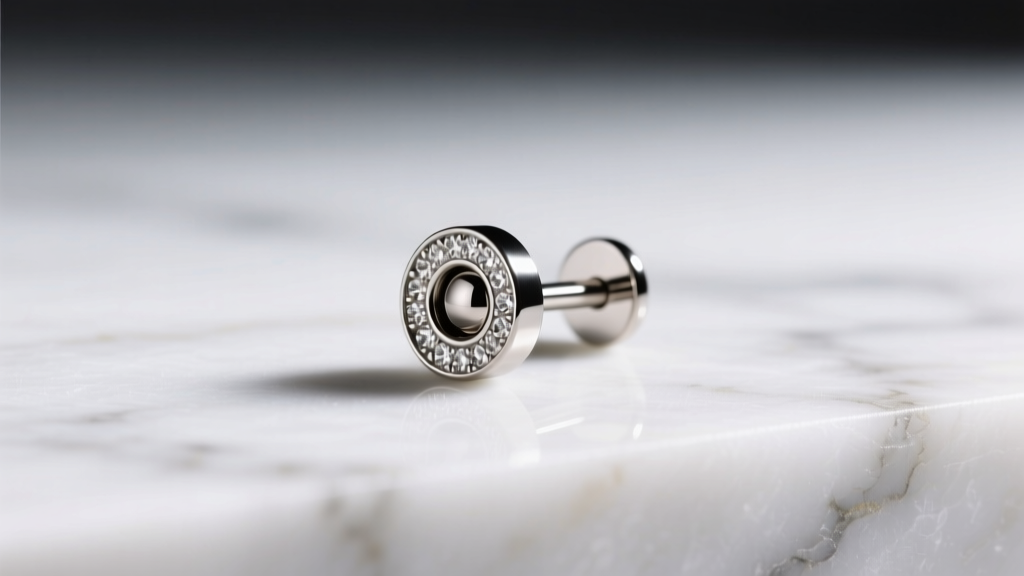
If you are asking, is titanium good for earrings, the short answer is an absolute yes—but with a major caveat regarding the specific grade of metal you choose. For anyone with sensitive ears, fresh piercings, or a history of contact dermatitis, titanium is widely considered the safest, most biocompatible metal available in the body jewelry market. Unlike traditional commercial earrings that rely on vague 'hypoallergenic' marketing buzzwords, high-quality titanium offers a scientifically backed guarantee of safety.
The primary reason titanium outperforms other metals is its complete lack of nickel. According to the Mayo Clinic, nickel allergy is one of the most common causes of allergic contact dermatitis, affecting roughly 10% to 20% of the global population. When standard 'surgical steel' earrings (which contain 8% to 12% nickel) are worn, the sweat and natural oils from your skin can cause nickel ions to leach into the piercing fistula, resulting in redness, itching, swelling, and the dreaded 'irritation bumps.' Titanium eliminates this variable entirely, providing a completely inert surface that the human body does not recognize as a foreign threat.
Understanding Titanium Grades: Not All Titanium is Equal
The biggest mistake beginners make when shopping for titanium earrings is assuming all titanium is created equal. The term 'titanium' on a jewelry tag does not automatically guarantee safety. To ensure your earrings are truly safe for long-term wear or fresh piercings, you must look for specific metallurgical certifications.
Implant-Grade vs. Commercial-Grade
The gold standard for body jewelry is ASTM F136 compliant Titanium 6AL-4V ELI (Extra Low Interstitial). This is the exact same alloy used by orthopedic surgeons for joint replacements and bone screws. It undergoes rigorous testing to ensure it is free from toxic trace elements and possesses a mirror-smooth surface finish that prevents bacterial adhesion.
Conversely, you will often encounter ASTM B265 (Commercially Pure Titanium) or unmarked 'titanium alloys' in mall kiosks and fast-fashion retailers. While commercially pure titanium is generally nickel-free, it is softer, more porous, and prone to micro-scratches that can harbor bacteria and irritate healing tissue.
| Metal Type | Nickel Content | ASTM Standard | Best Use Case |
|---|---|---|---|
| Implant-Grade Titanium | 0% | ASTM F136 | Fresh piercings, severe allergies, daily wear |
| Commercial Titanium | 0% | ASTM B265 | Healed piercings, budget-friendly sensitive wear |
| Surgical Steel (316L) | 8% - 12% | ASTM F138 | Fully healed piercings only (if no nickel allergy) |
| Niobium | 0% | N/A (Reactive) | Fresh piercings, highly malleable custom bends |
| 14k / 18k Solid Gold | Varies by alloy | N/A | Healed piercings (ensure nickel-free white gold) |
Titanium vs. Surgical Steel: A Microscopic Showdown
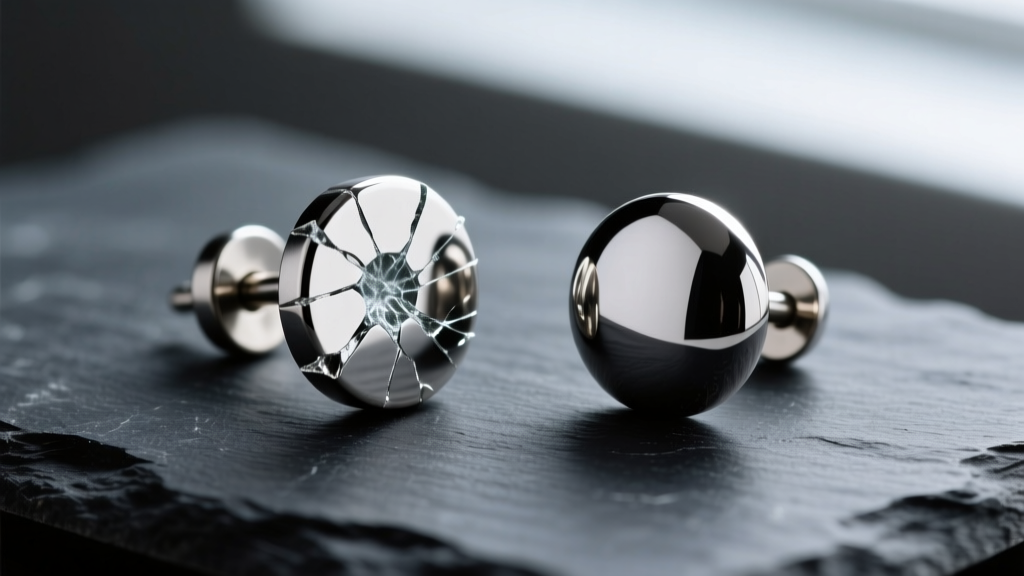
When you view standard surgical steel and implant-grade titanium under a microscope, the differences in surface finish become glaringly obvious. The Association of Professional Piercers (APP) strictly mandates implant-grade titanium or niobium for initial piercings because of how these metals are polished.
- Surface Porosity: Cheaper steel alloys often feature microscopic pitting and tool marks from the manufacturing process. When inserted into a piercing, these micro-abrasions act like tiny cheese graters against delicate healing tissue, trapping dead skin cells and sebum.
- Mirror Finish: High-end titanium brands (such as Neometal or Anatometal) utilize electropolishing techniques that yield a flawless, glass-like mirror finish. This allows the jewelry to glide through the fistula without causing micro-tears.
- Weight and Comfort: Titanium is roughly 45% lighter than steel. For larger gauge earrings, cartilage hoops, or heavy dangle styles, this drastic reduction in weight prevents lobe stretching and cartilage migration over time.
Best Titanium Earring Styles for Sensitive Lobes and Cartilage
Choosing the right metal is only half the battle; the structural design of the earring dictates how well your ear will tolerate it. Here is how to select the right titanium style based on your anatomy.
Threadless Flat-Back Labrets (The Ultimate Standard)
If you struggle with traditional butterfly-back studs, switching to a threadless titanium flat-back labret will revolutionize your ear health. Butterfly backs trap moisture, dead skin, and hair products, creating a breeding ground for bacteria (often resulting in the foul odor colloquially known as 'ear cheese'). A flat-back labret features a smooth, flat titanium disc that sits flush against the back of the ear, eliminating pressure points and debris traps.
How Threadless Works: Instead of screwing the decorative end onto the post (which can strip threads or cross-thread), threadless jewelry uses tension. The pin on the decorative end is inserted halfway into the hollow post, bent slightly at a 5-degree angle, and pushed all the way in. The tension of the bent metal against the inner wall of the post locks it securely in place.
Seamless Huggies and Clickers for Cartilage
For helix, tragus, or conch piercings, titanium clicker rings are ideal. Ensure the hinge mechanism is high-quality and the seam where the ring closes is perfectly flush. A poorly manufactured seam will catch on the piercing channel every time you rotate the hoop, leading to chronic irritation and hypertrophic scarring.
Gauge Sizes: Getting the Thickness Right
Beginners often overlook gauge (the thickness of the earring post), which is just as critical as the material. Wearing a post that is too thin for your piercing can cause the 'cheese-cutter effect,' where the thin metal slowly migrates and slices through the tissue.
- 20 Gauge (0.81mm): Standard for commercial, mass-market lobe earrings. Rarely found in high-quality implant-grade titanium.
- 18 Gauge (1.0mm): The standard for high-end lobe jewelry and some delicate cartilage piercings.
- 16 Gauge (1.2mm): The universal standard for most cartilage piercings (helix, forward helix, tragus, conch).
- 14 Gauge (1.6mm): Used for industrial scaffolds, daiths, and thicker conch piercings.
The Magic of Anodization: Safe, Vibrant Colors
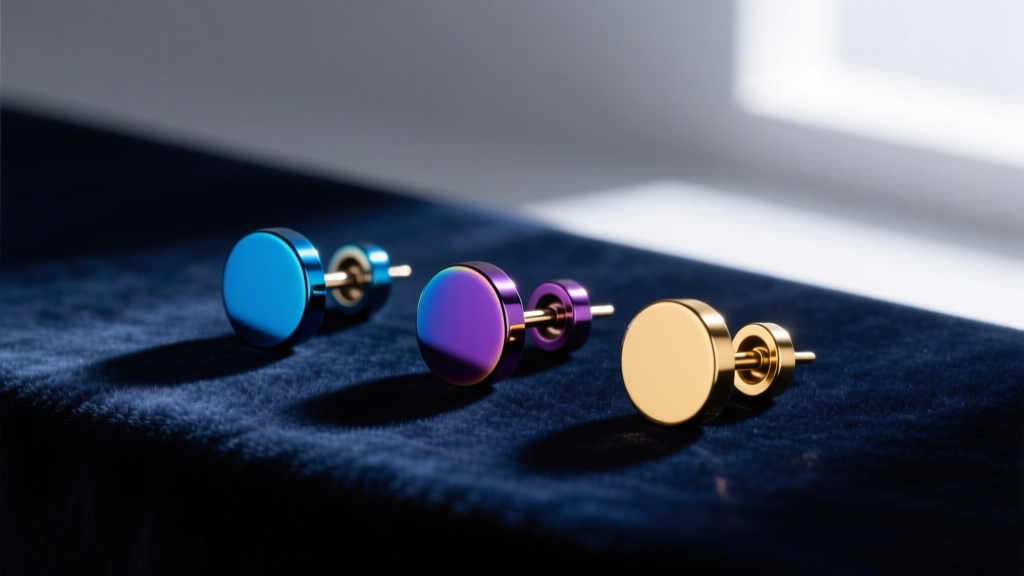
One of the most remarkable properties of titanium is its ability to be anodized. If you want colorful jewelry without the risk of toxic dyes, paints, or enamel chipping off into your piercing, anodized titanium is the answer.
Anodization is an electrolytic passivation process that increases the thickness of the natural titanium oxide layer on the surface of the metal. By adjusting the voltage applied during the process, the oxide layer refracts light at different wavelengths, producing vibrant, permanent colors ranging from bright gold and rose to deep blue, purple, and teal. Because no foreign pigments are added to the metal, anodized titanium remains 100% safe for fresh piercings and highly reactive skin. Furthermore, if your anodized jewelry gets scratched, a professional piercer can easily re-anodize it in their studio in a matter of seconds.
Red Flags: How to Spot Fake or Low-Quality Titanium
Because implant-grade titanium is more expensive to machine and polish, some unscrupulous manufacturers cut corners. Here is how to protect yourself:
Warning: The term 'Surgical Titanium' is a marketing myth. There is no recognized metallurgical standard for 'surgical titanium.' It is usually just low-grade commercial titanium or steel plated with a microscopically thin layer of titanium that will wear off in weeks, exposing the reactive base metal beneath.
- Check for Brand Hallmarks: Reputable brands like Neometal, Anatometal, and Maria Tash stamp or laser-etch their logos and metal grades on the jewelry or provide certified packaging.
- The Magnet Test: Pure titanium and ASTM F136 alloys are entirely non-magnetic. If your 'titanium' earring sticks to a strong neodymium magnet, it contains ferromagnetic metals (like iron or steel) and is not pure titanium.
- Price Point Reality: A single, genuine implant-grade titanium flat-back labret with a basic polished end typically costs between $30 and $45. If you find a pack of five 'titanium' studs for $12, you are almost certainly buying plated brass or low-grade steel.
Final Verdict and Care Instructions
So, is titanium good for earrings? It is unequivocally the best material available for anyone prioritizing long-term ear health, comfort, and allergy prevention. To maintain your titanium jewelry, avoid harsh chemical dips or ultrasonic cleaners if your jewelry features soft gemstones like opals or pearls. For routine cleaning, simply soak the jewelry in a small cup of warm water with a few drops of mild, fragrance-free castile soap, gently brush with a soft-bristled baby toothbrush, and dry completely with a lint-free cloth before storing. By investing in ASTM F136 implant-grade titanium, you are investing in a lifetime of irritation-free wear.


