Large Ball Earrings: Technical Guide to Weight, Gauges, and Fit
Master the physics of large ball earrings. Explore gauge sizes, weight distribution, backing mechanisms, and lobe-stretching prevention.

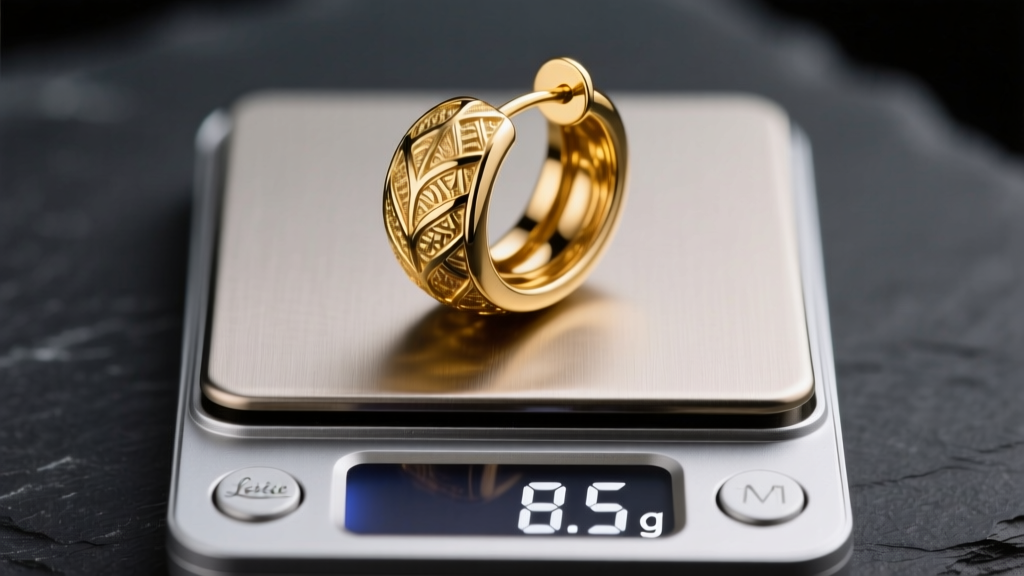
The Engineering of Spherical Jewelry
Large ball earrings are a staple of both minimalist and maximalist jewelry design, offering a bold geometric silhouette that catches the light from every angle. However, from an engineering perspective, spherical earrings present unique structural challenges. Unlike flat discs or elongated drops, a sphere's volume scales cubically with its radius. This means a seemingly minor increase in diameter results in a massive exponential increase in weight and gravitational pull on the earlobe. In this technical deep dive, we examine the metallurgy, physics, and ergonomic design required to make large ball earrings both safe and comfortable for long-term wear.
The Geometry of Spherical Volume and Weight
To understand why some large ball earrings cause tissue damage while others sit perfectly, we must look at the mathematical formula for the volume of a sphere: V = 4/3 πr³. If you upgrade from a 10mm diameter ball to a 14mm diameter ball, you are not increasing the weight by 40%; you are increasing the volume—and therefore the weight of a solid sphere—by nearly 175%. A solid 10mm sphere of 18k gold weighs approximately 8.1 grams. A solid 14mm sphere of the same alloy weighs over 22 grams. For context, the Association of Professional Piercers (APP) notes that continuous wear of earrings exceeding 10-12 grams per lobe can lead to irreversible tissue thinning and lobe elongation over time.
Solid vs. Electroformed Hollow Construction
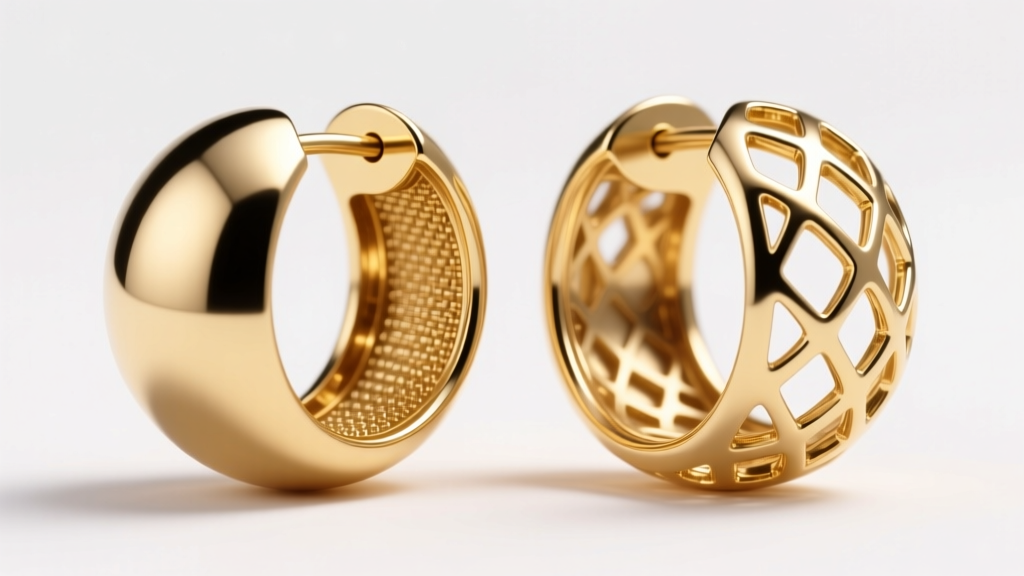
To combat the cubic weight penalty, expert jewelers utilize electroforming. This process allows for the creation of hollow, lightweight spheres that maintain the exact exterior dimensions of a solid ball but weigh up to 70% less. When shopping for large ball earrings over 12mm in diameter, always verify whether the piece is solid or hollow. Hollow spheres are highly durable for daily wear but are susceptible to denting if subjected to high-impact compression.
Material Density and Weight Matrix
The choice of metal drastically alters the wearability of oversized spherical earrings. The Gemological Institute of America (GIA) outlines the varying densities of precious metal alloys, which directly dictate the final mass of the jewelry. Below is a technical matrix comparing the estimated weights of a 14mm diameter ball across different materials and construction methods.
| Material (Alloy) | Density (g/cm³) | 14mm Solid Weight | 14mm Hollow Weight | Lobe Safety Rating |
|---|---|---|---|---|
| Grade 23 Titanium (Ti-6Al-4V) | 4.43 | 6.3g | 2.1g | Excellent |
| 14k Yellow Gold (58.5%) | 13.5 | 19.2g | 6.4g | Poor (Solid) / Good (Hollow) |
| 18k Yellow Gold (75%) | 15.6 | 22.3g | 7.4g | Poor (Solid) / Fair (Hollow) |
| 316L Surgical Stainless Steel | 8.0 | 11.4g | 3.8g | Fair (Solid) / Excellent (Hollow) |
| Tungsten Carbide | 15.6 | 22.3g | N/A (Too brittle) | Unsafe for Lobes |
As the data illustrates, titanium and surgical steel are vastly superior for solid large ball earrings. If a client insists on 18k gold, hollow electroforming or a thin spun-metal shell is an absolute requirement to prevent the 'cheese-cutter' effect on the earlobe.
Post Metallurgy and Shear Strength
The most common point of catastrophic failure in large ball earrings is the post. The post acts as a cantilever beam, with the earlobe serving as the fulcrum. The heavy spherical mass creates a bending moment that can easily warp standard jewelry wire.
Gauge Thickness Requirements
Standard fashion earrings typically use 20-gauge (0.81mm) or 18-gauge (1.02mm) posts. These are structurally insufficient for spheres larger than 10mm. The shear stress exerted by a swinging 15-gram ball will permanently bend a 20-gauge post within weeks of active wear. For large ball earrings, the following gauge minimums must be adhered to:
- 10mm to 12mm diameter: Minimum 18-gauge (1.02mm) hardened steel or 14k gold.
- 12mm to 16mm diameter: Minimum 16-gauge (1.29mm) to resist lateral bending.
- Over 16mm diameter: Minimum 14-gauge (1.63mm) or a specialized structural post with a reinforced solder joint at the base.
Expert Insight: Always check the solder joint where the post meets the sphere. In poorly manufactured large ball earrings, the post is simply soldered to the curved exterior, creating a weak point. High-end manufacturing involves drilling a micro-hole into the sphere, inserting the post, and soldering from the inside or using a laser welder for deep penetration.
Advanced Backing Systems and Load Distribution
The backing mechanism is just as critical as the post. A standard butterfly friction back concentrates the entire downward force of the earring onto two tiny metal loops, which dig into the posterior earlobe and cause necrosis or discomfort. To properly support large ball earrings, the load must be distributed across a wider surface area.
Recommended Backing Mechanisms
1. Flat Disc Backs (6mm - 8mm): These provide a flush, wide surface area that distributes the weight evenly across the back of the lobe. They are ideal for heavy studs and prevent the earring from drooping forward.
2. La Pousette (Locking) Backs: Originally designed for high-value diamond studs, La Pousette backs feature a dual-spring locking mechanism that grips the post notch securely. While they don't inherently solve the weight distribution issue, they completely eliminate the risk of the heavy ball pulling off the post and being lost.
3. Silicone O-Rings with Disc Washers: A highly effective, low-cost solution. Placing a medical-grade silicone washer between the metal disc back and the earlobe adds friction and cushioning, preventing the heavy sphere from rotating and drooping.
Cartilage vs. Lobe Placement Dynamics
When styling large ball earrings, the anatomical placement dictates the required jewelry architecture. The earlobe is composed of soft, pliable tissue that can accommodate the pendulum swing of a heavy stud. Cartilage, however, is rigid and highly prone to pressure necrosis and migration.
The Helix and Tragus Problem
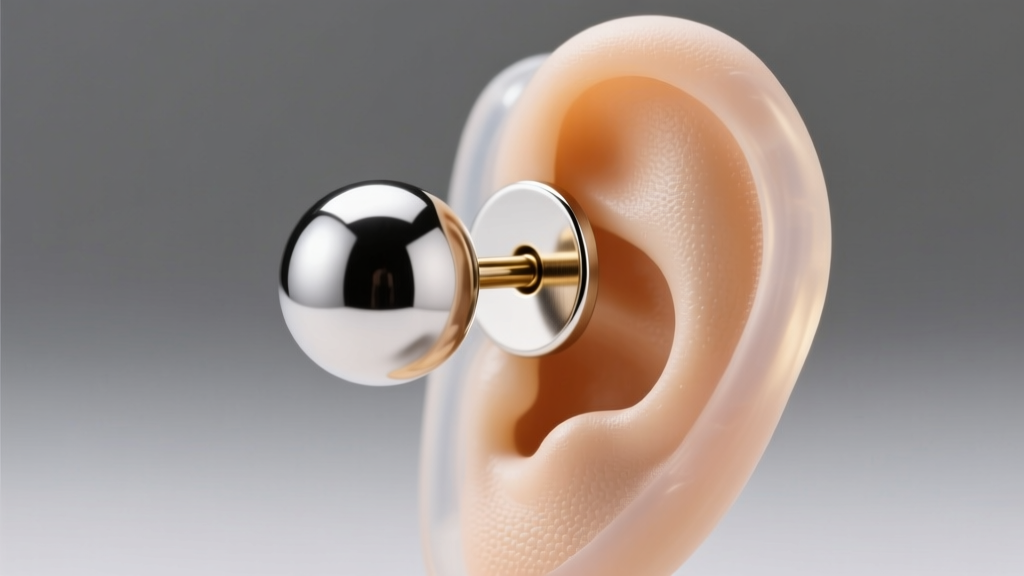
Placing a heavy, standard-post large ball earring in the upper helix or tragus is a technical error. The weight of the ball will pull the post downward, angling the jewelry inside the piercing channel. This creates uneven pressure on the fistula, leading to irritation bumps and eventual rejection. For cartilage placements, large ball earrings must be mounted on flat-back labret posts (typically 16-gauge or 14-gauge) that are internally threaded or threadless. The flat base of the labret rests flush against the back of the cartilage, providing a stable, perpendicular anchor that neutralizes the gravitational pull of the sphere.
Expert Troubleshooting Guide
Even with precise engineering, wearers of large ball earrings may encounter ergonomic issues. Below is a diagnostic framework for resolving common complaints.
- Issue: The earring constantly droops forward.
Diagnosis: The center of gravity of the sphere is too far forward relative to the post placement, or the backing is too small.
Solution: Switch to an 8mm flat disc back or add a silicone support pad. If the post is soldered too low on the sphere, the piece is fundamentally flawed and cannot be corrected without custom jewelry modification. - Issue: The post bends when inserting the backing.
Diagnosis: The gauge is too thin (likely 20g) for the user's piercing channel resistance, or the metal is dead-soft (pure 24k gold or low-carat annealed gold).
Solution: Upgrade to a 16-gauge post in a work-hardened alloy like 14k nickel-free white gold or Grade 5 Titanium. - Issue: The earlobe feels bruised after 4 hours of wear.
Diagnosis: The total mass exceeds the tissue's load-bearing capacity, causing localized ischemia (restricted blood flow).
Solution: Restrict wear time to under 3 hours, or commission a jeweler to hollow out the sphere via electroforming to reduce the mass below the 8-gram threshold.
Understanding the intersection of geometry, metallurgy, and human anatomy transforms large ball earrings from a cumbersome novelty into a masterclass of wearable engineering. By prioritizing correct gauge thicknesses, appropriate material densities, and load-distributing backings, you can confidently wear oversized spherical silhouettes without compromising the structural integrity of your piercings.


