Safe Earrings Newborn Piercings Require: A Parent's Guide
Discover the safest earrings newborn babies can wear. Learn about implant-grade titanium, flat-back labrets, gauge sizes, and healing aftercare.


The Reality of Infant Ear Piercing: Timing and Anatomy
When parents begin searching for safe earrings newborn babies can wear, they are often met with conflicting advice from family traditions, pediatricians, and jewelry retailers. As of 2026, the consensus among modern pediatric dermatologists and certified body piercers is clear: safety is dictated by anatomy, material science, and jewelry mechanics, not just the age of the child. While some cultural practices dictate piercing within the first few weeks of life, medical professionals generally recommend waiting until the infant has received their first series of tetanus vaccinations, typically around two to four months of age. This ensures the baby's immune system is better equipped to handle the localized trauma of a piercing.
Furthermore, infant earlobes are incredibly soft, vascular, and prone to rapid swelling. The anatomy of a newborn's ear is still developing, meaning a piercing placed too high or too close to the edge of the lobe can migrate or reject as the child grows. A professional, needle-based piercing performed by a certified specialist ensures precise placement that accounts for the natural growth trajectory of the earlobe, avoiding the blunt-force tissue trauma caused by spring-loaded piercing guns commonly found in mall kiosks.
Material Science: Why 'Hypoallergenic' is a Marketing Trap
The most critical mistake parents make is trusting the term 'hypoallergenic.' In the jewelry industry, this term is largely unregulated and often applied to metals that still contain high levels of nickel, the most common culprit for allergic contact dermatitis. When selecting earrings for a newborn, you must look for specific metallurgical standards rather than marketing buzzwords.
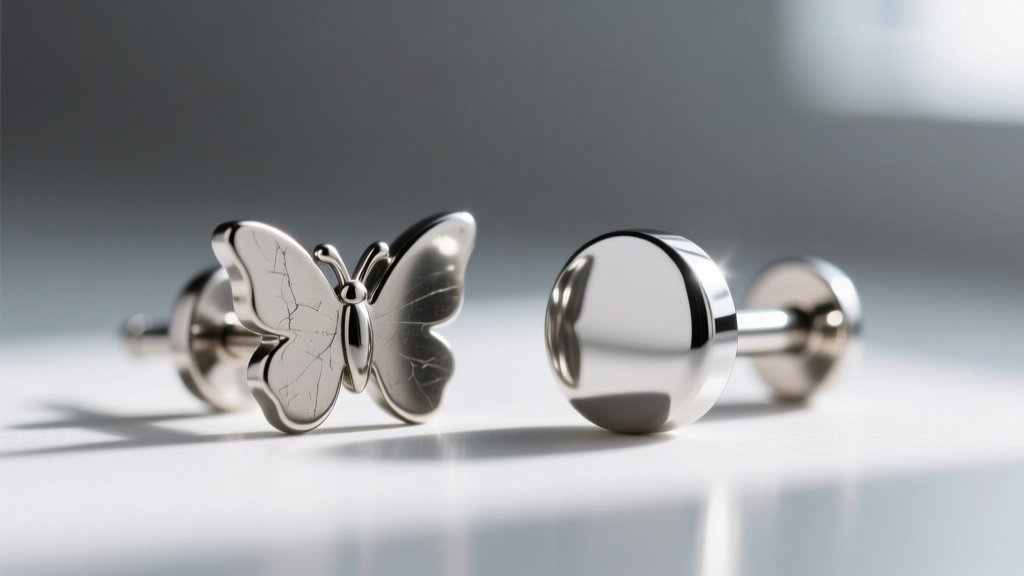
According to the Association of Professional Piercers (APP), the only metals suitable for initial infant piercings are implant-grade titanium and specific karats of solid gold. 'Surgical steel' (often 316L stainless steel) contains up to 10% nickel and should never be used in a fresh, unhealed wound, especially on an infant's highly reactive skin.
| Material | Safety Grade | Nickel Content | Verdict for Newborns |
|---|---|---|---|
| Implant-Grade Titanium (ASTM F-136) | Excellent | 0% | The absolute gold standard; lightweight and biocompatible. |
| Solid 14k or 18k Gold (Nickel-Free Alloy) | Very Good | 0% (if properly alloyed) | Safe, but must be verified as nickel-free and cadmium-free. |
| 'Surgical' Stainless Steel (316L) | Poor | 8% - 10% | High risk of allergic reaction; avoid for fresh piercings. |
| Sterling Silver (925) | Dangerous | Varies | Tarnishes easily, harbors bacteria, and causes argyria (skin staining). |
| Gold-Plated or Filled | Dangerous | Unknown | The plating will wear off, exposing the baby to base metals. |
The Only Safe Style: Threadless Flat-Back Labrets
If you take away one rule from this guide, let it be this: never put a traditional butterfly-back earring on a newborn. Traditional friction-post earrings feature sharp, jagged clasps that harbor bacteria, scratch the delicate skin behind the baby's ear, and pose a severe choking and aspiration hazard if the clasp loosens in the crib.
Instead, the professional standard for infant earrings is the threadless or internally threaded flat-back labret. These earrings feature a smooth, flat disc that sits flush against the back of the earlobe, eliminating pressure points and completely removing the choking hazard. The decorative front snaps securely into the hollow post using a slight bend in the pin, creating a friction lock that a baby cannot pull out, yet a piercer can safely remove.

Gauge and Length Specifications
Commercial baby earrings are often 20-gauge or 22-gauge (0.8mm to 0.6mm). These wires are dangerously thin; if the baby sleeps on the ear or tugs at it, the thin wire can slice right through the soft lobe, a phenomenon known as the 'cheese-cutter effect.' Professional piercers use 18-gauge (1.0mm) or 16-gauge (1.2mm) posts to provide structural stability and prevent migration.
Post length is equally vital. An infant's lobe will swell significantly in the first two weeks. A piercer will typically start with a 3/16-inch (5mm) or 1/4-inch (6mm) post to accommodate this swelling. Once the swelling subsides (usually around week four), you must return to the piercer to 'downsize' to a shorter post (typically 5/32-inch or 4mm) so the jewelry sits flush and does not catch on blankets or clothing.
Aftercare: Sterile Saline and the 'Leave It Alone' Method
Outdated aftercare methods involving twisting the earring, applying rubbing alcohol, or using antibiotic ointments are actively harmful to a healing newborn piercing. Twisting tears the fragile fistula (the healing tissue tube), while alcohol and ointments disrupt the cellular healing process and trap bacteria.
The modern medical consensus, supported by the NHS guidelines on infant care, emphasizes a minimalist approach to wound healing. Keep the area clean, dry, and completely undisturbed.
- Cleaning Solution: Use only sterile, canned 0.9% sodium chloride wound wash with no additives or preservatives.
- Frequency: Spray gently on the front and back of the lobe once or twice a day.
- Drying: Gently dry the area using a hairdryer on the 'cool' setting or by lightly patting with disposable, non-woven gauze. Avoid cotton swabs or cotton balls, as the fibers can wrap around the post and cause severe irritation.
- Bathing: Avoid submerging the baby's head in bathwater. Use a damp cloth to wash the face and hair, keeping the earlobes dry.
Troubleshooting: Infection vs. Irritation vs. Embedding
Parents often panic at the first sign of redness, but it is crucial to distinguish between normal healing, irritation, and true medical emergencies.
1. Embedding (A Medical Urgency)
If the flat back of the earring disappears into the skin of the earlobe, this is called embedding. It happens when the initial post is too short for the baby's swelling, or if the baby sleeps exclusively on one side. Action: Take the baby to a professional piercer or pediatric urgent care immediately to have the jewelry removed or swapped for a longer post. Do not wait, as the skin can heal completely over the metal within hours, requiring a surgical incision.
2. Irritation Bumps
A small, flesh-colored or red bump near the piercing hole is usually an irritation bump caused by the baby sleeping on the ear, snagging the jewelry on a towel, or using a post that is too long after swelling has subsided. Action: Apply a sterile, warm saline compress for three minutes a day and ensure the baby sleeps on their back or on the opposite side using a travel pillow to keep the ear elevated.
3. True Infection
Signs of a true bacterial infection include the lobe being hot to the touch, radiating red streaks, thick green or foul-smelling pus, and the baby running a fever or exhibiting extreme lethargy. Action: Do not remove the jewelry (which can trap the infection inside an abscess). Contact your pediatrician immediately for a course of infant-safe oral antibiotics.
Sourcing Safe Jewelry: What to Expect in 2026
High-quality, infant-safe jewelry is an investment in your child's health. Expect to pay between $40 and $90 for a single implant-grade titanium flat-back labret with a simple synthetic opal or bezel-set gemstone from reputable brands like Neometal or Intrinsic Body. If you prefer solid 14k or 18k gold from premium manufacturers like BVLA or Maria Tash, prices will range from $120 to over $300 per piece. Always purchase directly from a certified professional piercer or the manufacturer's official storefront to guarantee the metallurgical integrity of the jewelry. By prioritizing implant-grade materials, proper gauge sizing, and flat-back mechanics, you ensure your baby's first piercing is a safe, beautiful, and stress-free milestone.


