Material Guide to Large Earring Backs for Heavy Jewelry
Discover the best materials for large earring backs. Compare silicone, titanium, and gold to prevent sagging and support heavy statement jewelry.

The Physics of Heavy Earrings: Why Material Matters
When you wear statement jewelry, the piercing fistula acts as a fulcrum. A heavy chandelier or oversized drop earring—often weighing between 15 and 30 grams—creates significant rotational torque. This lever effect pulls the top of the earring post forward while driving the earring back aggressively into the posterior earlobe. Standard 5mm butterfly backs fail under this stress because they concentrate the pressure into a tiny surface area, leading to ischemia (restricted blood flow), discomfort, and eventual lobe tearing.
To counteract this, jewelers and stylists rely on large earring backs (typically 10mm to 15mm in diameter) to distribute the mechanical load across a wider area of the earlobe. However, surface area is only half the equation. The material composition of the back dictates its friction coefficient, tensile strength, and biocompatibility. As of 2026, understanding the metallurgical and polymer properties of these backs is essential for anyone wearing or designing heavy jewelry.
Material Breakdown: Friction, Tensile Strength, and Biocompatibility
Medical-Grade Silicone & Advanced Polyurethane
Silicone remains the most popular material for jumbo earring clutches due to its exceptional coefficient of friction (typically around 0.8 against skin and metal). This high grip prevents the earring from rotating or sliding down the post. For heavy earrings, a silicone back with a Shore A hardness rating of 40 to 50 is ideal; it is firm enough to resist deformation under weight but soft enough to cushion the earlobe.
However, traditional silicone is micro-porous and absorbs sebum and sweat over time, which can degrade the material and cause odor. In 2026, high-end jewelry manufacturers are increasingly shifting toward medical-grade polyurethane blends. These advanced polymers offer the same cushioning and grip as silicone but are entirely non-porous, resisting oil degradation and maintaining their structural integrity for years.
Implant-Grade Titanium (ASTM F136)
For those with metal sensitivities or those seeking a permanent, durable solution, implant-grade titanium (specifically ASTM F136) is the gold standard. According to the Association of Professional Piercers (APP), this specific alloy is highly biocompatible and entirely nickel-free. Titanium large earring backs are usually machined as wide, flat discs or mechanical locking sleeves (such as La Pousette backs).
Because titanium has a naturally low friction coefficient against gold or steel posts, it cannot rely on surface grip alone. Instead, titanium backs utilize mechanical tension—often featuring an internal PTFE (Teflon) O-ring or a precision-machined internal clutch that snaps into a groove on the earring post, providing a secure, weight-bearing lock that will never stretch out.
14k/18k Solid Gold & Platinum
Precious metal large earring backs offer unparalleled luxury and longevity, but they require careful engineering. 18k gold is significantly softer and more malleable than 14k gold. If a wide 14mm gold disc is stamped too thinly, the torque from a heavy drop earring will permanently warp the disc, ruining the friction fit.
To function properly, solid gold large earring backs must have a minimum thickness of 0.8mm to 1.0mm. Many premium jewelers now reinforce the internal sleeve of gold backs with a titanium or surgical steel core, combining the hypoallergenic exterior of gold with the structural rigidity of harder metals.
Comparative Data: Weight Support and Friction Coefficients
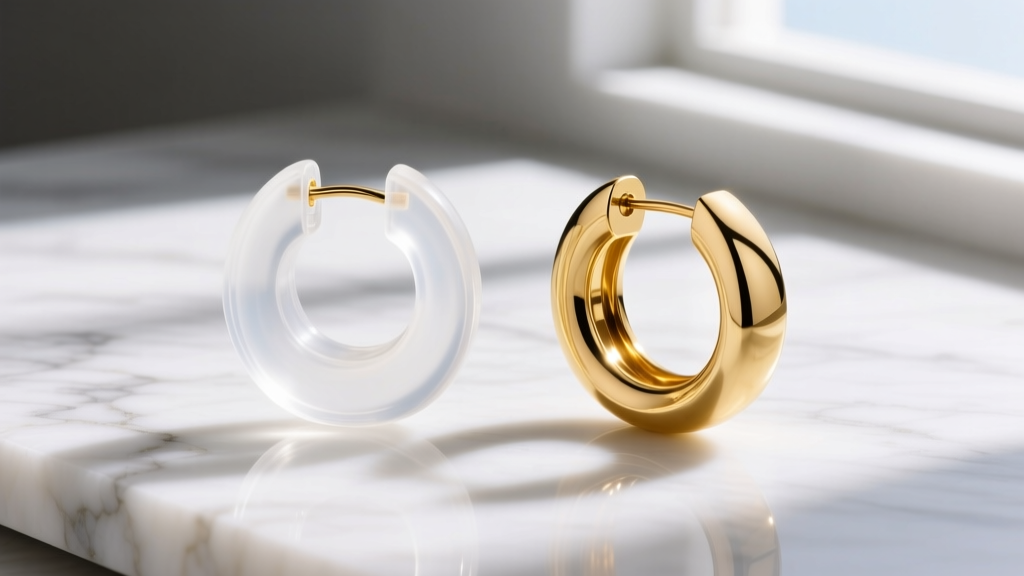
Choosing the right material requires matching the physical properties of the back to the weight and style of the earring. The table below outlines the performance metrics of the most common materials used for large earring backs.
| Material | Shore Hardness / Gauge | Max Recommended Load | Grip Mechanism | Est. Cost per Pair |
|---|---|---|---|---|
| Medical-Grade Silicone | Shore A 40-50 | 15 - 20 grams | Surface Friction | $2 - $8 |
| Polyurethane Blend | Shore A 55-60 | 20 - 25 grams | Surface Friction | $10 - $18 |
| ASTM F136 Titanium | N/A (Metal) | 30+ grams | Mechanical Lock / O-Ring | $25 - $60 |
| 14k Solid Gold (Reinforced) | N/A (Metal) | 25 - 30 grams | Friction Sleeve + Core | $80 - $150+ |
Failure Modes: When Large Earring Backs Slip or Bend
Even the best materials will fail if the physical dimensions are mismatched. The most common failure mode for heavy earrings is a gauge mismatch between the post and the back. Standard fashion earrings typically use 20-gauge (0.81mm) posts, while heavier or custom pieces may use 18-gauge (1.02mm) or even 16-gauge (1.29mm) posts.
If you force an 18-gauge post into a silicone back designed for a 20-gauge post, you will permanently stretch the internal polymer sleeve. The next time you use that back, it will slide right off. Conversely, if a heavy earring has a thin 20-gauge post, the post itself will bend under the weight of a 25-gram chandelier before the large earring back ever fails. For heavy jewelry, always ensure the earring post is at least 18-gauge and that the back's internal sleeve is manufactured to that exact tolerance.
Dermatological Considerations for Wide Surface Areas
While large earring backs are excellent for weight distribution, their wide surface area introduces a new variable: moisture trapping. A 14mm disc covers a significant portion of the posterior earlobe, restricting airflow. According to dermatological studies on contact dermatitis and jewelry allergies, trapped sweat, dead skin cells, and heat can create an environment conducive to bacterial or fungal growth, leading to localized irritation.
To mitigate this, experts recommend large earring backs that feature ventilation channels or a slightly concave interior design. Concave backs create a micro-gap between the metal or silicone and the skin, allowing the earlobe to breathe while still providing the necessary structural support at the edges of the disc.
Expert Framework: Matching the Back to the Earring Style
To optimize both comfort and security, use this decision framework when selecting large earring backs for specific jewelry styles:
- Chandelier & Multi-Tiered Drops: These earrings swing and shift, creating dynamic torque. Use jumbo polyurethane or silicone clutches (12mm-15mm). The high surface friction will absorb the kinetic energy of the swinging earring, preventing the post from rotating and drooping forward.
- Heavy Solid Metal Studs & Geometric Blocks: These pieces do not swing but exert a constant, heavy downward pull. Use titanum mechanical locking backs. The rigid metal-to-metal lock will support the static weight indefinitely without degrading or stretching over time.
- Oversized Thick Hoops: Hoops require the back to sit flush against the lobe to maintain a perfect circle. Use wide-disc 14k gold backs with a reinforced core. The flat, rigid surface keeps the hoop perfectly vertical, while the precious metal prevents any allergic reactions in the sensitive post-auricular fold.
Care and Maintenance for Longevity
The lifespan of your large earring backs depends entirely on your cleaning protocols. Silicone and polyurethane backs should be removed from the posts weekly and washed with warm water and a mild, fragrance-free antibacterial soap. Avoid soaking silicone in rubbing alcohol, as prolonged exposure can dry out the polymers and cause micro-cracking.
For titanium and gold mechanical backs, use an ultrasonic jewelry cleaner or a soft brush with mild dish soap to clear sebum and dead skin from the internal locking mechanisms. A buildup of debris inside a titanium O-ring sleeve will compromise the mechanical lock, causing the heavy earring to slip unexpectedly. By matching the correct material to your jewelry's weight and maintaining a strict cleaning routine, you can wear heavy statement pieces comfortably and securely all day.


