Male Celebrities With Earrings: 2026 Technical Style Guide
Discover the exact gauge sizes, materials, and styles of male celebrities with earrings in 2026. A technical deep dive into A-list ear curation.

The Evolution of Men's Ear Curation in Hollywood
The landscape of men's jewelry has undergone a radical transformation over the last decade. When analyzing the styling choices of male celebrities with earrings on the 2026 red carpet, we no longer see the solitary, generic diamond stud of the early 2000s. Today, A-list actors, musicians, and fashion icons are embracing anatomically precise, highly curated ear setups that rival high-end feminine jewelry in both complexity and technical execution. However, replicating these looks requires more than just buying a similar design; it demands a strict understanding of gauge sizing, metallurgical grades, and threading mechanisms. This expert deep dive deconstructs the exact technical specifications behind the most iconic men's earring trends of the year, providing actionable data for jewelers, piercers, and enthusiasts.
Deconstructing the Looks: Gauge, Material, and Threading
To understand how celebrities maintain healthy, aesthetically pleasing piercings while wearing heavy or intricate jewelry, we must break down the three dominant archetypes currently dominating the cultural zeitgeist.
The Pearl & Gemstone Drop (The Mescal-Styles Archetype)
Popularized by actors like Paul Mescal and Harry Styles, the single pearl or gemstone drop earring has become a staple of modern masculine elegance. From a technical standpoint, the failure point for this style is usually the post thickness. Many commercial brands sell these drops on 20-gauge (0.81mm) or 22-gauge (0.64mm) wires. When a heavy 8mm Akoya pearl or a 2-carat bezel-set diamond is suspended on a wire this thin, the 'cheese-cutter effect' occurs, where the thin metal slowly migrates through the earlobe tissue due to gravity and kinetic movement. The celebrity standard is to utilize a 16-gauge (1.2mm) or 14-gauge (1.6mm) threadless pin, ensuring the lobe remains structurally supported while holding the drop end via tension.
The Heavy Signet & Textured Hoop (The Rocky-Bad Bunny Archetype)
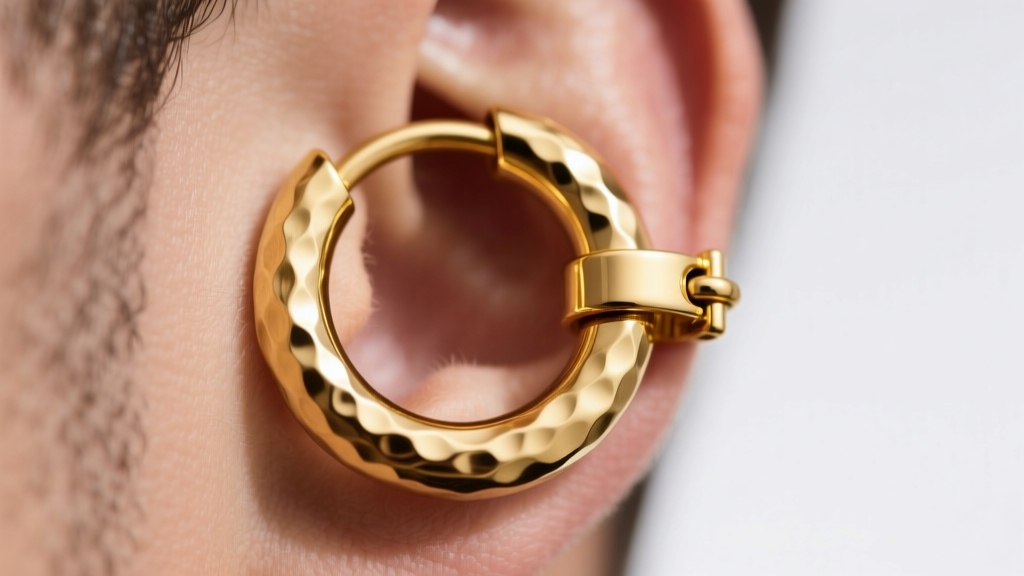
Artists like A$AP Rocky and Bad Bunny frequently sport thick, heavy gold hoops and signet-style huggies. The technical secret to wearing these comfortably lies in the diameter-to-gauge ratio and the closure mechanism. Continuous rings (where the wire loops into a hollow tube) are notoriously difficult to secure and prone to warping. Instead, high-end celebrity setups utilize segment rings or hinged clickers with a locking latch. For hoops exceeding 15mm in diameter and 3mm in thickness, a minimum of 12-gauge (2.0mm) is required to prevent the jewelry from pulling the piercing channel downward, which causes irreversible tissue thinning.
The Minimalist Threadless Cartilage Stack (The Elordi Archetype)
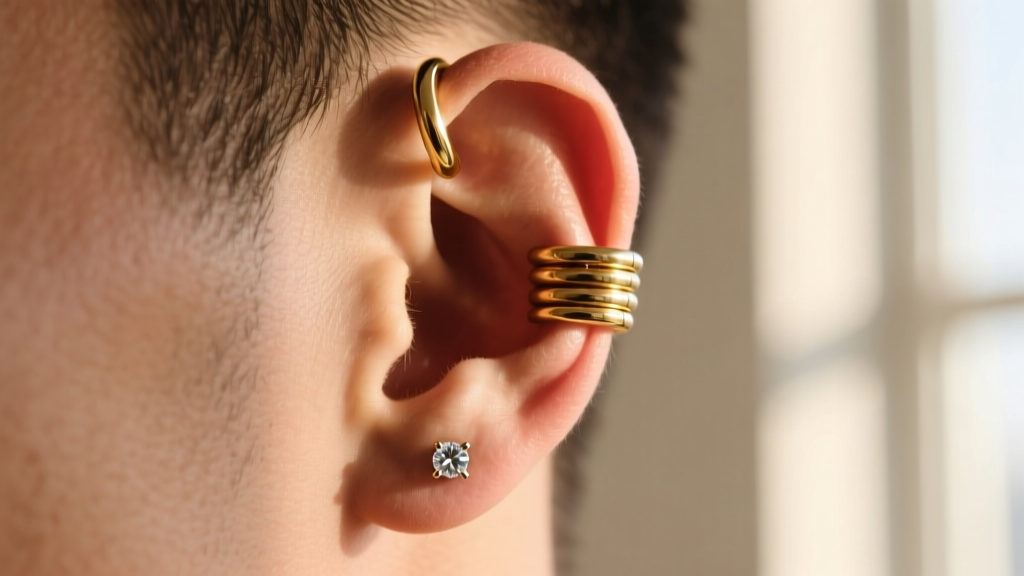
Jacob Elordi and Timothée Chalamet have popularized the subtle, multi-piercing cartilage stack, featuring flat-back labrets with microscopic diamond or sapphire ends. The critical technical component here is the use of threadless (press-fit) jewelry. Externally threaded jewelry—where the screw is on the post—acts like a file, tearing the delicate fistula of the cartilage upon every insertion. Celebrity piercers exclusively use internally threaded or threadless titanium posts, where the pin features a slight bend that creates tension against the inside of the receiving tube, securing the end without any screwing mechanism.
Technical Specifications Table: Replicating Celebrity Piercings
The following matrix outlines the exact specifications required to safely replicate the most requested men's celebrity earring styles in 2026.
| Style Archetype | Primary Placement | Optimal Gauge | Material Grade | Threading Type | Est. Price Range (USD) |
|---|---|---|---|---|---|
| Pearl Drop | Standard Lobe | 16g (1.2mm) | 14k/18k Solid Gold | Threadless Pin | $250 - $600 |
| Heavy Huggie Hoop | Standard Lobe | 12g (2.0mm) | 14k Solid Gold | Hinged Clicker | $400 - $1,200 |
| Diamond Cartilage Stack | Helix / Flat | 16g (1.2mm) | ASTM F136 Titanium | Threadless | $150 - $450 per piece |
| Signet Dangle | Lobe / Stretch | 10g (2.4mm) | 18k Solid Gold | Internally Threaded | $800 - $2,500 |
| Industrial Bar | Helix to Helix | 14g (1.6mm) | ASTM F136 Titanium | Internally Threaded | $120 - $300 |
Material Science: Why Celebrities Avoid Surgical Steel
A common misconception among consumers is that 'surgical steel' is the gold standard for body jewelry. In reality, the term is a marketing misnomer. Most commercial steel jewelry is made from 316L stainless steel, which contains up to 10% nickel. Nickel is a highly reactive allergen that causes contact dermatitis, leading to swelling, weeping, and the eventual rejection of the piercing. When you look closely at the ears of male celebrities with earrings, you are almost exclusively looking at two materials:
- Implant-Grade Titanium (ASTM F136): This specific alloy contains zero nickel and is highly biocompatible. It is the undisputed standard for fresh piercings and cartilage stacks due to its lightweight nature and hypoallergenic properties.
- Nickel-Free 14k/18k Gold: While gold is a classic choice, it must be alloyed correctly. High-end jewelers use palladium or silver as alloying metals instead of nickel to maintain the karat weight without introducing allergens. The Gemological Institute of America (GIA) frequently notes the importance of verifying alloy compositions in body jewelry to prevent heavy metal toxicity and allergic reactions.
The Association of Professional Piercers (APP) strictly advises against 316L steel for initial piercings and long-term wear in sensitive cartilage zones, a guideline that top-tier celebrity piercers follow religiously.
Placement and Anatomy: The Celebrity Ear Map
The aesthetic success of a cartilage stack relies entirely on the angle of the initial piercing. A helix piercing that is angled too far forward will cause a hoop to flare outward awkwardly, while an angle that is too far back will cause the jewelry to press into the scalp. Expert piercers map the ear using a surgical marker, ensuring that the entry and exit points are perfectly perpendicular to the plane of the ear. For conch piercings—a favorite for adding a central diamond stud to a male ear stack—the angle must be calculated based on whether the client intends to wear a flat-back stud or a conch hoop, as the required trajectory differs by up to 25 degrees.
The Importance of Post Length and Downsizing
Cartilage piercings swell significantly during the first 4 to 8 weeks of healing. Celebrity piercers initially use long posts (e.g., 8mm to 10mm) to accommodate this swelling. However, leaving a long post in after the swelling subsides creates a lever effect; if the jewelry is bumped, the long post multiplies the force applied to the fistula, causing irritation bumps (hypertrophic scarring). The mandatory technical step is 'downsizing'—returning to the piercer after 6 weeks to swap the post for a snug 5mm or 6mm flat-back labret.
Sourcing and Aftercare for High-End Men's Jewelry
Replicating the exact looks seen on red carpets requires sourcing from specialized body jewelry manufacturers rather than traditional fashion brands. Companies like BVLA (Body Vision Los Angeles), Anatometal, and Maria Tash are the industry standard for celebrity piercers. These brands machine their jewelry to a mirror finish, eliminating microscopic scratches where bacteria can harbor. Furthermore, their threadless ends are precision-cut to ensure a perfect snap-fit that will not loosen during sleep or physical activity.
For aftercare, the 2026 consensus has moved entirely away from harsh chemicals like tea tree oil, alcohol, or hydrogen peroxide, which destroy the delicate epithelial cells lining the piercing channel. The only recommended aftercare protocol is the application of sterile 0.9% sodium chloride wound wash, sprayed twice daily and gently dried with non-woven gauze. By combining the precise gauge sizing, ASTM F136 materials, and threadless engineering utilized by male celebrities with earrings, anyone can build a sophisticated, healthy, and red-carpet-ready ear curation.


