Medusa Earrings: Engineering Serpentine Ear Cuffs & Gorgon Motifs
Explore the technical engineering of Medusa earrings, from serpentine ear cuff tension mechanics to Gorgon motif casting and cartilage sizing.

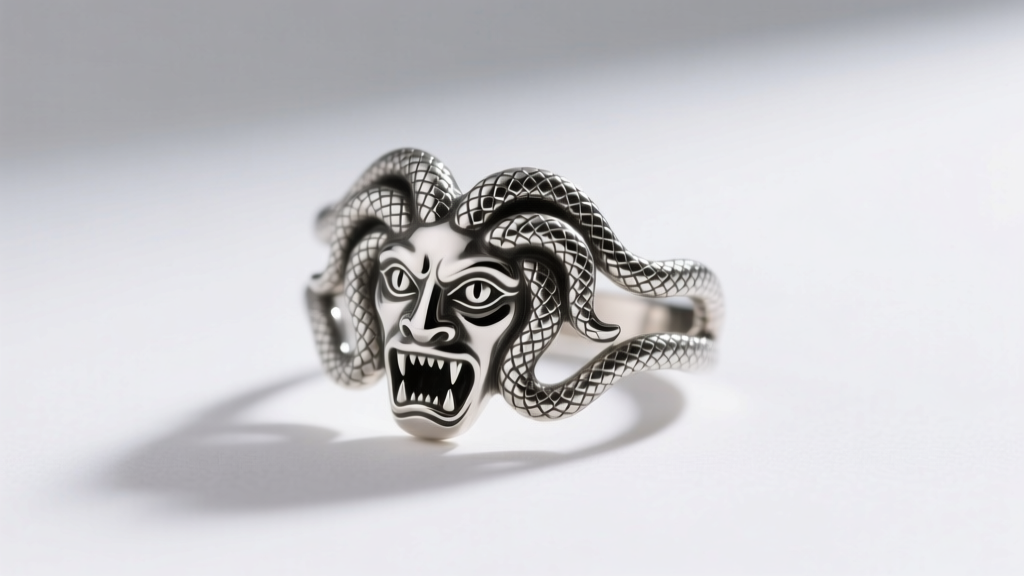
When jewelry enthusiasts and piercing professionals discuss "Medusa earrings," a common anatomical confusion arises. In the piercing world, a Medusa refers strictly to a philtrum (upper lip) piercing. However, within the specialized domain of ear adornment, Medusa earrings represent a highly technical category of serpentine ear cuffs, Gorgon-motif cartilage pieces, and multi-anchor ear-scapades that mimic a nest of vipers wrapping around the ear's natural ridges. Designing and wearing these pieces requires a deep understanding of metallurgy, tension physics, and cartilage anatomy.
This expert guide deconstructs the engineering behind Medusa earrings, exploring how jewelers achieve micro-detail in snake scales, how different alloys affect cuff tension, and how to properly anchor these heavy, intricate pieces to the ear without causing tissue damage.
The Anatomy of Medusa Ear-Scapades
Unlike standard huggies or simple helix studs, a true Medusa ear-scape is a structural marvel. It typically features a primary anchor point—often a Gorgon face or a coiled viper head—that secures into a mid-helix or conch piercing. From this anchor, the "snakes" (articulated or cast metal arms) extend outward, wrapping around the auricle's folds (the scapha and antihelix) and terminating in a tension-based ear cuff on the outer helix rim.
The primary challenge in designing these pieces is weight distribution. A solid cast sterling silver Medusa ear-scape can easily weigh between 8 to 14 grams. If the center of gravity is not perfectly aligned with the primary piercing anchor, the earring will droop, causing the post to tilt inside the fistula (the piercing channel), leading to irritation bumps and cartilage fatigue.
Metallurgy and Casting: Forging the Gorgon
Creating the intricate overlapping scales and serpentine textures of a Medusa motif requires advanced casting techniques. As of 2026, the industry has largely bifurcated into two production methods: traditional lost-wax casting and high-resolution 3D resin printing.
Lost-Wax Casting vs. 3D Resin Printing
Historically, jewelers carved the Medusa motif in jeweler's wax, which was then encased in investment plaster and burned out in a kiln. Molten metal was injected into the void. However, capturing the micro-texture of individual snake scales (often less than 0.5mm wide) in wax is incredibly difficult. Modern manufacturers now use 8K resolution DLP (Digital Light Processing) 3D printers to create castable resin masters. These resins burn out cleanly at 750°C, leaving zero ash residue and capturing scale textures with micron-level precision.
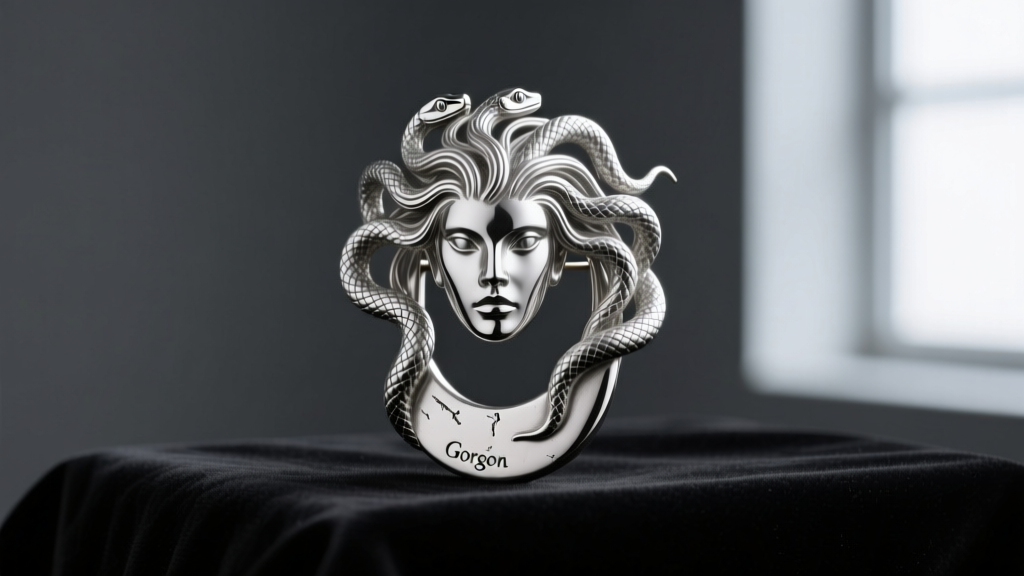
During the casting of sterling silver (92.5% silver, 7.5% copper), jewelers must account for a volumetric shrinkage rate of approximately 1.2% to 1.5%. If the CAD model is not scaled up to compensate for this shrinkage, the final Medusa ear cuff will be too small to fit the average helix rim, which typically measures between 2.5mm and 4.0mm in thickness.
The Physics of Serpentine Ear Cuffs: Tension and Fit
The terminal end of a Medusa earring usually relies on an ear cuff mechanism to provide secondary stabilization. The cuff must grip the helix cartilage firmly enough to prevent the heavy Gorgon motif from spinning, but gently enough to avoid cutting off circulation to the ear's peripheral tissue.
The effectiveness of this grip is dictated by the metal's Vickers Hardness (HV) and its yield strength. If a metal is too soft, the cuff will slowly stretch open over time, losing its grip. If it is too hard, it cannot be adjusted to the wearer's specific cartilage thickness and may cause pressure necrosis.
| Material | Vickers Hardness (HV) | Tension Retention | Adjustability |
|---|---|---|---|
| Fine Silver (999) | ~25 HV | Poor (Stretches easily) | High (But loses shape) |
| Sterling Silver (925) | ~65 HV | Moderate | Moderate |
| 14k Yellow Gold | ~135 HV | Excellent | Low (Requires professional sizing) |
| 18k White Gold | ~160 HV | Superior | Very Low (Brittle if over-bent) |
For daily wear, 14k gold offers the optimal balance of yield strength and malleability. Sterling silver Medusa cuffs require periodic professional re-tensioning, as the copper alloy work-hardens and eventually becomes brittle if bent back and forth too many times.
Cartilage Compatibility: Gauges and Piercing Integrations
The anchor point of a Medusa ear-scape is its most critical structural component. Because these pieces are heavy, they must be anchored through fully healed, mature cartilage piercings. According to the Association of Professional Piercers (APP), cartilage jewelry must meet strict biocompatibility and structural standards to prevent migration and rejection.
The Dangers of Butterfly Backs
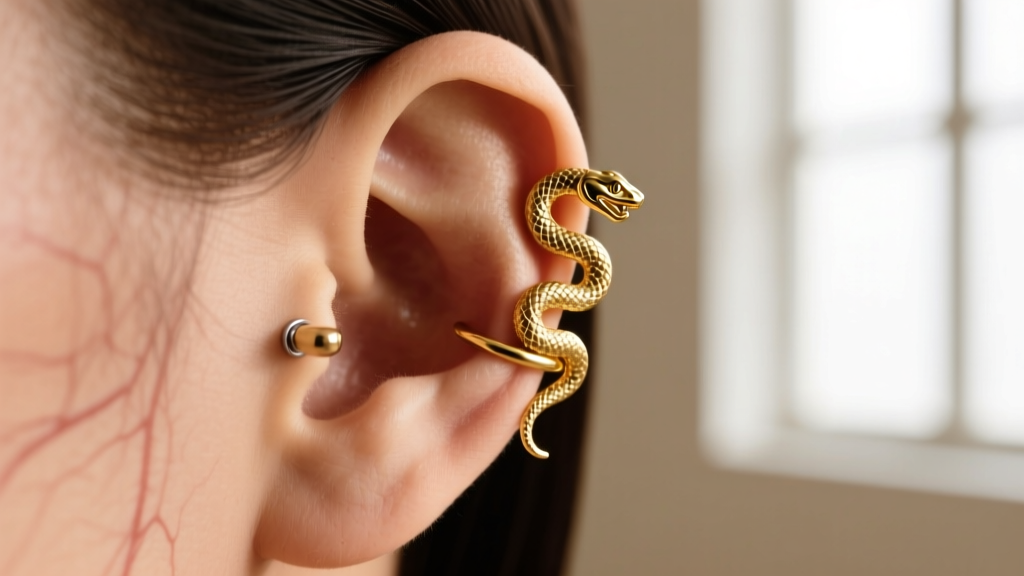
Mass-market Medusa earrings often utilize standard friction-fit "butterfly" backs. This is a critical design flaw for heavy ear-scapades. The small surface area of a butterfly back concentrates the weight of the Gorgon motif into a tiny point on the back of the ear, frequently causing pressure ulcers and localized tissue death. Furthermore, the sharp post ends can scratch the post-auricular skin.
Expert jewelers engineer Medusa anchors using internally threaded or threadless flat-back labret posts. A flat-back disc (typically 4mm to 6mm in diameter) distributes the weight evenly across the back of the helix or conch. The standard gauge for these anchors is 16G (1.2mm) or 14G (1.6mm), which provides the necessary sheer strength to support the metalwork without bending. Using an 18G (1.0mm) or 20G (0.8mm) post for a heavy Medusa motif will almost certainly result in a bent post and a tilted, uncomfortable earring.
Maintenance: Preventing Patina and Tension Fatigue
The intricate nature of Medusa earrings—specifically the deep undercuts between snake scales and the Gorgon's facial features—makes them notorious traps for sebum, dead skin cells, and environmental pollutants. Cleaning these pieces requires specific protocols to avoid damaging the metal or any integrated gemstones (such as micro-pavé tsavorite garnets often used for "snake eyes").
- Avoid Chemical Dips: Liquid silver dips rely on thiourea to strip tarnish (silver sulfide). While they clean the metal instantly, they also strip the intentional oxidation (patina) that jewelers apply to the recesses of the snake scales to create depth and contrast.
- Ultrasonic Caution: While ultrasonic cleaners are excellent for removing sebum from crevices, they can shatter tension-set gemstones or loosen micro-pavé settings if the Medusa earring features stone accents. Limit ultrasonic exposure to under 3 minutes.
- Manual Detailing: Use a soft-bristled baby toothbrush with a mild, phosphate-free dish soap to gently agitate the scale textures. Rinse with distilled water to prevent hard water spots from forming in the micro-crevices.
Expert Sourcing and Price Tiers
When investing in a Medusa ear-scape, understanding the pricing tiers helps differentiate between mass-produced costume jewelry and structurally sound, body-safe art. According to metallurgical standards outlined by the Gemological Institute of America (GIA), the alloy composition directly dictates both the longevity and the biocompatibility of the piece.
Entry-Level ($40 - $90): Typically cast in brass or bronze with a thin silver or gold plating. The ear cuff tension is unreliable, and the anchor posts are often made of surgical steel that may contain nickel. These are suitable for occasional, short-term wear but will cause irritation if worn for more than a few hours.
Mid-Tier ($120 - $350): Solid sterling silver or 14k gold vermeil over a brass core. These pieces feature better CAD-designed scale textures and often utilize flat-back anchors. However, the underlying brass core can cause allergic reactions if the plating wears through at the friction points.
High-End / Bespoke ($500 - $2,500+): Cast in solid 14k or 18k gold, or ASTM F136 implant-grade titanium. These are engineered by specialized body jewelry artisans. The anchor posts are precision-machined, the ear cuffs are hand-tensioned to the client's specific cartilage thickness, and the Gorgon motifs feature hand-engraved scale detailing that cannot be replicated by casting alone.
Ultimately, Medusa earrings represent the pinnacle of structural ear jewelry. By prioritizing flat-back anchors, appropriate metal hardness, and meticulous casting techniques, you can wear a mythological masterpiece on your helix without sacrificing comfort or cartilage health.


