Beginner Guide to Men Hoop Earrings Gold: Sizing and Styles
Discover the ultimate beginner guide to men hoop earrings gold. Learn about 14K vs 18K, gauge sizes, clasp types, and expert styling tips.


Why Gold Hoops Are the Ultimate Starter Earring for Men
The landscape of men's jewelry has shifted dramatically over the last decade, moving from niche subcultures into mainstream sartorial essentials. Among the myriad of options available, men hoop earrings gold remain the undisputed champions of versatility. Whether you are stepping into the world of fine jewelry for the first time or looking to upgrade from basic stainless steel, gold hoops offer a timeless silhouette that bridges the gap between streetwear edge and tailored sophistication.
However, buying your first pair of fine gold hoops can be intimidating. The market is flooded with misleading karat stamps, confusing gauge measurements, and fragile clasp mechanisms that fail within weeks. This comprehensive beginner's guide cuts through the marketing fluff, providing you with the exact metallurgical specs, sizing frameworks, and mechanical insights you need to make a confident, informed purchase in 2026.
Decoding Gold Purity: 14K vs. 18K vs. 24K
One of the most common mistakes beginners make is assuming that a higher karat number automatically equates to a better piece of jewelry. In the context of daily-wear earrings, this is a structural fallacy. Pure gold is incredibly malleable; a hoop made of 24K gold will bend out of shape the first time you sleep on it or catch it on a towel. To create durable jewelry, gold is alloyed with metals like copper, silver, and zinc. According to the Gemological Institute of America (GIA), understanding these alloy ratios is critical for balancing color, durability, and skin sensitivity.
| Karat | Gold Content | Durability & Scratch Resistance | Price Range (Standard 12mm Hoop) | Best Use Case |
|---|---|---|---|---|
| 24K | 99.9% | Very Poor (Bends easily) | $300 - $500+ | Investment pieces, not for daily wear |
| 18K | 75.0% | Good (Rich color, prone to micro-scratches) | $200 - $450 | Special occasions, luxury statement pieces |
| 14K | 58.3% | Excellent (Highly durable, holds shape) | $80 - $250 | Daily wear, active lifestyles, beginners |
| 10K | 41.7% | Superior (Very hard, paler color) | $50 - $120 | Budget-friendly, high-impact environments |
The Expert Verdict: For a beginner purchasing their first pair of men hoop earrings gold, 14K gold is the undisputed sweet spot. It offers the perfect equilibrium of rich yellow hue, structural integrity, and affordability. Furthermore, high-quality 14K gold from reputable jewelers is typically nickel-free, drastically reducing the risk of contact dermatitis.

Getting the Fit Right: Diameter and Gauge Sizes
Sizing is where most online purchases go wrong. Hoop earrings are measured in two distinct dimensions: diameter (the overall size of the circle) and gauge (the thickness of the wire that passes through your ear). Ignoring either metric will result in an uncomfortable fit or a ruined piercing.
Diameter: Choosing Your Silhouette
- 8mm - 10mm (Huggies): Sits tightly against the earlobe. Ideal for a subtle, minimalist look or for secondary lobe piercings.
- 12mm - 15mm (The Standard): The quintessential men's hoop. It clears the earlobe with a small gap, offering noticeable presence without catching on clothing.
- 18mm - 25mm (Statement): Bold and expressive. Best suited for larger earlobes or those leaning heavily into streetwear and hip-hop aesthetics.
Gauge: The Critical Thickness Metric
The Association of Professional Piercers (APP) notes that standard earlobe piercings done with a gun are typically 20G (0.81mm) or 18G (1.0mm), while needle piercings are usually 16G (1.2mm) or 14G (1.6mm).
Crucial Warning: Never force a thicker gauge hoop into a smaller piercing. If your ear is pierced at 18G, buying a 14G hoop will cause micro-tearing, scar tissue buildup (hypertrophy), and severe pain. Always verify your piercing gauge before purchasing. If you prefer the chunky look of a 14G or 12G hoop but have standard 18G piercings, visit a professional piercer to safely stretch the fistula using a sterile taper.
Clasp Mechanisms: Engineering and Failure Modes
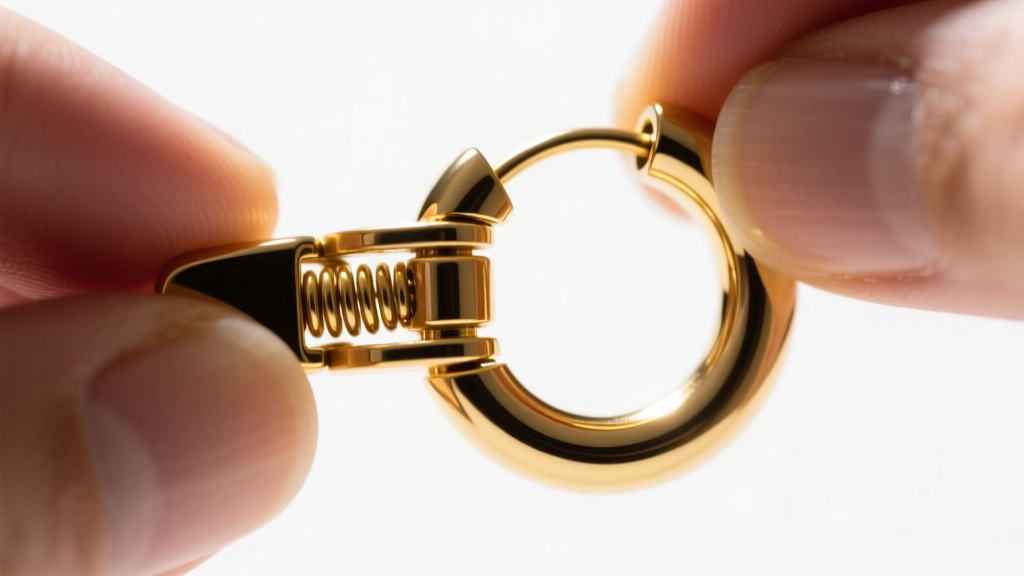
The clasp is the weakest point of any hoop earring. A beautiful 18K gold hoop is useless if the closure mechanism fails and drops it down a city drain. Here is a breakdown of the three primary clasp types you will encounter.
1. Hinged Clicker (The Gold Standard)
Featuring a seamless hinge on one side and a precision-machined snap-lock on the other, the clicker is the most secure option for men. When closed, it emits a satisfying 'click.' Failure Mode: Cheaply manufactured clickers can lose their tension over time, causing the post to slip out of the receiver. Always buy clickers from reputable brands that use high-tension spring alloys inside the receiver.
2. Continuous (Endless) Hoop
This design features a continuous circle of wire where one end is slightly tapered and inserts into the hollow opposite end. Failure Mode: The thin insertion wire is highly prone to bending. If bent, it will never perfectly align with the hollow tube again, rendering the earring unwearable. Furthermore, inserting them requires a level of manual dexterity that frustrates many beginners.
3. Latch-Back / Saddleback
A hinged wire that snaps into a grooved catch on the opposite side. Failure Mode: The external threads or grooved catches can harbor bacteria and dead skin cells. They also feature a visible 'gap' at the closure point, disrupting the seamless visual flow of the hoop.
Styling Framework: Matching Hoops to Your Vibe
Gold hoops are remarkably adaptable, but the specific dimensions you choose should complement your personal style and facial structure. Use this decision matrix to find your ideal pair:
- The Minimalist Professional: Opt for a 10mm to 12mm 14K yellow gold huggie with a polished finish. This pairs seamlessly with tailored suits, knitwear, and smart-casual office attire. The small diameter ensures it won't catch on collars or headphones during commutes.
- The Streetwear Enthusiast: Lean into 15mm to 20mm 14K or 18K hoops, potentially with a brushed or matte finish to reduce glare. Matte gold pairs exceptionally well with heavy cotton hoodies, denim, and silver chain layering (mixing metals is a dominant trend in 2026).
- Face Shape Considerations: If you have a very round face, avoid perfectly circular, thick hoops, as they can exaggerate facial roundness. Instead, opt for a slightly elongated oval hoop or a huggie with a subtle geometric drop. If you have an angular or square jawline, classic round hoops provide a necessary visual softening effect.
Troubleshooting: Why Does Gold Turn Skin Green?
A common beginner complaint is discovering a green or black smudge on the earlobe after wearing gold hoops. This is not an indicator of fake gold; rather, it is a chemical reaction. Pure gold does not oxidize, but the alloys mixed with it (specifically copper in yellow and rose gold) do. When copper alloys react with the natural acids in your sweat, lotions, or environmental humidity, it creates copper chloride, which transfers to the skin.
The Fix: 1. Coat the inside of the hoop's post with a microscopic layer of clear nail polish or jeweler's nano-coating to create a barrier. 2. Clean your earrings weekly with warm water, a drop of mild dish soap, and a soft baby toothbrush to remove acidic sebum buildup. 3. Remove your hoops before swimming in chlorinated pools, as chlorine actively degrades gold alloys and accelerates oxidation.
Final Thoughts on Your First Purchase
Investing in men hoop earrings gold is an exercise in personal branding and material appreciation. By prioritizing 14K gold for its structural resilience, accurately measuring your gauge to protect your piercing health, and selecting a hinged clicker mechanism for ultimate security, you bypass the pitfalls that trap most first-time buyers. Start with a classic 12mm polished yellow gold clicker—it is the most versatile anchor piece in modern men's jewelry, capable of elevating any outfit while standing the test of time.


