Men's Double Earring Piercing: Fixing Healing & Spacing Issues
Troubleshoot your men's double earring piercing with expert advice on healing, spacing corrections, irritation bumps, and the best jewelry grades.


The men's double earring piercing has evolved from a niche subculture statement into a mainstream staple of modern male grooming and style. However, getting two piercings in a single lobe—or managing an existing pair that isn't healing correctly—introduces a unique set of biomechanical and dermatological challenges. When you double the hardware, you double the potential for friction, uneven swelling, and alignment errors.
Whether you are planning to get your second lobe piercing or you are currently battling irritation bumps on an existing pair, this troubleshooting guide dives deep into the exact gauge sizes, spacing metrics, and material grades required to maintain a healthy, sharp-looking double setup.
The Anatomy of a Men's Double Earring Piercing
Before troubleshooting, we must establish the baseline for proper lobe anatomy. The standard first lobe piercing is typically placed in the geometric center of the earlobe. When adding a second piercing, the placement is critical to ensure both pieces of jewelry sit flush without overlapping.
The 8mm to 10mm Spacing Rule
The most common failure mode in a men's double earring piercing is improper spacing. If the second piercing is placed too close to the first, the jewelry will touch, causing continuous friction that leads to hypertrophic scarring (irritation bumps). Professional piercers adhere to a strict 8mm to 10mm distance between the two puncture sites. This gap accommodates standard men's jewelry, such as 6mm to 8mm flat-back studs or small 8mm huggie hoops, without the pieces colliding.
Gauge Sizing: Why 16G is Superior to 18G
While many mall kiosks and mall jewelers use 20-gauge (0.8mm) or 18-gauge (1.0mm) needles, a 16-gauge (1.2mm) piercing is vastly superior for men's lobes. A thicker 16G post distributes pressure more evenly across the tissue, drastically reducing the "cheese-cutter effect"—a phenomenon where thin jewelry slowly migrates and slices through the bottom of the lobe over time due to the weight of the jewelry or accidental snags.
Troubleshooting Spacing and Alignment Errors
What happens if your piercings are already done, but the spacing is wrong or the angles are crooked? Alignment errors are incredibly common, especially if the piercings were done at different times by different technicians.
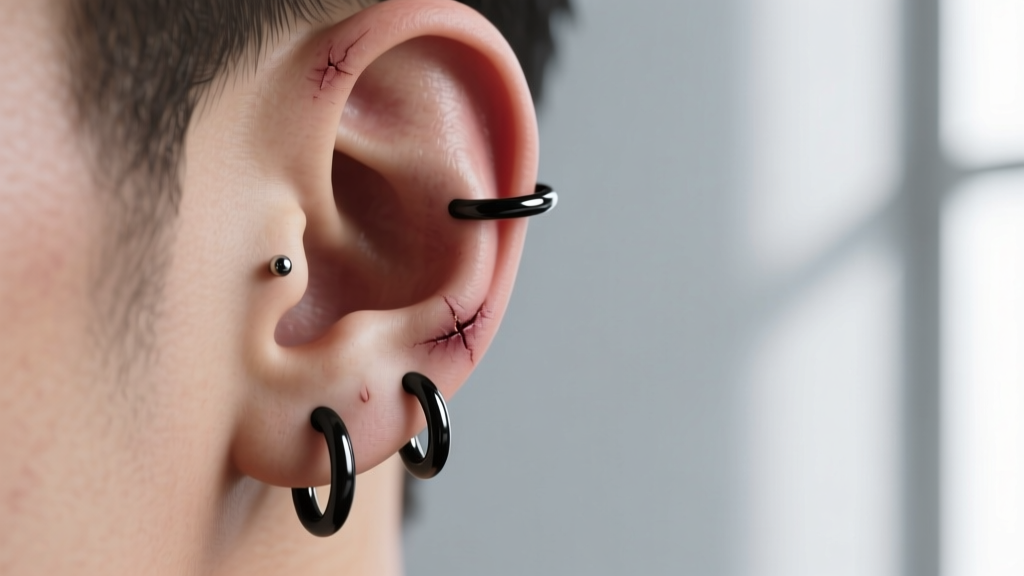
- The Crooked Angle: If your flat-back studs point in different directions, the piercings were likely done at mismatched angles. The Fix: You cannot force a crooked piercing to straighten out with jewelry. The only permanent fix is to retire the piercing (allow it to close or have a dermatologist punch-excise the scar tissue), wait 6 to 12 months, and have an APP-certified piercer re-pierce it using a laser level or precise freehand marking.
- The Crowded Gap (Less than 6mm): If your jewelry constantly rubs together. The Fix: Switch to ultra-minimalist 4mm or 5mm bezel-set studs. Avoid hoops entirely on the crowded piercing, as the curvature of a hoop will inevitably invade the space of the adjacent jewelry.
- The Uneven Height: If the second piercing sits too high, near the cartilage ridge. The Fix: This is often a blessing in disguise. Treat the upper placement as a "high lobe" piercing and curate it with a small cartilage stud or a tiny clicker ring, while keeping a larger statement piece on the lower standard lobe.
Healing Two Piercings Simultaneously: Failure Modes & Fixes
Healing a men's double earring piercing at the same time taxes the local immune system. The lymph nodes in your neck and jaw may swell slightly during the first week. Below is a diagnostic framework to help you identify and solve the most common healing complications.
| Symptom Profile | Probable Cause | Actionable Fix |
|---|---|---|
| Localized red bump next to the exit hole; dry, flaky skin; no pus. | Hypertrophic Scarring (Irritation Bump) caused by friction, sleeping on the ear, or jewelry that is too long. | Downsize the post length immediately. Apply a sterile warm saline compress for 3 minutes daily. Do NOT use tea tree oil. |
| Thick yellow/green discharge; hot to the touch; throbbing pain; fever. | Bacterial Infection (Staphylococcus or Pseudomonas). | Seek medical attention from a doctor. Do not remove the jewelry, or the hole will close and trap the abscess inside. |
| Piercing hole appears to be slowly moving downward; tissue between holes feels thin. | Migration / Cheese-Cutter Effect due to heavy jewelry or thin gauge wire. | Remove heavy dangling earrings immediately. Switch to lightweight 16G implant-grade titanium flat-backs. |
| Persistent crusting that won't wash away; itching; weeping clear fluid. | Contact Dermatitis (Nickel allergy from low-grade surgical steel). | Replace all jewelry with ASTM F-136 Implant-Grade Titanium. Cleanse with a 0.9% sterile saline wound wash. |
"The biggest mistake men make with double lobe piercings is treating them like a single piercing. The tissue between the two holes is under immense structural stress. Downsizing your initial long posts to custom-fitted shorter posts at the 4-week mark is non-negotiable to prevent the top jewelry from snagging and tearing the bridge of tissue." — Guidelines derived from the Association of Professional Piercers (APP)
Material Upgrades to Prevent Rejection and Dermatitis
When troubleshooting chronic irritation in a men's double earring piercing, the culprit is often the metal itself. Many commercial jewelry brands sell "surgical steel" (usually 316L stainless steel), which contains up to 10% nickel. When two piercings are close together, the localized immune response to nickel leaching is amplified, leading to chronic weeping and contact dermatitis.
The Gold Standard: ASTM F-136 Implant-Grade Titanium
For any troubleshooting related to slow healing or allergic reactions, you must upgrade to ASTM F-136 titanium. This specific alloy contains zero nickel and is polished to a mirror finish, meaning microscopic scratches won't harbor bacteria. Expect to pay between $40 and $120 per piece for high-quality, internally threaded or threadless titanium jewelry from reputable brands like NeoMetal or BVLA.
Avoid External Threading
Never use externally threaded jewelry (where the screw is on the post that passes through the ear). The sharp threads act like a cheese grater on the delicate fistula (the tube of healed skin inside the piercing), causing micro-tears that invite infection. Always insist on threadless (push-pin) or internally threaded jewelry.
Curating the Jewelry: Styles That Work for Men's Lobes
Once your men's double earring piercing is fully healed (which takes 3 to 6 months for lobes), the goal shifts from health to aesthetics. Men's jewelry design has matured significantly, moving past the basic ball-closure rings of the early 2000s into structured, architectural pieces.

1. The Flat-Back Labret (The Daily Driver)
Threadless flat-back studs are the ultimate low-profile option. The flat disc sits flush against the back of the earlobe, meaning they will never poke you while sleeping or snag on a motorcycle helmet. Opt for a 5mm or 6mm disc size and a matte black or brushed gold PVD-coated titanium end.
2. The Huggie Hoop (The Structured Curve)
Unlike large, dangling hoop earrings that can look disproportionate on a standard male lobe, "huggies" are small, thick-gauge hoops designed to literally hug the earlobe. Look for an inner diameter of 8mm to 10mm with a thickness of 16G or 14G. A hinged segment ring with a click-closure mechanism ensures the hoop won't accidentally pull open.
3. The Single Prong Stud (The Minimalist)
For a subtle, high-end look, a single bezel-set gemstone (like a black onyx or dark gray spinel) offers a sharp contrast against the skin without drawing excessive attention. This is highly recommended for corporate environments where men want to maintain a polished aesthetic.
Expert Maintenance Routine for Long-Term Health
Troubleshooting doesn't end when the piercing heals. Long-term maintenance is required to keep the fistula healthy, especially when wearing heavier jewelry in a double setup.
- The LITHA Method: "Leave It The Hell Alone." Stop twisting your earrings. Twisting tears the delicate epithelial lining inside the piercing channel and introduces surface bacteria directly into the wound.
- Sleeping Posture: If you are a side sleeper, invest in a U-shaped travel neck pillow. Sleep with your ear positioned in the hollow center of the pillow to eliminate all compression and friction on your double piercings overnight.
- Hydration and Cleaning: Even healed piercings accumulate dead skin cells and sebum, which can calcify and cause a foul odor. Once a week, gently massage a drop of unscented, piercing-safe liquid soap (like Provon) into the lobes while in the shower, then rinse thoroughly.
By respecting the biomechanics of the earlobe, insisting on proper 16-gauge implant-grade titanium, and adhering to strict spacing parameters, your men's double earring piercing will remain a sharp, trouble-free asset to your personal style for decades. For further medical concerns regarding abnormal scarring or keloids, always consult a board-certified dermatologist or refer to resources provided by the Mayo Clinic.


