Möbius Earrings: The Geometry and Metallurgy of the Half-Twist
Explore the technical design, metallurgy, and biomechanics of Möbius earrings. Learn how the half-twist impacts gauge, weight, and casting.

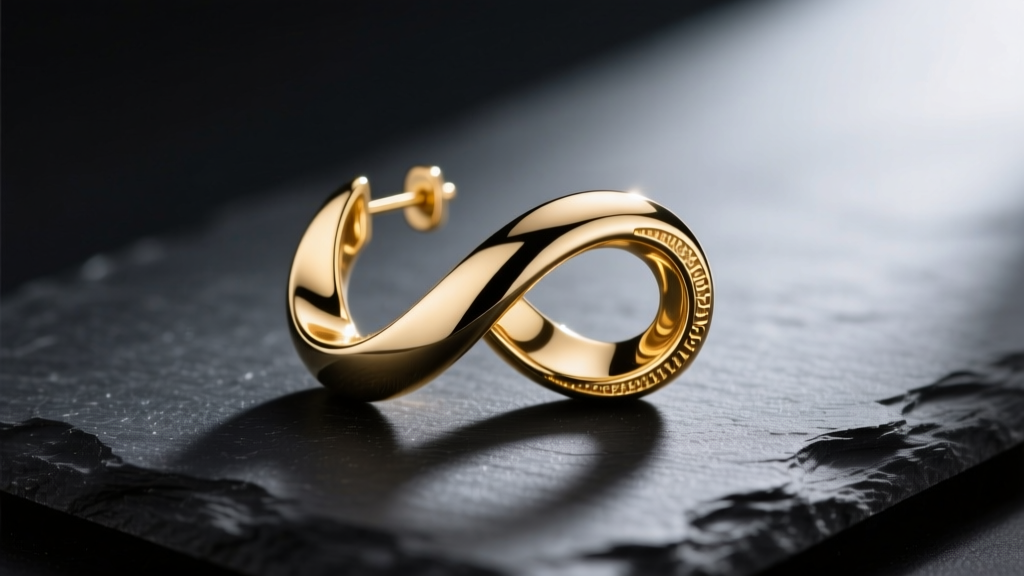
The Möbius strip is a mathematical marvel—a non-orientable surface with only one side and one continuous boundary. When translated into fine jewelry, Möbius earrings represent a profound intersection of topological geometry and advanced metallurgy. Unlike standard twisted ribbon hoops, which feature a full 360-degree rotation, a true Möbius earring requires a precise 180-degree half-twist. This seemingly simple geometric modification introduces significant challenges in computer-aided design (CAD), lost-wax casting, and biomechanical weight distribution. As of 2026, the demand for mathematically accurate body jewelry has pushed manufacturers to adopt aerospace-grade modeling techniques to ensure structural integrity at the twist apex.
The Geometry of the Möbius Strip in Jewelry Design
In topological terms, a Möbius strip is created by taking a rectangular strip of material, giving it a half-twist, and joining the ends. In jewelry design, executing this seamlessly requires advanced parametric CAD software like Rhino 3D or MatrixGold. Designers cannot simply model a torus and apply a deformation modifier; doing so often results in pinched vertices and uneven wall thicknesses.
Parametric CAD and the 180-Degree Sweep
To achieve a flawless continuous surface, jewelers utilize a technique known as a "sweep along a path with a twisting rail." The designer first plots a perfect circular curve (the path) and a secondary helical curve (the rail) that rotates exactly 180 degrees over the circumference. A rectangular cross-section is then swept along this path. According to manufacturing guidelines from Rio Grande, maintaining a uniform wall thickness of at least 1.2mm throughout the sweep is critical to prevent warping during the casting process. If the metal is modeled too thinly at the exact point of the 180-degree twist, the structural integrity is compromised, leading to micro-fractures during everyday wear.
Metallurgy and Manufacturing: Casting the Half-Twist
Manufacturing a true Möbius earring via traditional lost-wax casting introduces unique thermal dynamics. The half-twist creates an asymmetrical mass distribution within the casting flask. When molten metal—such as 18k yellow gold or platinum 950—is injected into the mold, the varying angles of the twist can trap air bubbles or cause uneven cooling rates, leading to porosity.
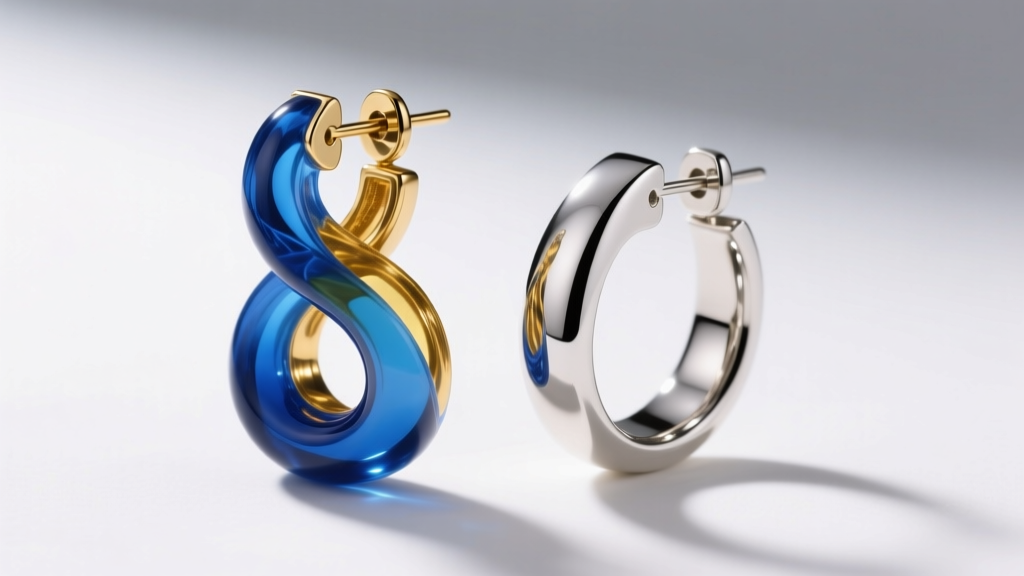
To mitigate these risks, expert casters employ strategic spruing. The sprue (the channel through which molten metal flows) must be attached directly to the thickest part of the twist apex to act as a heat sink, ensuring that the metal at the twist solidifies last. Furthermore, modern 2026 direct-to-metal 3D printing (DMLS) using titanium powders has begun to bypass casting altogether for complex geometries, allowing for microscopic lattice structures inside the twist to reduce weight without sacrificing external rigidity. The Gemological Institute of America (GIA) notes that understanding the specific melting points and shrinkage rates of precious alloys is paramount when dealing with non-linear, asymmetrical jewelry forms.
Gauge, Weight Distribution, and Biomechanics
The most common complaint regarding poorly engineered Möbius earrings is earlobe fatigue. Because the 180-degree twist shifts the center of mass away from the central axis of the ear piercing, the earring becomes inherently front-heavy. This asymmetric weight distribution exerts continuous torque on the fistula (the piercing channel), which can lead to lobe stretching, migration, or discomfort over time.
To counteract this biomechanical flaw, designers must carefully select materials based on their specific gravity. A 25mm diameter Möbius hoop cast in solid platinum will exert significantly more downward force than the exact same design machined from Grade 5 titanium.
| Material | Density (g/cm³) | Estimated Weight (25mm Hoop) | Biomechanical Impact |
|---|---|---|---|
| Grade 5 Titanium (Ti-6Al-4V) | 4.43 | ~3.2 grams | Minimal lobe stress; ideal for daily wear |
| 14k Yellow Gold | 12.90 | ~9.4 grams | Moderate stress; requires reinforced posts |
| 18k Yellow Gold | 15.60 | ~11.3 grams | High stress; best for occasional wear |
| Platinum 950 | 21.45 | ~15.6 grams | Severe stress; requires counter-balancing |
For heavier precious metals, master jewelers often incorporate a hidden counter-weight or design the post to sit slightly off-center, realigning the center of gravity directly beneath the earlobe piercing to eliminate rotational torque.
Lobe vs. Cartilage: Placement and Hardware
While Möbius hoops are popular in standard earlobe piercings, they have become a staple in cartilage placements, particularly the helix and conch. However, cartilage is highly sensitive to pressure and angle changes. The Association of Professional Piercers (APP) strictly advises against using standard butterfly-back posts or externally threaded jewelry for cartilage, as the uneven pressure from a heavy, twisted hoop can cause hypertrophic scarring or rejection.
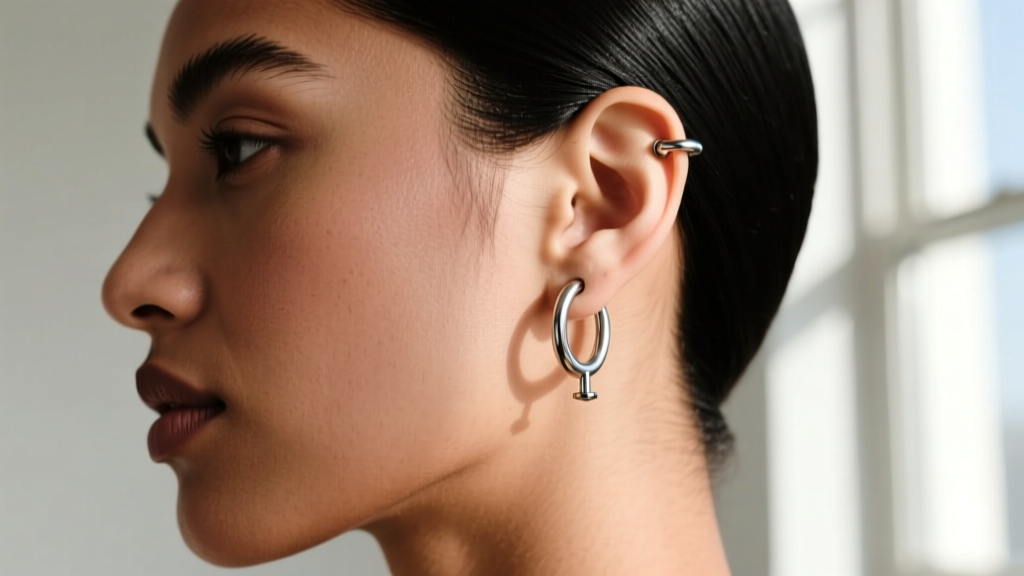
Optimal Hardware for Cartilage Placements
- Gauge Size: A minimum of 16-gauge (1.2mm) or 14-gauge (1.6mm) is required to support the weight of the Möbius twist without causing the "cheese-cutter effect" (where thin metal slowly slices through tissue).
- Threading: Internally threaded or threadless (push-pin) flat-back labret posts are mandatory. The flat disc distributes the weight evenly against the back of the ear cartilage.
- Post Length: An initial post length of 8mm to 10mm accommodates swelling, but must be downsized to 6mm once healed to prevent the heavy Möbius front from snagging on hair or clothing.
Verifying Topological Authenticity
As the popularity of geometric jewelry has surged, the market has been flooded with "fake" Möbius strips. Many mass-produced earrings feature a full 360-degree twist or a simple figure-eight crossover. While aesthetically similar to the untrained eye, a 360-degree twist results in an orientable surface with two distinct sides, completely defeating the mathematical premise of the design.
A true Möbius strip has only one continuous edge. If you can trace the outer edge of the earring with your fingernail and return to your starting point without ever crossing over to the "other side" of the metal ribbon, you are holding a mathematically authentic Möbius strip.
When investing in high-end precious metal Möbius earrings, always request the CAD renderings from the jeweler to verify the 180-degree sweep rail. Hand-forged pieces by master metalsmiths will often feature a subtle, intentional file mark or laser-engraved hallmark exactly at the twist apex, serving as both a maker's mark and a testament to the structural reinforcement applied to the most vulnerable point of the geometry. Whether crafted from aerospace-grade titanium or cast in 18k gold, the Möbius earring remains a triumph of mathematical theory brought to life through metallurgical precision.


