Navy Earring Regulations: A Beginner's Guide to Compliance
Master navy earring regulations with our beginner-friendly guide. Learn exact sizing, approved materials, and uniform compliance tips for 2026.

Decoding the Official Navy Earring Regulations
Entering the United States Navy is a profound commitment, and adapting to military grooming standards is one of the first hurdles for new recruits and commissioned officers alike. While uniform regulations cover everything from boot polish to haircut tapers, jewelry rules often cause the most confusion during uniform inspections. Understanding navy earring regulations is not just about passing a Saturday morning inspection; it is about safety, uniformity, and adhering to the strict guidelines outlined in NAVPERS 15665I (U.S. Navy Uniform Regulations).
Whether you are a new recruit heading to Great Lakes for boot camp, a JROTC cadet preparing for a competition, or a spouse looking to buy a compliant gift, this beginner-friendly explainer will break down exactly what is authorized, what is prohibited, and how to avoid common uniform infractions in 2026.
Women's Uniform Standards: Size, Shape, and Placement
For female sailors, earrings are authorized while in uniform, but the parameters are incredibly specific. The Navy prioritizes a conservative, professional appearance that does not interfere with the wearing of headgear or pose a snag hazard aboard ships and submarines.
The 4mm to 6mm Rule
According to official MyNavyHR Uniform Regulations, women may wear one earring per ear, centered on the lower earlobe. The earring must be a plain ball shape, measuring exactly 4mm to 6mm (approximately 1/8 to 1/4 of an inch). This means standard 3mm 'petite' studs are technically out of regs, and anything larger than 6mm will result in an inspection failure. The finish can be polished or matte, but it must be completely free of engravings, gems, or decorative borders.
Approved Materials and Colors
The authorized materials are strictly limited to maintain uniformity across the fleet. You may choose from:
- Yellow Gold: 14k or 18k, plain ball.
- White Gold: Plain ball, polished or matte.
- Sterling Silver: Plain ball, highly polished.
- White Pearl: Natural or cultured, round, 4mm to 6mm. Must be pure white (no cream, black, or peach overtones).

Men's Uniform Standards: The Strict Prohibition
For male sailors, the rules are much more straightforward but often misunderstood by civilians. Navy earring regulations strictly prohibit men from wearing earrings while in uniform. This applies to all uniform variants, including Service Dress, Working Uniforms (NWUs), and physical training gear. Furthermore, men are not authorized to wear earrings while on a military installation, even if they are in civilian attire, unless they are in a designated private living area like a barracks room or on-base housing.
The Material Matrix: What to Buy and What to Avoid
When shopping for compliant earrings, it is easy to accidentally purchase items that look correct but fail upon close inspection. Use this decision matrix to ensure your purchase meets military standards.
| Material / Style | Authorized? | Inspection Notes & Failure Modes |
|---|---|---|
| Yellow Gold Ball (4-6mm) | Yes | Must not have a visible diamond or gem inset. Pure metal only. |
| White Pearl (4-6mm) | Yes | Must be perfectly round. Baroque or teardrop pearls are an automatic fail. |
| Sterling Silver Ball | Yes | Ensure the post is also silver or white gold to avoid mismatched metals. |
| Rose Gold | No | Not explicitly authorized in NAVPERS 15665I. Will fail strict inspections. |
| Diamond / Cubic Zirconia | No | Stones catch the light and violate the 'plain and conservative' mandate. |
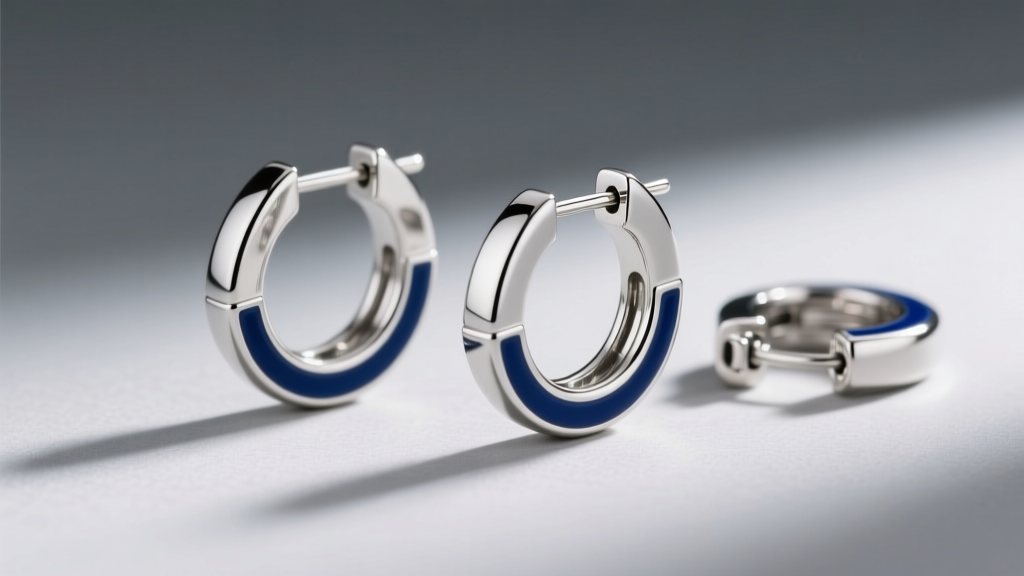
| Hoops, Huggies, Dangles | No | Severe safety hazard around ship machinery and rigging. Strictly banned. |
Piercing Placement and the Cartilage Conundrum
A frequent question among younger sailors entering the fleet involves cartilage piercings. The regulations are absolute: only the lower earlobe is authorized for piercing. If you have helix, tragus, conch, or industrial piercings, you must remove the jewelry before putting on any Navy uniform.
Furthermore, stretching the earlobes (gauging) is highly restricted. While the Navy does not specify an exact post gauge (standard 20-gauge or 18-gauge posts are typical), visibly stretched earlobes or flesh tunnels are not permitted. If a sailor has previously stretched lobes, they may be required to wear flesh-colored silicone retainers or, in some cases, seek surgical correction to remain in compliance with grooming standards outlined by the Department of Navy Issuances (DONI).
What About Clip-Ons and Magnetic Studs?
If a female sailor is not pierced, she is still authorized to wear earrings, provided they are clip-on or magnetic styles that perfectly mimic the authorized 4mm-6mm ball studs. The visual standard remains identical; the method of attachment is the only variable.
Off-Duty Rules: When Can You Wear What?
The strictness of navy earring regulations relaxes significantly when you are off-duty and off-base. When female sailors are in civilian clothes, they are free to wear hoops, dangles, ear cuffs, and multiple cartilage piercings, provided the jewelry does not present a safety hazard in their specific civilian workplace.
For male sailors, off-duty civilian life also permits earrings. However, the moment you step onto a naval station, shipyard, or base—even if you are just stopping by the commissary in jeans and a t-shirt—male sailors must remove all ear jewelry. Commanding Officers have the authority to enforce grooming standards anywhere on a military installation.

Where to Buy and Pricing Expectations
For guaranteed compliance, the best place to purchase uniform earrings is the Navy Exchange (NEX), either in-person on base or via their online storefront. The NEX explicitly labels jewelry as 'Uniform Compliant,' removing the guesswork.
- Sterling Silver / Gold-Plated Sets: $15 - $25
- Solid 14k Yellow/White Gold: $45 - $90
- Cultured White Pearl Studs: $30 - $60
Pro-Tip for Boot Camp Recruits: Do not bring expensive solid gold or genuine pearl earrings to Recruit Training Command (RTC). Bring inexpensive, compliant sterling silver or gold-plated 6mm ball studs for daily wear during training to prevent loss, and save the premium metals for when you graduate and report to your first command.
Maintenance and Inspection Prep
Passing inspection isn't just about the size of the earring; it is about its condition. Tarnished silver or dull, dirty pearls will draw negative attention from inspectors.
- Polishing Metals: Use a standard jeweler's polishing cloth weekly. Avoid harsh chemical dips that can degrade the post or clutch.
- Cleaning Pearls: Wipe cultured pearls with a soft, damp cloth after wearing. Never use ultrasonic cleaners or ammonia-based solutions on pearls, as they will strip the nacre and ruin the luster.
- Check the Clutch: Ensure the earring back (butterfly clutch or screw-back) is tight. A loose earring that droops on the earlobe violates the 'centered and professional' requirement.
Final Thought: Uniform regulations exist to project a unified, professional front to the world. By mastering these navy earring regulations early in your career, you ensure that your focus remains on your mission, not on fixing uniform infractions before morning colors.