What Is the Normal Earring Size? A Technical Gauge & MM Guide
Discover the true normal earring size for lobes and cartilage. Our expert guide breaks down exact gauge, millimeter, and post length specifications.

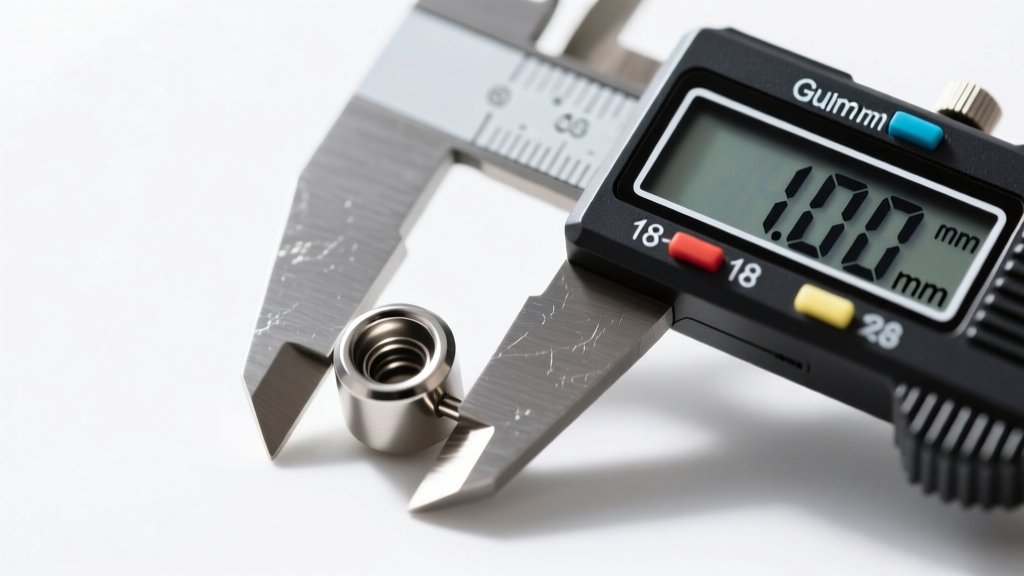
If you have ever stood in front of a jewelry display or scrolled through an online boutique wondering, "What is the normal earring size?" you are not alone. The truth is, the concept of a single, universal "normal" earring size is a myth perpetuated by mass-market fashion retailers. In the professional body modification and fine jewelry industries, earring sizing is a precise, three-dimensional science governed by anatomy, piercing placement, and tissue health.
As we navigate the jewelry landscape in 2026, the shift toward bespoke, anatomy-specific jewelry has made understanding exact millimeter (mm) and gauge measurements more critical than ever. Whether you are selecting a seamless gold hoop for a healed helix or a titanium labret for a fresh lobe piercing, relying on a generic "standard" size can lead to discomfort, migration, or tissue tearing. This expert deep dive will decode the technical specifications of earring sizing, giving you the exact data needed to curate a perfect, anatomically correct collection.
The Myth of the "Normal" Earring Size
When consumers ask about the normal earring size, they are usually conflating three distinct measurements: gauge (the thickness of the wire or post), length (the distance from the front of the gem to the back of the post), and diameter (the inner curve of a hoop). A standard earring bought at a mall kiosk might feature a 20-gauge wire with a 7mm post, but that same piece would be entirely inappropriate for a cartilage piercing, which typically requires a thicker 16-gauge post and a shorter 5mm length to accommodate the denser tissue and lack of a deep fleshy lobe.
Professional piercers and high-end jewelers do not use the word "normal." Instead, they refer to "initial jewelry standards" and "healed anatomy fits." According to the Association of Professional Piercers (APP), jewelry must be selected based on the specific vascular structure and swelling capacity of the individual's tissue, not an arbitrary industry baseline.
Decoding Earring Gauges: Thickness Explained
The gauge system is inherently counterintuitive: the higher the gauge number, the thinner the metal. This inverse relationship stems from the historical wire-drawing process, where metal was pulled through progressively smaller holes. Understanding this is the first step in determining your true earring size.
| Gauge (G) | Millimeter (mm) | Inch (Fraction) | Primary Application |
|---|---|---|---|
| 22G | 0.64mm | 1/40" | Vintage clip-ons, ultra-fine fashion studs (not recommended for fresh piercings) |
| 20G | 0.81mm | 1/32" | Standard healed lobe piercings, nose bones |
| 18G | 1.02mm | 1/25" | Healed lobes, standard cartilage, nostril |
| 16G | 1.29mm | 1/20" | Initial lobe piercings, helix, forward helix, tragus |
| 14G | 1.63mm | 1/16" | Conch, daith, rook, industrial, stretched lobes |
Expert Insight: While 20G is often sold as the "normal" size for fashion earrings, professional piercers almost universally use 16G or 14G for initial piercings. Thicker jewelry (lower gauge) resists the "cheese-cutter effect," a phenomenon where thin wire slowly migrates through the tissue due to the weight of the jewelry or accidental snagging.
Standard Dimensions by Piercing Location
Once you have established the correct gauge, the next variable is the length of the post (for studs and labrets) or the inner diameter (for hoops). Tissue thickness varies wildly from person to person, but the following baselines serve as the industry starting point for healed piercings.
Standard Lobe Piercings
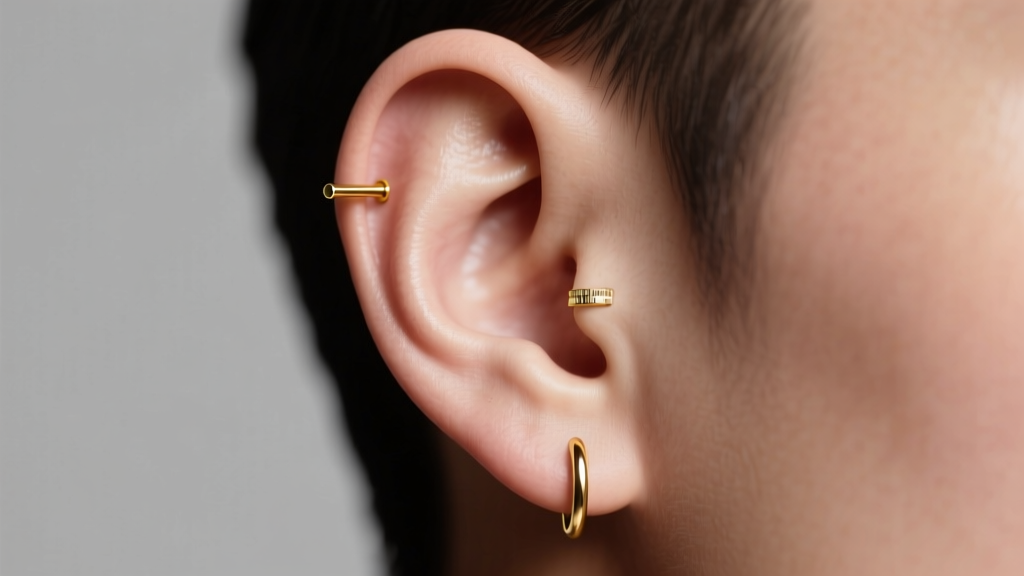
The earlobe is composed of soft, vascular tissue that can compress and expand. For a healed standard lobe piercing, the normal earring size for a post length is typically 6mm (1/4") to 8mm (5/16"). If you wear a butterfly-back earring, the post is often 8mm to 10mm to accommodate the bulky backing. However, modern fine jewelry favors flat-back labrets, which sit flush against the ear. For flat-backs, a 6mm post is usually the perfect snug fit for a healed lobe, eliminating the space where hair and bacteria can accumulate.
Cartilage and Helix Piercings
Cartilage is dense, avascular, and lacks the elasticity of the lobe. It also sits closer to the surface of the skin. Therefore, the normal earring size for a healed helix or flat piercing is a much shorter 5mm (3/16") to 6mm (1/4"). Wearing an 8mm post in a healed helix will result in the jewelry sticking out awkwardly, catching on hair, and risking impact trauma.
Hoop and Huggie Diameters: Measuring the Inner Curve
When shopping for hoops, the measurement that matters is the Inner Diameter (ID), not the Outer Diameter (OD). The ID dictates how the hoop wraps around your specific anatomy. A hoop with a 10mm ID made of thick 14G wire will have a completely different OD—and thus a different visual weight—than a 10mm ID hoop made of delicate 20G wire.
- 8mm (5/16") ID: The standard "normal" size for a snug helix hoop, a tight nostril hoop, or a very close-fitting huggie for a thin earlobe.
- 10mm (3/8") ID: The most popular huggie size for standard earlobes, offering a slight drop without dangling. Also used for tragus and conch hoops.
- 12mm (1/2") ID: A classic small hoop for lobes, providing enough room to sleep in comfortably while maintaining a minimalist profile.
- 15mm - 20mm ID: Standard medium hoops for lobes and stretched cartilage. These sizes allow for movement and dangle but require a fully healed, stable piercing channel to avoid angle irritation.
How to Measure Your Own Piercing for a Perfect Fit
Do not guess your earring size based on what a retailer labels as "standard." To achieve a bespoke fit, you must measure your existing, well-fitting jewelry or your anatomy directly.
- Invest in Digital Calipers: A cheap plastic ruler cannot measure a 1.29mm 16-gauge post accurately. Digital calipers measure to the 0.01mm and are essential for any serious jewelry collector.
- Measure Post Length Correctly: For straight barbells and flat-back labrets, measure only the wearable post length from the base of the gem setting to the top of the threading or flat disc. Do not include the decorative end.
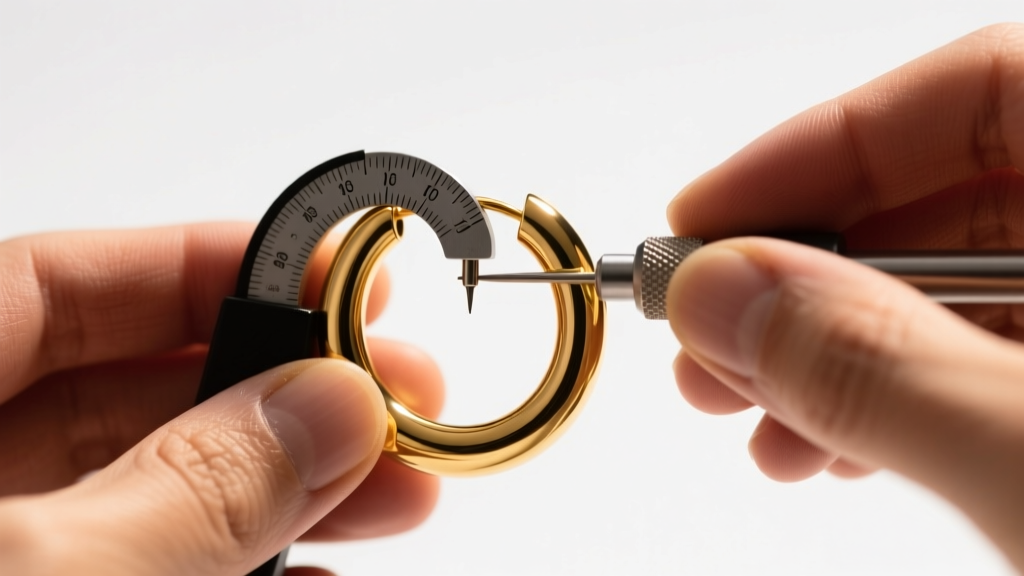
- Measure Hoop ID: Close the hoop and measure the distance across the inside of the circle. If you are measuring an open segment ring, use a multi-gauge wheel or a printable hoop sizing chart taped flat to a table.
Material Considerations for Fresh vs. Healed Piercings
Size is only half the equation; material dictates how the tissue reacts to that size. The APP Jewelry Materials Guide strictly outlines what is safe for human implantation. For fresh piercings, or if you are experiencing swelling that requires a longer "normal" size temporarily, Implant-Grade Titanium (ASTM F136) is the undisputed gold standard. It is completely nickel-free, highly polished, and biocompatible.
Once the piercing is fully healed (which takes 6-12 months for lobes and up to 2 years for cartilage), you can transition to 14k or 18k solid gold (nickel-free, alloyed with metals like palladium or silver). Avoid gold-plated or gold-filled jewelry in any gauge or size, as the friction of insertion and removal will eventually wear away the microscopic gold layer, exposing the reactive brass or copper core to the fistula (the healed skin tube of the piercing).
Expert Troubleshooting: When the "Standard" Size Fails
Even when you follow the rules, anatomy can throw a curveball. Here is how to troubleshoot common sizing failures:
The Embedding Effect
If your flat-back labret is sinking into your earlobe or helix, the post is too short for your current tissue volume. This often happens if you downsized too early after a fresh piercing, or if you sleep on the ear, causing localized swelling. Solution: Upsize to a post that is 1mm to 2mm longer immediately to allow the tissue to breathe and prevent the dermal layer from healing over the jewelry back.
Angle Irritation and Migration
If a standard 6mm helix hoop is sticking out straight from your ear rather than hugging the curve, your piercing was likely done at a shallow angle, or the 6mm ID is too small for the thickness of your ear's outer rim. Solution: Switch to an 8mm ID hoop, or consult a professional about having the piercing repierced at a steeper, anatomically correct angle to accommodate standard jewelry sizes.
Ultimately, the "normal" earring size is simply the size that respects your unique anatomy. By mastering gauges, post lengths, and inner diameters, you elevate your jewelry collection from a box of ill-fitting accessories to a curated, comfortable, and technically perfect display of personal style.


