The Gemologist’s Guide to Onyx Drop Earrings: Settings, Grades & Care
Discover the technical specifications, setting styles, and care protocols for onyx drop earrings. An expert gemological deep dive for collectors.

The Mineralogy and Treatment of Black Onyx
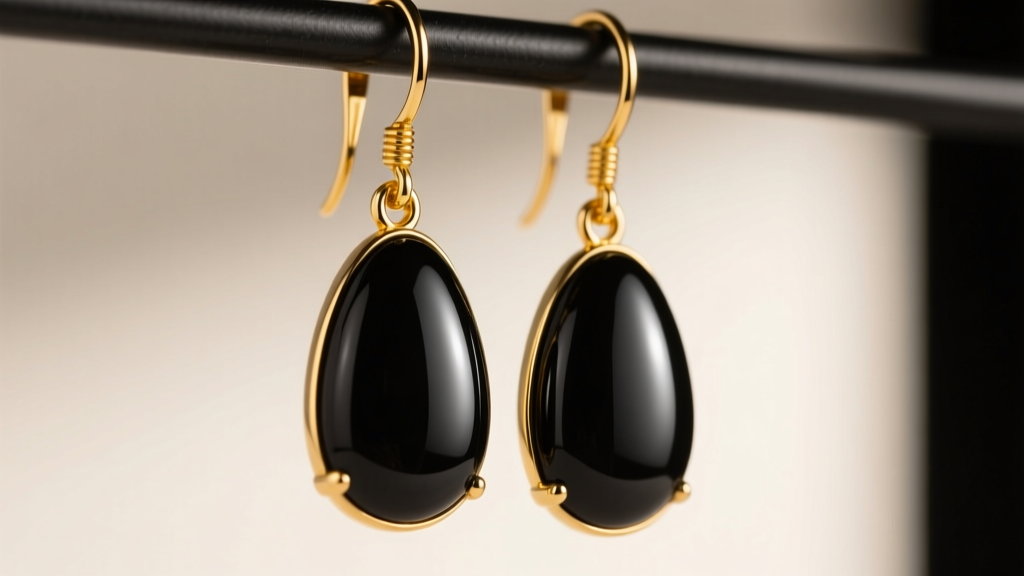
When evaluating onyx drop earrings from a gemological perspective, it is crucial to understand the mineralogical reality of the stone. True, naturally occurring black onyx is exceptionally rare. According to the Gemological Institute of America (GIA), the vast majority of black onyx on the commercial market is actually gray or white banded agate (a microcrystalline variety of quartz) that has undergone a permanent carbonization treatment. This process, historically rooted in ancient Roman techniques, involves soaking the porous chalcedony in a sugar solution and subsequently boiling it in concentrated sulfuric acid. The acid carbonizes the sugar trapped within the stone's microscopic pores, resulting in a deep, uniform, and permanent black color.
Because the treatment is permanent and universally accepted in the gem trade, it does not negatively impact the stone's value in the same way that heat treatment might affect certain sapphires. However, as a technical collector, you must verify the material's identity. Black onyx possesses a specific gravity (SG) of 2.58 to 2.64 and a refractive index (RI) of 1.53 to 1.54. Unlike glass imitations, which are singly refractive and often contain spherical gas bubbles, genuine onyx is doubly refractive (though often masked by its cryptocrystalline structure) and will exhibit a conchoidal fracture under high magnification if chipped.
Engineering the Drop: Mechanical Failure Points
The defining characteristic of drop earrings is their kinetic movement. Unlike studs, which sit flush against the earlobe, onyx drop earrings act as pendulums. This introduces significant mechanical stress to the findings, particularly at the connection points. The most common failure point in drop earring engineering is the jump ring—the small metal loop connecting the ear wire to the gemstone bail or drilled bead.
In lower-quality manufacturing, jump rings are simply snipped and bent into a circle, leaving a microscopic seam. Over months of wear, the pendulum effect of a heavy onyx drop (which can easily exceed 15 carats per stone) will cause this seam to expand, eventually leading to the loss of the gemstone. As of 2026, high-end jewelers mitigate this risk by utilizing soldered jump rings or direct-to-wire drilling. For drops exceeding 10x14mm in calibration, a leverback ear wire with a soldered bail is vastly superior to a standard 20-gauge French hook, as the leverback's locking mechanism prevents the earring from sliding off the earlobe during high-movement activities.
Setting Architectures: Bezel vs. Prong
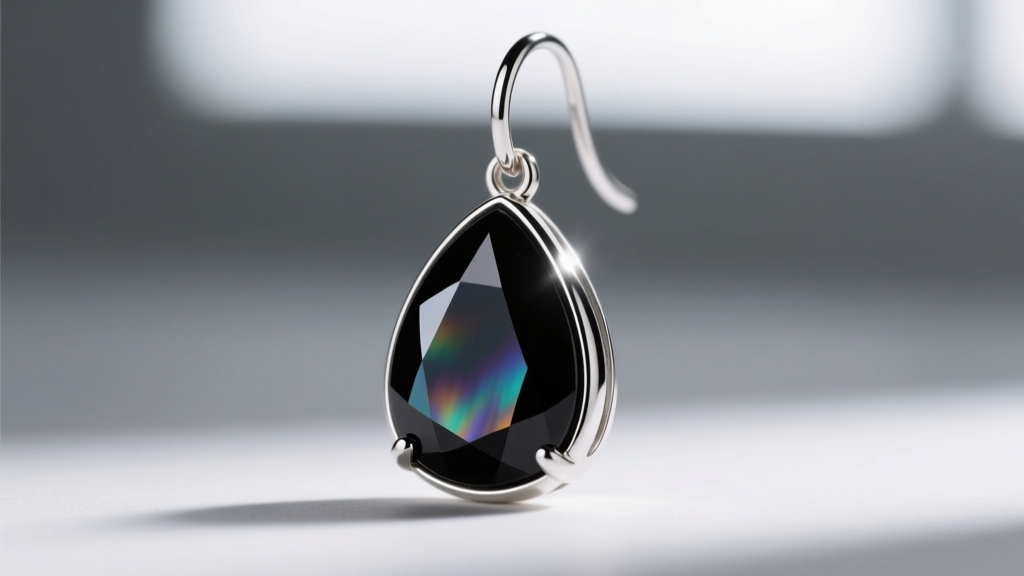
Onyx registers at a 6.5 to 7 on the Mohs hardness scale. While this makes it reasonably resistant to everyday scratching, its cryptocrystalline structure means it is highly susceptible to chipping along the girdle if subjected to uneven point pressure. This physical property heavily dictates the optimal setting architecture for onyx drop earrings.
| Setting Type | Mechanical Security | Light Performance | Gemological Risk |
|---|---|---|---|
| Full Bezel | Exceptional | Low (Blocks side light) | Minimal; protects the entire girdle from impact. |
| Prong (4 or 6) | Moderate | High (Maximizes surface reflection) | High; point pressure can cause conchoidal chipping if the stone is not perfectly calibrated. |
| Half-Bezel | Good | Moderate | Low; leaves the north/south poles exposed but secures the vulnerable equator. |
| Top-Drilled Briolette | Variable | High (360-degree movement) | Moderate; requires a perfectly smooth laser drill hole to prevent wire abrasion. |
For faceted onyx drops, such as pear or marquise cuts, a full bezel setting in 14k or 18k gold is the gold standard for security. The bezel wall must be burnished evenly; if the jeweler applies too much pressure on one side to compensate for a poorly calibrated stone, the internal tension will fracture the onyx.
Calibration Standards and Carat Weight Estimation
When sourcing onyx drop earrings, understanding standardized calibration is vital for predicting the visual footprint and the physical weight of the jewelry. Because onyx is relatively dense compared to organic gems but lighter than cubic zirconia, weight estimation requires specific formulas. Below is a technical calibration chart for standard pear-cut onyx drops, assuming a standard depth of 60% to 65%.
| Dimensions (mm) | Estimated Carat Weight (per stone) | Optimal Wire Gauge for Setting |
|---|---|---|
| 8 x 12 mm | 3.50 - 4.20 ct | 22-gauge (0.64mm) |
| 10 x 14 mm | 6.80 - 7.50 ct | 20-gauge (0.81mm) |
| 13 x 18 mm | 14.00 - 15.50 ct | 18-gauge (1.02mm) |
| 15 x 20 mm | 20.00 - 22.00 ct | 16-gauge (1.29mm) with reinforced bail |
If a vendor advertises a 15x20mm onyx drop earring but claims it weighs only 5 carats, you are likely looking at black glass or black spinel, not genuine chalcedony. Cross-referencing dimensional weight is a primary authentication tool for gemologists evaluating vintage or estate onyx jewelry.
Maintenance Protocols and Ultrasonic Risks
The most critical error a collector can make when maintaining onyx drop earrings is utilizing an ultrasonic cleaner. The International Gem Society (IGS) explicitly warns against ultrasonic and steam cleaning for any porous, dyed, or fracture-filled gemstone. While the carbonization dye in black onyx is generally stable, the high-frequency acoustic cavitation bubbles generated by ultrasonic cleaners can penetrate microscopic fissures in the stone. If the onyx has been treated with surface waxes or oils to enhance its luster—a common practice in lapidary finishing—the ultrasonic waves will strip these agents, leaving the stone looking dull and chalky.
Furthermore, many modern onyx drops are constructed as doublets (a thin slice of onyx glued over a black backing material to save weight and cost). The chemical solvents in some jewelry cleaning solutions, combined with ultrasonic vibrations, will rapidly degrade the epoxy resin bonding the layers, causing the stone to delaminate.
The Correct Cleaning Protocol
- Solution: Use a mixture of distilled water and a pH-neutral, phosphate-free dish soap.
- Application: Submerge the drops for no more than 3 minutes.
- Agitation: Gently sweep the surface with an ultra-soft, baby-hair brush. Never use a standard toothbrush, as the stiff nylon bristles can leave micro-scratches on the high-polish finish of the onyx.
- Drying: Pat dry with a lint-free microfiber cloth. Ensure the connection points (jump rings and bails) are completely dry to prevent galvanic corrosion in sterling silver settings.
Final Verdict for the Technical Collector
Onyx drop earrings represent a masterclass in the intersection of lapidary art and mechanical engineering. Their deep, light-absorbing color makes them a staple of both Art Deco revival and contemporary minimalist jewelry design. However, their longevity relies entirely on the precision of their setting and the wearer's adherence to strict, non-mechanical cleaning protocols. By prioritizing soldered findings, bezel architectures, and verified specific gravity metrics, collectors can ensure their onyx drops remain structurally sound and visually flawless for generations.


