Can I Wear Earrings in a Passport Photo? 2026 Guide
Wondering if you can wear earrings in a passport photo? Discover which jewelry materials prevent flash glare and biometric rejections in our 2026 guide.


The Short Answer: Can I Wear Earrings in a Passport Photo?
If you are asking, "can I wear earrings in a passport photo?", the short answer is yes—but with strict material and structural caveats. According to the U.S. Department of State and the International Civil Aviation Organization (ICAO), jewelry is permitted as long as it does not obscure your face, cast heavy shadows, or create glare that interferes with biometric scanning. However, what most applicants fail to realize is that the material composition of your earrings plays a massive role in whether your digital submission is automatically accepted or flagged for manual review.
In 2026, passport agencies rely heavily on AI-driven facial recognition software based on ICAO Doc 9303 standards. This software maps the nodal points of your face, including the jawline and the space around your ears. High-reflectivity metals can cause flash glare that corrupts the image metadata, while heavy materials can distort your earlobe and cast shadows that trick the algorithm into detecting facial asymmetry. To ensure your photo passes on the first try, you must understand the material science behind travel-compliant ear jewelry.
Material Reflectivity and the Albedo Effect
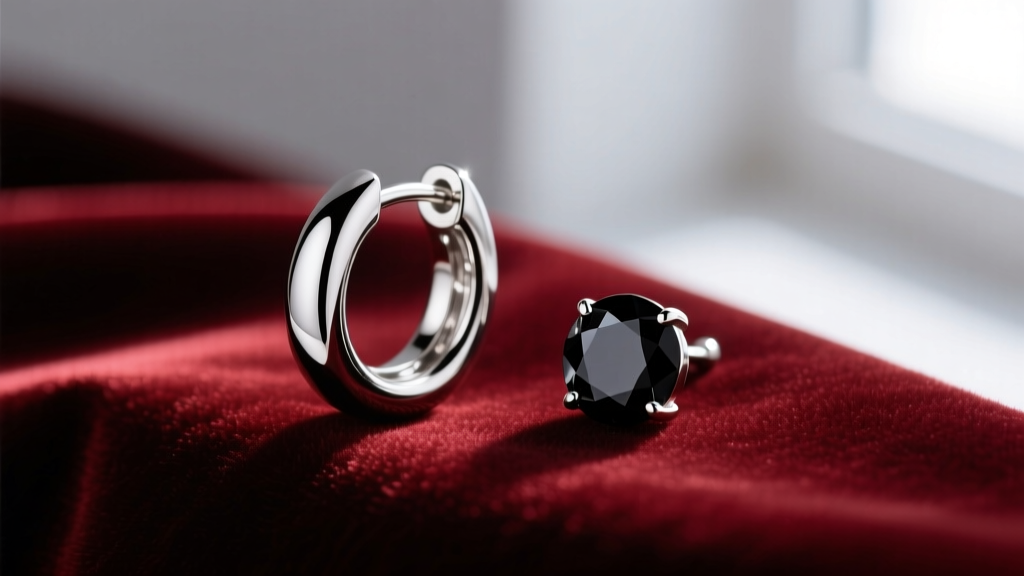
Camera flashes in photo booths and professional studios are designed to bounce light off the subject to create even illumination. The problem arises when your earrings act as secondary mirrors. In physics, albedo measures the reflectivity of a surface. Polished precious metals have an incredibly high albedo, meaning they bounce harsh, concentrated light directly back into the camera lens.
- Polished Sterling Silver (925) & Rhodium Plating: These materials possess an albedo of up to 95%. When hit by a xenon camera flash, they create a "white-out" pixel cluster. The biometric scanner reads this glare as an anomaly or a light leak, resulting in an automatic rejection.
- High-Polish 18k Yellow Gold: While slightly less reflective than silver, polished gold still creates significant specular highlights that can bleed into the facial mapping zone, particularly if worn in the upper cartilage (helix or forward helix).
- Brushed Grade 23 Titanium (ASTM F136): Titanium naturally possesses a lower albedo (around 45%), but when finished with a brushed or matte texture, light is scattered diffusely rather than reflected directly. This makes brushed titanium the ultimate material for passport photos.
- Black Zirconia & PVD-Coated Steel: Physical Vapor Deposition (PVD) black coatings and matte black zirconia absorb light rather than reflecting it. Their albedo is often below 10%, making them virtually invisible to flash-glare detection algorithms.
Weight, Density, and Shadow Obscuration
Beyond reflectivity, the physical density of your earring material dictates how it interacts with gravity and your earlobe. The ICAO requires a clear, unobstructed view of the face and neck. Heavy earrings pull the earlobe downward, altering the natural shadow your ear casts on your neck. The biometric software uses the ear-to-neck shadow ratio as a secondary depth-mapping metric.
Material Density Comparison
When choosing earrings for a passport photo, opt for low-density materials that sit flush against the lobe without causing distortion.
| Material | Density (g/cm³) | Lobe Distortion Risk | Passport Verdict |
|---|---|---|---|
| Tungsten Carbide | 15.6 | High (Pulls lobe down) | Avoid |
| Solid 18k Gold | 15.2 | High | Avoid |
| 316L Surgical Steel | 8.0 | Moderate | Use with caution (small sizes only) |
| Grade 5 Titanium | 4.4 | Very Low | Highly Recommended |
| Anodized Niobium | 8.5 | Low (if small gauge) | Recommended |
For standard lobe piercings (usually 16-gauge or 14-gauge, which are 1.2mm and 1.6mm thick respectively), a 3mm to 5mm bezel-set stud made from Grade 5 Titanium is lightweight enough to maintain the ear's natural posture while remaining entirely compliant with federal photo guidelines.
Piercing Placement: Lobe vs. Cartilage Considerations
Where the jewelry sits is just as critical as what it is made of. If you have multiple piercings, the material rules shift slightly depending on the placement.
Standard Lobe Piercings
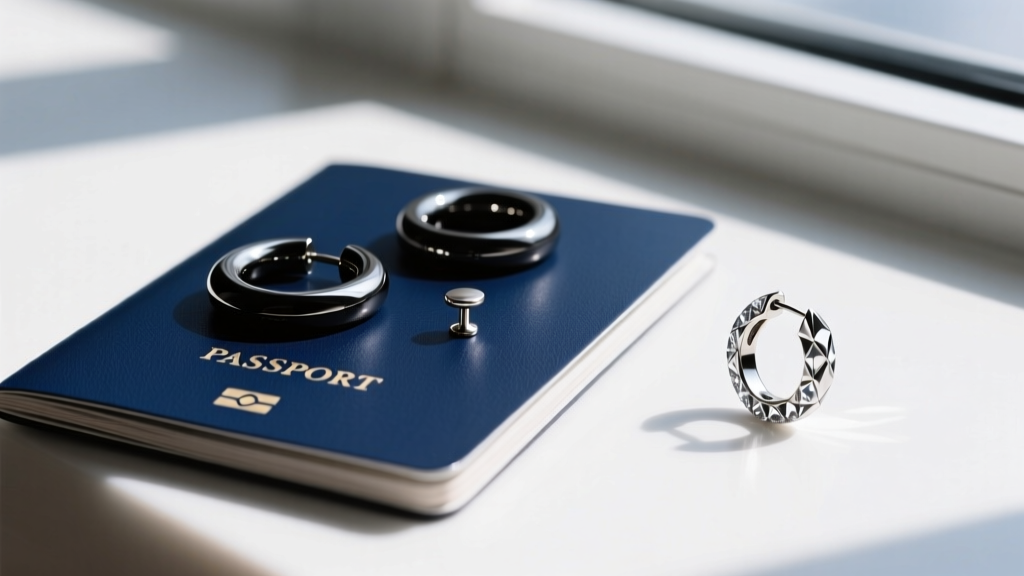
Stick to flush-fitting studs or ultra-tight 10mm huggies. Avoid any dangles, drop earrings, or hoops larger than 15mm. Even if a hoop is made of matte black steel, its physical circumference can cross the imaginary bounding box the software draws around your jawline, triggering an "obscured face" error.
Upper Cartilage (Helix, Forward Helix, Tragus)
Cartilage jewelry sits closer to the facial mapping zone. A polished diamond-cut hoop in the forward helix will catch the flash and cast a harsh, artificial shadow across the temple. For cartilage, use 16-gauge (1.2mm) flat-back labret studs made from anodized niobium or matte PVD titanium. The flat back prevents the post from protruding and altering the silhouette of your ear against the white background.
The 2026 Compliance Matrix: What to Wear
To synthesize the material science and biometric requirements, here is a quick-reference decision framework for your next trip to the photo booth or post office.
Expert Tip: If you must wear a sentimental piece that is highly polished (like a family heirloom diamond stud), apply a tiny, removable dot of matte clear nail polish or a specialized anti-glare photography wax to the metal setting to diffuse the flash. Just ensure it does not alter the color of the gemstone itself.
Top 3 Approved Material Profiles
- Brushed ASTM F136 Titanium Studs: The gold standard for hypoallergenic, low-reflectivity, and ultra-lightweight travel jewelry. They will not trigger glare sensors and will not distort the earlobe.
- Matte Black Zirconia Bezels: Zirconia is incredibly hard and, when finished in matte black, absorbs camera flash completely. It provides a sleek, modern look that is 100% invisible to biometric glare filters.
- Sandblasted 14k Rose Gold: If you prefer traditional precious metals, seek out sandblasted or heavily brushed finishes. The micro-abrasions on the metal surface scatter light, reducing the albedo to safe levels while retaining the warmth of gold.
Troubleshooting Rejections: When Jewelry Fails the Scan
If your passport photo is rejected and the reason cites "shadows" or "glare," but you were not wearing glasses (which are universally banned in U.S. passport photos), your earrings are the likely culprit. Modern digital submission portals run your image through an ICAO-compliant API before a human ever sees it.
When a high-polish rhodium earring reflects the flash, the API registers a cluster of pure white pixels (RGB 255, 255, 255) near the facial perimeter. The algorithm interprets this as a lighting failure or a background bleed. Conversely, if a heavy tungsten earring pulls your lobe down, the asymmetry in the neck shadow triggers a "facial contour anomaly" flag.
To resolve this, you do not necessarily need to remove your jewelry if you are dealing with fresh, unhealed piercings. Instead, swap to a 14-gauge internally threaded titanium flat-back labret with a matte finish. According to the U.S. Department of State, jewelry is perfectly acceptable as long as it does not hide your face or cause reflections. By understanding the material properties of your earrings, you can maintain your personal style while ensuring your travel documents are processed without delay.
For deeper technical specifications on global biometric photo standards, you can review the ICAO Doc 9303 guidelines on Machine Readable Travel Documents, which outline the exact facial mapping tolerances that your jewelry must respect.


