How to Prevent and Treat Earring Embedding in Fresh Piercings
Discover expert troubleshooting for earring embedding. Learn how to safely remove stuck studs, prevent tissue swelling, and choose the right post lengths.

The Biomechanics of Earring Embedding
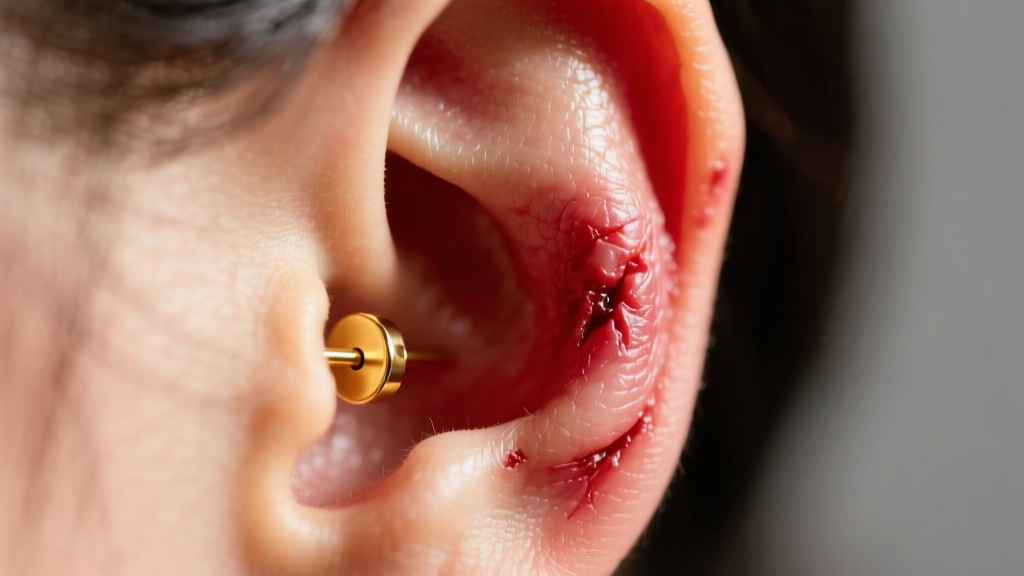
Earring embedding is a severe mechanical and biological failure that occurs when the backing or front stud of an earring becomes completely swallowed by the surrounding earlobe or cartilage tissue. This complication is most prevalent in fresh piercings undergoing the inflammatory phase of healing, but it can also strike fully healed piercings due to allergic reactions, localized infections, or sudden trauma. When tissue swells (edema) and the jewelry post lacks adequate length, the skin is forced to grow over the hardware. This leads to pressure necrosis, where the constant tension cuts off blood supply to the localized tissue, eventually causing the epidermis to epithelialize over the metal. Understanding the biomechanics of this failure is the first step in effective troubleshooting and prevention.
Immediate Triage: Safely Extracting an Embedded Stud
If you suspect earring embedding, time is a critical factor. The longer the hardware remains encased, the more the body will treat it as a foreign object to be walled off. Do not attempt to dig the jewelry out with unsterilized needles or tweezers, as this introduces pathogens and exacerbates tissue trauma. Follow this clinical extraction protocol:
Step 1: Reduce Localized Edema
Apply a warm, sterile saline compress to the area for 5 to 10 minutes. The heat promotes vasodilation, increasing blood flow and softening the hardened lymphatic crusts that may be anchoring the earring back to the skin. Use only sterile 0.9% sodium chloride wound wash; avoid homemade sea salt mixtures, which often have incorrect osmolarity and can dehydrate the tissue further.
Step 2: Lubricate and Mobilize
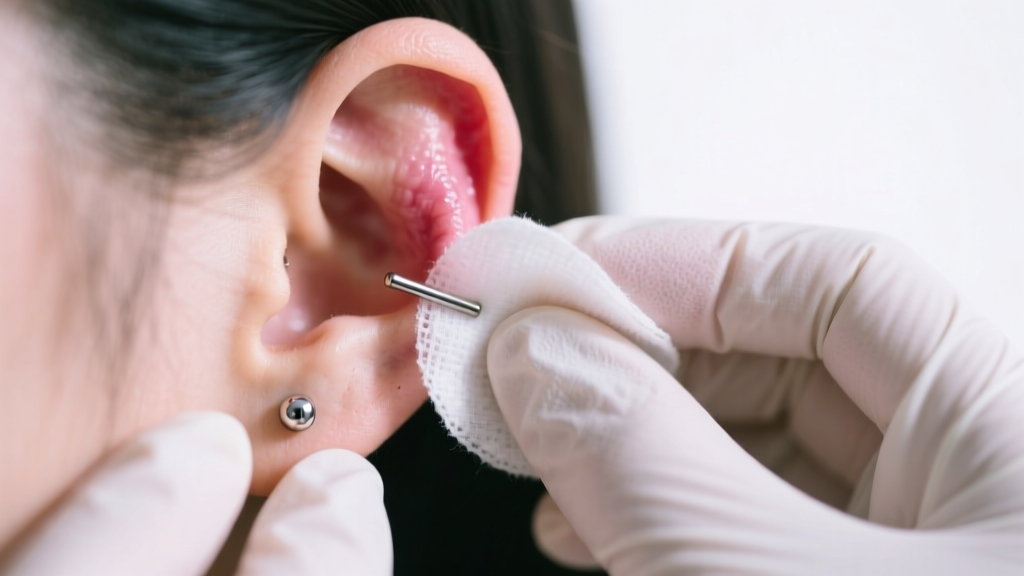
Once the tissue is softened, apply a drop of sterile, water-based lubricant or pure jojoba oil to the front and back of the post. Gently attempt to rotate the earring. If the post spins freely, the skin has not fully epithelialized over the backing. Apply gentle, steady pressure to the front of the stud while pulling the back away from the earlobe. Never use jerking motions, which can tear the fistula.
Step 3: The Push-Through Technique
If the backing is deeply recessed but not fully encased, a professional piercer may use a sterilized taper to gently push the post forward, creating enough clearance to grip the backing with hemostats. If the skin has completely closed over the earring back, stop immediately. At this stage, minor surgical intervention by a healthcare provider or an advanced professional piercer is required to carefully excise the thin layer of skin covering the hardware.
Hardware Culprits: Why Butterfly Backs Fail
The primary cause of earring embedding in modern body modification is the use of improper jewelry backs. Traditional friction-fit backs, commonly known as butterfly clutches, are notorious for trapping moisture, dead skin cells, and bacteria against the healing fistula. Furthermore, their rigid, narrow profile acts like a tourniquet when the ear swells, accelerating the embedding process. The APP Jewelry Guidelines strongly advise against friction backs for any healing piercing.
| Backing Type | Embedding Risk | Mechanism of Failure | Recommended Use |
|---|---|---|---|
| Butterfly Clutch | Extreme | Narrow profile cuts into swollen tissue; traps debris. | Never for healing; avoid entirely. |
| Screw-Back | Moderate | Can overtighten against swelling; threads harbor bacteria. | Healed lobes only. |
| Flat-Back Labret (Threadless) | Negligible | Distributes pressure evenly; allows for custom post lengths. | Gold standard for all fresh piercings. |
| O-Rings / Silicone | Low | Soft and flexible, but can degrade and trap moisture. | Temporary downsizing in healed piercings. |
The Sizing Matrix: Gauge and Post Length
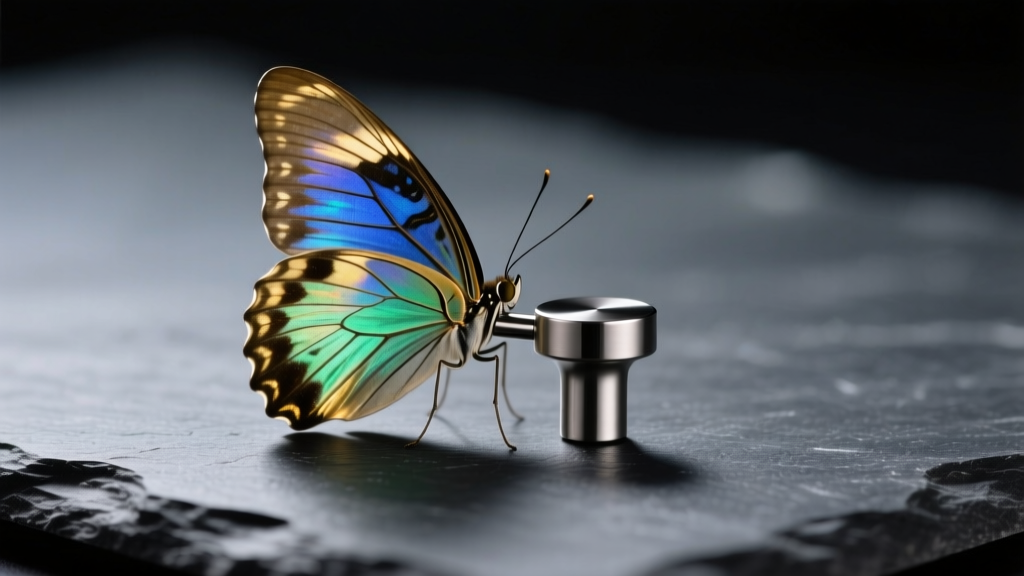
Proper hardware sizing is your ultimate defense against earring embedding. Standard commercial earrings often feature ultra-thin 20-gauge (0.8mm) or 18-gauge (1.0mm) posts. In a healing environment, these thin gauges create a "cheese-cutter effect," where the wire migrates through the swollen tissue. Upgrading to a thicker gauge provides structural stability and reduces the risk of migration and embedding.
Equally important is the post length. A standard 1/4-inch (6mm) post is designed for fully healed, shrunken fistulas. When a fresh piercing swells, a 6mm post will instantly embed. Professional piercers utilize longer posts to accommodate the initial inflammatory phase.
- Initial Lobe Piercings: 16G or 14G thickness; 3/8-inch (10mm) or 5/16-inch (8mm) post length.
- Initial Cartilage (Helix/Conch): 16G thickness; 1/4-inch (6mm) to 5/16-inch (8mm) post length, depending on tissue thickness.
- Downsizing Phase: After 4 to 8 weeks, once swelling subsides, the jewelry must be downsized to a 1/4-inch (6mm) or 3/16-inch (5mm) post to prevent snagging and angle distortion.
Material Grades and Allergic Swelling
Sometimes, embedding is not a mechanical failure but an immunological one. Contact dermatitis triggered by nickel or heavy metal alloys can cause massive, rapid swelling that engulfs the jewelry. Many commercial brands label their products as "surgical steel," but 316L stainless steel contains up to 10% nickel, which leaches into the body and triggers severe inflammatory responses in sensitive individuals.
To eliminate allergic swelling, insist on implant-grade materials. ASTM F-136 implant-grade titanium is completely nickel-free, highly biocompatible, and features a mirror-polished surface that prevents cellular adhesion. Niobium is another excellent, hypoallergenic alternative. By switching to verified implant-grade titanium, you remove the allergic variable, allowing the edema to subside and the tissue to retract from the jewelry post.
When to Seek Professional Intervention
While minor swelling can be managed at home using the protocols outlined by the Association of Professional Piercers (APP), severe earring embedding requires expert hands. If the earring back is entirely invisible beneath the skin, or if the area is radiating heat, leaking yellow or green purulent exudate, or accompanied by a fever, you are likely dealing with an active infection alongside the embedding. In these scenarios, do not attempt removal. Seek a licensed professional piercer or a medical doctor who can administer local anesthesia, safely excise the overgrown tissue, clean the fistula, and insert a sterilized, appropriately sized titanium flat-back labret to maintain the piercing channel while the trauma resolves.


