Why Your Purple Earring Turns Green: Troubleshooting Color Loss
Discover why your purple earring fades, shifts color, or turns skin green. Expert troubleshooting for amethyst, titanium, and enamel jewelry.

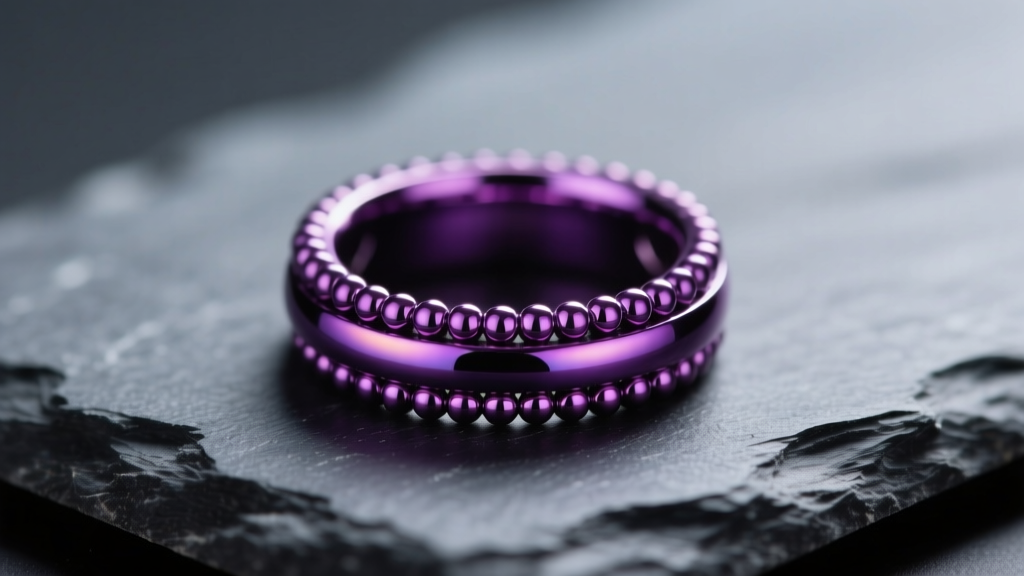
The Chemistry of Color: Why Purple Earrings Change
There are few jewelry hues as captivating as violet and plum, but maintaining a vibrant purple earring requires navigating a minefield of metallurgical and gemological pitfalls. Whether you are wearing a sleek anodized titanium clicker, a faceted amethyst stud, or a hand-painted enamel drop, purple is notoriously one of the most unstable colors in jewelry design. When consumers reach out to our editorial team with troubleshooting questions, the complaints almost always fall into three distinct categories: the jewelry is leaving a green or black smudge on the skin, the vibrant purple hue is mysteriously shifting to bronze or blue, or the gemstone itself is turning pale and cloudy.
To solve these issues, we must first understand that 'purple' in jewelry is not a single material. It is achieved through entirely different scientific mechanisms depending on the medium. In gemstones, purple is the result of trace elements and radiation; in titanium, it is an optical illusion created by light interference; and in fashion jewelry, it is often a surface-level dye or resin. This comprehensive troubleshooting guide will help you diagnose the exact failure mode of your purple earring and provide actionable, expert-level solutions to restore or replace it.
Symptom 1: The 'Green Skin' Reaction (It’s Not the Stone)
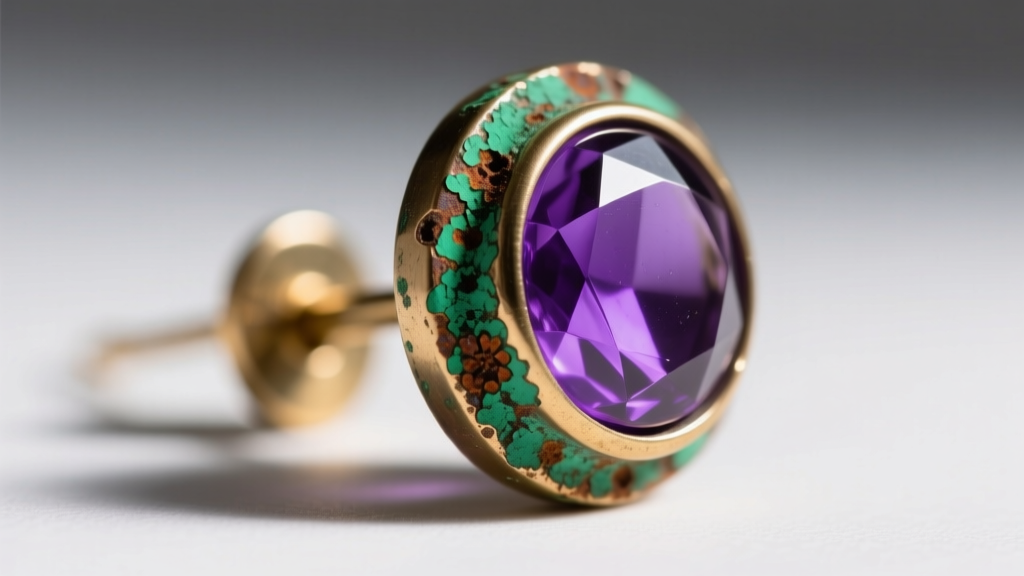
The most common panic we see from readers is the discovery of a green or black ring around their earlobe or cartilage piercing after wearing a new purple earring. It is vital to understand that the purple gemstone or enamel itself is not turning your skin green. The culprit is always the underlying base metal of the earring post, hook, or setting reacting with your unique skin chemistry.
Identifying the Base Metal Culprit
When a purple earring leaves a green residue, you are witnessing a chemical reaction known as oxidation. Most affordable purple earrings are set in brass, 'nickel silver,' or copper alloys. Despite the name, nickel silver contains absolutely no silver; it is an alloy of copper, nickel, and zinc. When the copper in these alloys comes into contact with the natural acids, salts, and oxygen in your sweat, it produces copper chloride—a green compound that easily rubs off onto the skin.
According to dermatological research published by the Mayo Clinic, prolonged exposure to these reactive base metals can also trigger allergic contact dermatitis, leading to redness, itching, and weeping piercings. If your skin has an acidic pH (typically between 4.5 and 5.5), you will accelerate this copper oxidation process, meaning your favorite purple earring will tarnish and stain your skin much faster than someone with a more neutral skin pH.
The Permanent Fix: Upgrading Your Metallurgy
You cannot permanently 'seal' a reactive base metal; clear nail polish or anti-tarnish sprays will eventually wear away due to the friction of inserting the earring post. The only true troubleshooting solution is to swap the metal. For fresh or sensitive piercings, the Association of Professional Piercers (APP) strictly recommends implant-grade titanium (ASTM F136) or solid 14k/18k gold. If you have a purple gemstone set in a reactive base, take it to a local bench jeweler to have the stone re-set into a platinum or solid gold setting.
Symptom 2: Anodized Titanium Color Shifting
If your purple earring is made of titanium and has mysteriously shifted to a muddy bronze, gold, or blue, you are experiencing the realities of voltage anodizing. Anodizing is not a paint or a dye; it is an electrochemical process that thickens the natural oxide layer on the titanium's surface. When light hits this oxide layer, it refracts and reflects back specific colors based on the layer's exact thickness.
To achieve a true, vibrant purple, a jeweler must run the titanium through an electrolytic bath at approximately 90 to 110 volts. If the voltage drops even slightly, or if the surface was not perfectly polished before anodizing, the color will be unstable. Furthermore, because the color is merely a microscopic layer of titanium dioxide, it is highly susceptible to environmental interference.
Why Your Titanium Earring Shifted to Bronze
- Friction and Wear: Constant friction from sleeping on the earring or pulling it through a tight piercing can physically wear down the oxide layer, revealing the raw grey titanium beneath or shifting the color to a lower-voltage hue like bronze.
- Chemical Stripping: Harsh chemicals, including chlorine in swimming pools, rubbing alcohol, and even certain acidic skincare ingredients (like salicylic acid or retinol), can chemically alter the oxide layer.
- Ultrasonic Cleaners: Never put an anodized purple earring in an ultrasonic jewelry cleaner. The high-frequency cavitation can literally blast the delicate oxide layer off the metal, ruining the purple finish permanently.
The Fix: Clean anodized titanium only with warm water and a mild, fragrance-free liquid soap. If the color has already shifted, the piece cannot be 'cleaned' back to purple, but a professional piercer or jeweler with an anodizer can often re-anodize the piece back to purple for a minimal fee, provided the surface is re-polished first.
Symptom 3: Amethyst and Tanzanite Fading
Natural purple gemstones are breathtaking, but they require specific care to maintain their saturation. The two most common purple earring stones are Amethyst (Mohs hardness of 7) and Tanzanite (Mohs hardness of 6.5). Both are vulnerable to environmental damage, but in entirely different ways.
UV Damage and Heat Shock in Amethyst
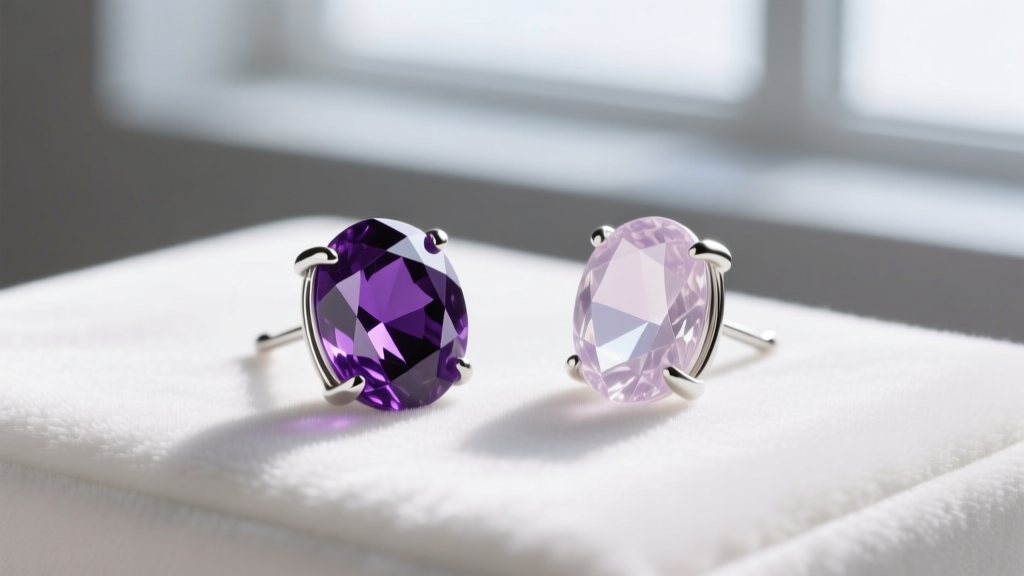
Amethyst derives its purple color from trace amounts of iron impurities that have been naturally irradiated within the earth's crust. However, this color center is sensitive to prolonged exposure to ultraviolet (UV) light and high heat. If you frequently wear your amethyst earrings while sunbathing, hiking in direct sunlight, or using tanning beds, the UV radiation can alter the valence state of the iron, causing the deep violet stone to slowly fade to a pale, washed-out lilac or even yellow-brown (similar to natural citrine). The Gemological Institute of America (GIA) explicitly warns against steam cleaning or exposing amethyst to extreme heat, as thermal shock can also cause internal fracturing, making the stone look cloudy and dull.
The Cleavage Problem with Tanzanite
Tanzanite is a much rarer and more expensive purple-blue stone, but it suffers from perfect cleavage. This means the crystal structure has natural planes of weakness. If you drop a tanzanite earring on a hard tile floor, or even bump it sharply against a doorframe, the stone can develop internal micro-fractures. These fractures disrupt the way light passes through the gem, causing it to lose its brilliance and appear 'faded' or dead. To troubleshoot this, inspect the stone under a jeweler's loupe; if you see web-like internal lines, the stone's structural integrity is compromised and it must be re-cut or replaced.
Troubleshooting Matrix: Quick Fixes & Prevention
| Symptom | Material Culprit | Root Cause | Permanent Fix / Prevention |
|---|---|---|---|
| Green/Black skin smudges | Brass, Copper, Nickel Silver | Sweat acids reacting with copper to form copper chloride | Re-set stone in 14k gold or ASTM F136 titanium |
| Purple shifting to bronze/gold | Anodized Titanium | Oxide layer worn down by friction, oils, or ultrasonic waves | Wash with mild soap; have professionally re-anodized |
| Stone turning pale or yellow | Amethyst (Quartz) | Prolonged UV exposure altering iron color centers | Store in dark jewelry box; avoid direct sunlight/heat |
| Stone looking cloudy/dull | Tanzanite, Sugilite | Internal micro-fractures from impact (perfect cleavage) | Remove during exercise; inspect with 10x jeweler's loupe |
| Chipping or peeling purple | Epoxy Resin / Cold Enamel | UV degradation and physical scratching of surface dye | Upgrade to vitreous (kiln-fired) enamel or solid stones |
Expert Buying Guide: Securing a Fade-Proof Purple Earring
If you are currently shopping for a replacement and want to avoid these troubleshooting nightmares, prioritize material transparency. When buying a purple earring, always demand to know the exact metal grade of the post and the backing. Avoid terms like 'silver-plated' or 'gold-tone,' as these are almost always copper alloys waiting to tarnish. For the safest, most hypoallergenic experience that will never turn your skin green, look for jewelry stamped with 'F136' (implant-grade titanium) or '14k/18k Solid'.
Furthermore, if you are buying purple enamel, ask the artisan if they use vitreous enamel (glass fused to metal at over 1400°F) or cold enamel (epoxy resin). Vitreous enamel is completely UV-stable, scratch-resistant, and will remain a brilliant, glass-like purple for generations, whereas cold enamel will inevitably yellow, chip, and fade within a few years of daily wear. By understanding the science behind the sparkle, you can curate a collection of purple earrings that remain as vivid and striking as the day you first put them on.


