Rubik's Cube Earrings: Material Comparison & Piercing Safety
Discover the best materials for Rubik's cube earrings. Compare enamel, titanium, and resin for durability, weight, and hypoallergenic piercing safety.

The Anatomy of Novelty: Why Material Matters in Geometric Earrings
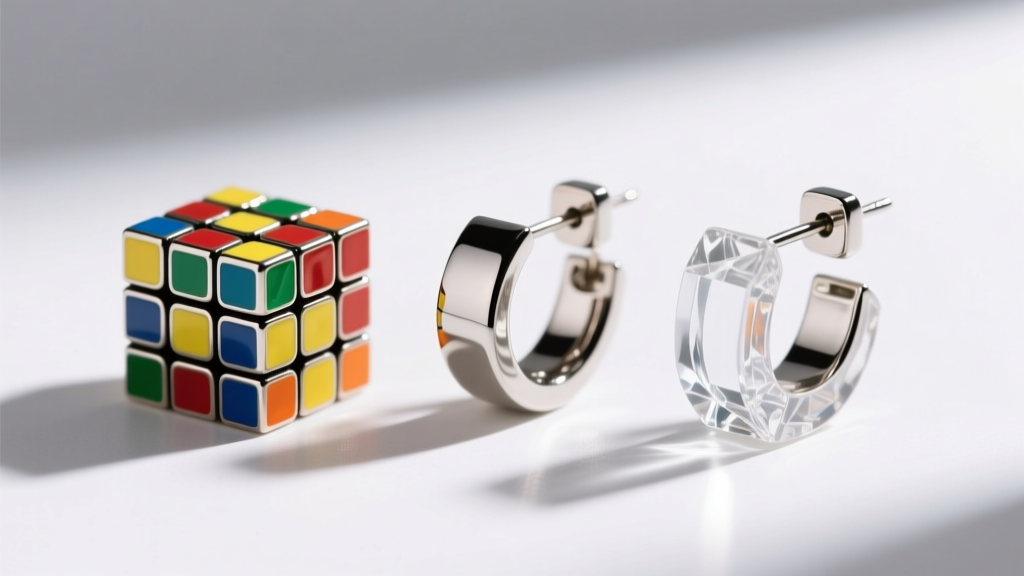
When it comes to novelty jewelry, aesthetic appeal often overshadows structural integrity. Rubik's cube earrings are a prime example of this phenomenon. While their nostalgic, geometric charm makes them a staple in quirky fashion and retro-themed styling, the physical properties of a cube present unique challenges for ear piercings. A cube is inherently blocky, meaning its weight distribution sits further away from the earlobe compared to a flat disc or a streamlined hoop. This creates a lever effect that can stretch piercings over time if the material is too dense.
Furthermore, the multi-colored nature of the Rubik's cube requires complex manufacturing techniques—ranging from cheap painted enamels to advanced titanium anodization. For anyone with sensitive ears or a history of contact dermatitis, understanding what your novelty earrings are actually made of is not just a matter of quality; it is a matter of medical necessity. According to the American Academy of Dermatology, nickel is one of the most common culprits for allergic contact dermatitis, and it is frequently hidden in the base metals of affordable novelty jewelry.
Material Breakdown: What Are Your Earrings Actually Made Of?
To make an informed purchase, we must dissect the four primary material categories used in the production of Rubik's cube earrings, evaluating their metallurgical properties, weight, and biocompatibility.
Zinc Alloy (Zamak) and Painted Enamel
The vast majority of sub-$20 Rubik's cube earrings found in fast-fashion retailers are cast from Zamak, a zinc alloy containing aluminum, magnesium, and copper. While Zamak is excellent for capturing sharp, geometric molds, it is highly porous and requires an electroplated undercoat—often containing nickel—before the colored enamel is applied. The colors are typically achieved using epoxy resin (cold enamel) or acrylic paint. Over time, the friction of daily wear causes the painted enamel to chip, exposing the reactive base metal underneath to your skin and moisture.
925 Sterling Silver with Inlaid Cold Enamel
Mid-tier jewelry brands often upgrade the base metal to 925 sterling silver. This eliminates the nickel underplating risk, making the post significantly safer for sensitive lobes. The colors are usually achieved through 'cold enamel' (a two-part epoxy resin mixed with pigments) which is carefully inlaid into recessed squares on the silver cube. While sterling silver is a precious metal, it is relatively dense. A solid 10mm sterling silver cube can weigh upwards of 10 grams, which is heavy enough to cause the 'cheese-cutter' effect, slowly migrating your piercing downward.
Grade 23 Titanium and Voltage Anodization
For the ultimate hypoallergenic experience, high-end independent jewelers craft Rubik's cube earrings from ASTM F136 compliant Grade 23 Titanium. Instead of using paint or resin, the colors are achieved through anodization. By running an electrical current through the titanium in an electrolyte bath, a transparent oxide layer forms on the surface. Varying the voltage changes the thickness of this layer, which refracts light to produce vibrant, permanent colors (e.g., 15V for gold, 60V for green, 90V for blue). Because there are no dyes or enamels to chip off, anodized titanium cubes are virtually indestructible and 100% biocompatible. You can verify these standards via ASTM International.
3D-Printed Resin and Acrylic
The modern maker movement has introduced high-resolution SLA (Stereolithography) 3D-printed resin cubes. These are incredibly lightweight and can be painted with automotive-grade clear coats for high gloss. Because a 10mm resin cube weighs less than 1.5 grams, it is the ideal material for cartilage piercings, upper lobes, or stretched earlobes where heavy metals would cause immediate discomfort or migration.

Comparative Analysis: Weight, Allergens, and Colorfastness
The following table synthesizes the physical properties of a standard 10mm Rubik's cube earring across different material grades. Use this framework to match the jewelry to your specific piercing type and lifestyle.
| Material Composition | Avg. Weight (10mm) | Biocompatibility | Color Method | Best Piercing Placement |
|---|---|---|---|---|
| Zamak / Base Metal | ~7.5g | Poor (High Allergy Risk) | Surface Paint / Epoxy | Occasional wear only |
| 925 Sterling Silver | ~10.4g | Good (Nickel-Free) | Inlaid Cold Enamel | Standard lower lobes |
| Grade 23 Titanium | ~4.5g | Excellent (Implant Grade) | Voltage Anodization | Fresh piercings, sensitive ears |
| SLA 3D Printed Resin | ~1.2g | Moderate (Coating dependent) | Pigmented Resin | Cartilage, helix, stretched lobes |
Overcoming the 'Novelty Post' Problem
The most critical failure point in novelty earrings is not the cube itself, but the post. To maximize profit margins, manufacturers frequently solder thin, 22-gauge (0.64mm) or 20-gauge (0.81mm) brass or steel posts to the back of heavy metal cubes. When a 7-gram cube is supported by a 0.64mm wire, the pressure exerted on the fistula (the piercing hole) is immense. This leads to inflammation, tearing, and permanent stretching of the earlobe.
The Expert Fix: If you are purchasing heavy enamel or silver cubes, inspect the post thickness. You want a minimum of 18-gauge (1.02mm) or ideally 16-gauge (1.29mm) for structural support. If you already own a pair of heavy novelty earrings with thin, irritating posts, take them to a local bench jeweler. For a nominal fee (usually $15-$25), a jeweler can snip off the base metal post and laser-weld a thick, implant-grade titanium post in its place, completely transforming a hazardous fast-fashion accessory into a safe, wearable piece of art.

Care and Maintenance: Preserving the Colors of the Cube
The maintenance protocol for your earrings depends entirely on the coloring method used during manufacturing. Treating all earrings the same is a fast track to ruined jewelry.
- For Painted and Cold Enamel Cubes: Never use ultrasonic cleaners or harsh chemical dips (like silver polishing baths). The high-frequency vibrations will shatter the bond between the epoxy resin and the metal base, causing the colored squares to pop out. Clean these exclusively with a drop of mild dish soap, warm water, and a baby toothbrush.
- For Anodized Titanium Cubes: Titanium is virtually impervious to tarnish, but the anodized oxide layer can be scratched by abrasive materials. Avoid polishing cloths that contain jeweler's rouge. Simply wipe them down with a microfiber cloth and isopropyl alcohol to remove sebum and skin cells.
- For 3D Printed Resin: Prolonged exposure to UV sunlight will cause yellowing in lighter-colored resins (especially the white and yellow squares of the cube). Store resin earrings in an opaque jewelry box when not in use to maintain color accuracy.
Final Verdict: Choosing the Right Pair for Your Lifestyle
Rubik's cube earrings are a brilliant conversation starter, but they demand a more critical eye for material science than standard stud earrings. If you are buying for a child or for a one-time costume event, Zamak and painted enamel will suffice. However, for daily wear, especially for those with metal sensitivities, investing in anodized Grade 23 titanium or lightweight 3D-printed resin ensures that your love for retro geometry doesn't come at the expense of your piercing health. Always prioritize post thickness, verify the base metal, and match the weight of the cube to the structural limits of your specific piercing placement.