How to Select and Style Triangle Diamond Earrings: Expert Guide
Master the art of choosing triangle diamond earrings. Learn step-by-step how to match cut, setting, and face shape for a flawless, modern look.

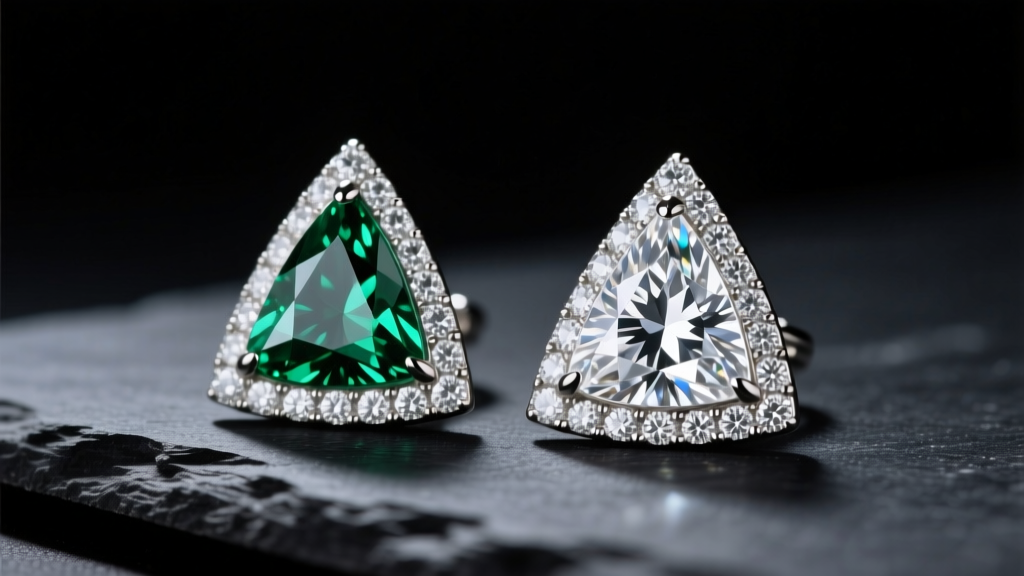
The Geometry of Brilliance: Understanding Triangle Diamonds
Triangle diamond earrings—often featuring the trillion or trilliant cut—represent a bold, architectural departure from traditional round brilliants and princess cuts. Characterized by their striking three-sided geometry and sharp, modern lines, these earrings require a highly specialized approach to selection. Unlike round diamonds, which are graded heavily on symmetry and light return, triangular diamonds demand meticulous attention to corner integrity, depth percentages, and setting architecture. According to the Gemological Institute of America (GIA), fancy shapes like the trillion require a different evaluation matrix, as their elongated points and unique faceting patterns interact with light in entirely distinct ways. This step-by-step guide will walk you through the exact technical specifications, setting requirements, and styling frameworks needed to choose the perfect pair of triangle diamond earrings.
Step 1: Decoding the 4Cs Specifically for Trillion Cuts
Applying standard round diamond grading to triangle diamond earrings will result in a suboptimal purchase. The trillion cut typically features 31 to 50 facets, and its unique shape dictates strict parameters for color, clarity, and cut proportions.
Cut Proportions: Avoiding Light Leakage
The most critical factor in a trillion cut is the depth percentage. For optimal brilliance, the depth should fall strictly between 32% and 48%, with a table percentage between 50% and 60%. Triangles cut too shallow will exhibit a 'fisheye' effect, where the girdle is reflected inside the stone, while stones cut too deep will suffer from severe light leakage in the center, appearing dark and lifeless. Always request an ASET (Angular Spectrum Evaluation Tool) image from the jeweler to verify light performance before purchasing.
Color Concentration at the Points
The sharp corners of a triangle diamond naturally concentrate body color. While you might comfortably purchase an 'I' or 'J' color grade in a round brilliant, doing so in a trillion cut will result in visible yellowing at the three points. For white gold or platinum triangle diamond earrings, stick to a minimum of G or H color grades. If setting in 18k yellow gold, you can safely drop to an I color, as the warm metal will mask the faint tint.
Clarity and Structural Vulnerabilities
The American Gem Society (AGS) warns that inclusions located near the girdle or the sharp points of fancy shapes pose a significant chipping risk during the setting process. Avoid any triangle diamond with SI2 or I1 clarity grades where carbon spots or feathers are mapped near the corners. A minimum of VS2 clarity is highly recommended to ensure the structural integrity of the points, which are subjected to immense pressure when prongs are tightened.
Step 2: Selecting the Correct Setting Architecture
The setting is not merely an aesthetic choice for triangle diamond earrings; it is a structural necessity. The three points of a trillion cut are highly vulnerable to impact and snagging.
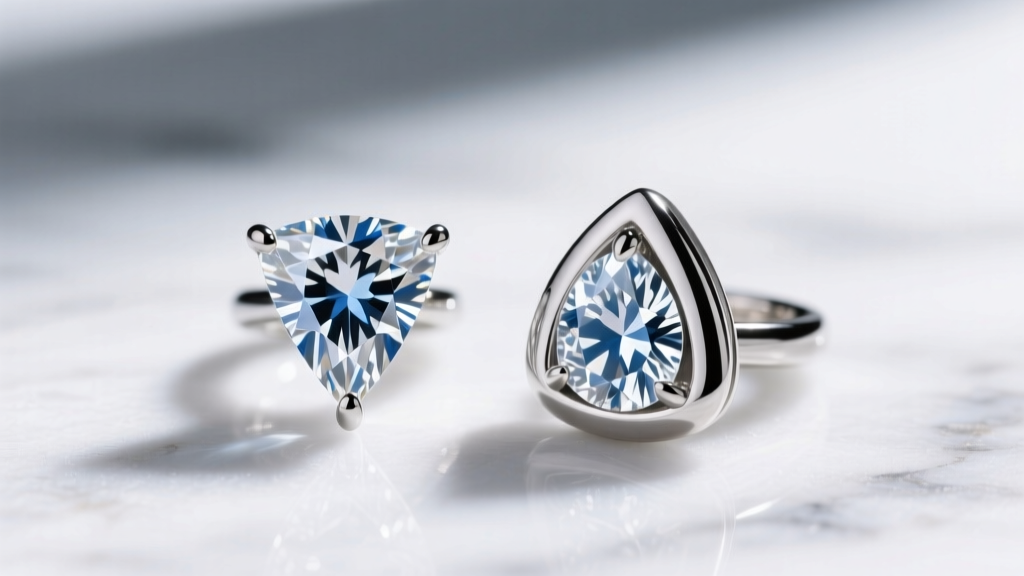
- The V-Prong Setting: This is the industry standard for exposed trillion diamonds. Unlike standard round prongs, a V-prong wraps around the sharp corner, cradling it in a protective metal sleeve. Ensure the V-prongs are cast in a durable alloy like 14k gold or platinum, with a minimum thickness of 0.8mm at the apex to prevent bending.
- The Custom Bezel: For active lifestyles or daily-wear studs, a full bezel setting is the ultimate protective measure. A master jeweler will craft a custom triangular metal rim that completely encases the girdle and points. While a bezel reduces the face-up spread by roughly 0.2mm, it eliminates the risk of corner chipping entirely.
- The Halo Setting: If you want to maximize the visual footprint of your earrings, a triangular halo of melee diamonds adds perceived size. However, the melee stones must be precisely calibrated (usually 1.0mm to 1.3mm) to maintain the straight, geometric lines of the outer edge. A poorly executed halo will look wavy and distort the triangle's sharp silhouette.
'A trillion cut diamond is only as secure as its weakest corner. Never compromise on V-prong thickness or bezel precision to save on metal weight.' — Master Bench Jeweler
Step 3: Face Shape Mapping and Orientation
The orientation of triangle diamond earrings—whether the point faces up, down, or outward—drastically alters how they frame the face. Use the following decision matrix to match the earring style and orientation to your specific bone structure.
| Face Shape | Recommended Orientation | Best Earring Style | Visual Effect |
|---|---|---|---|
| Round | Point facing down (Inverted) | Drop or Dangle | Elongates the jawline and adds angular contrast to soft features. |
| Square / Angular | Point facing outward | Stud or Huggie | Softens the jawline by drawing the eye horizontally rather than vertically. |
| Heart | Point facing up | Stud or Ear Cuff | Mirrors the natural taper of the chin, balancing a wider forehead. |
| Oval | Any orientation | Statement Drops | Oval faces are highly versatile; experiment with asymmetrical triangle drops. |
Step 4: Styling Frameworks for 2026 and Beyond
Triangle diamond earrings are inherently avant-garde, making them a staple in contemporary fine jewelry styling. As we move through 2026, the trend has shifted away from perfectly matched, symmetrical sets toward intentional, curated asymmetry.

The Asymmetrical Ear Stack
Instead of wearing two identical triangle studs, try anchoring one ear with a 1.00ct bezel-set trillion stud (point facing up) and styling the opposite ear with a cascading drop earring featuring smaller, inverted trillion accents. This creates a dynamic, editorial look that feels highly personalized.
Wardrobe Pairing and Necklines
The sharp geometry of triangle earrings demands complementary necklines. Deep V-necks and sweetheart necklines naturally echo the triangular motif, creating a cohesive visual flow. Avoid high, ruffled collars or complex halter necks, which will compete with the sharp lines of the diamonds and increase the risk of the prongs snagging on delicate fabrics.
Step 5: Long-Term Maintenance and Prong Inspection
Maintaining triangle diamond earrings requires a stricter regimen than traditional round studs due to the complex setting architecture and corner vulnerabilities.
- Biannual Prong Audits: Have a jeweler inspect the V-prongs under 10x magnification every six months. The metal at the very tip of the V-prong is prone to wear and can pull away from the diamond's corner if struck against a hard surface.
- Safe Cleaning Protocols: Avoid ultrasonic cleaners, especially if your triangle earrings feature a halo or pave accents. The high-frequency vibrations can easily shake loose the tiny melee stones set along the straight edges. Instead, soak the earrings in a solution of warm water and a few drops of mild dish soap for 15 minutes, then gently agitate with a soft-bristled baby toothbrush.
- Storage Isolation: Never store triangle earrings loose in a jewelry box. The sharp points can easily scratch the pavilions of other diamonds or become blunted against harder gemstones like sapphires. Always store them in individual microfiber pouches or dedicated fabric-lined compartments.
By respecting the unique gemological properties and structural demands of the trillion cut, you can confidently invest in a pair of triangle diamond earrings that offer unparalleled modern elegance, enduring durability, and striking visual impact.


