Expert Guide to Shrimp Hoop Earrings: Sizing, Hinges & Metal Grades
Master the mechanics of shrimp hoop earrings. Explore hinge types, 14k vs 18k gold durability, gauge sizing, and cleaning techniques for segmented hoops.

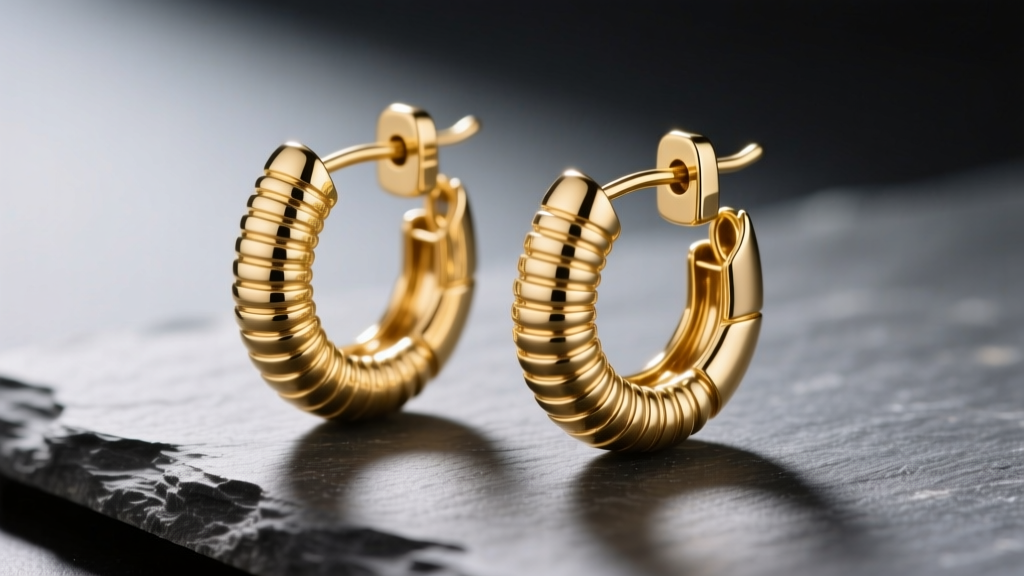
Shrimp hoop earrings have evolved from a niche vintage novelty into a staple of modern fine jewelry. Characterized by their ribbed, segmented, and slightly tapered tubular silhouettes, these hoops mimic the natural topography of a shrimp shell. However, beneath this organic aesthetic lies a complex intersection of metallurgy, precision engineering, and structural physics. As of 2026, the market has seen a massive shift toward CNC-milled solid gold options, replacing the fragile hollow-cast models of the past decade. This guide provides a technical deep dive into the anatomy, material grades, hinge mechanics, and maintenance protocols required to evaluate, wear, and preserve shrimp hoop earrings.
The Anatomy of the Shrimp Silhouette
Unlike standard round-wire hoops, shrimp hoops are defined by their transverse ridges. These segments are not merely decorative; they serve a critical structural purpose. The ribbed topography increases the moment of inertia of the earring's cross-section, providing structural rigidity without requiring a massive, heavy solid core.
- Transverse Ridges: Act as corrugated supports, preventing the tubular hoop from bending or warping under lateral stress.
- Tapered Profile: Most high-end shrimp hoops feature a subtle taper, being slightly thicker at the bottom (the 6 o'clock position) and narrowing toward the hinge. This lowers the center of gravity, ensuring the earring hangs perfectly perpendicular to the earlobe without flipping forward.
- Surface Refraction: The alternating convex ridges and concave valleys create multiple micro-facets. This increases the surface area for light refraction, giving polished gold a high-contrast, liquid-like shine that flat hoops cannot achieve.
Metallurgy & Material Grades: 14k vs. 18k Gold
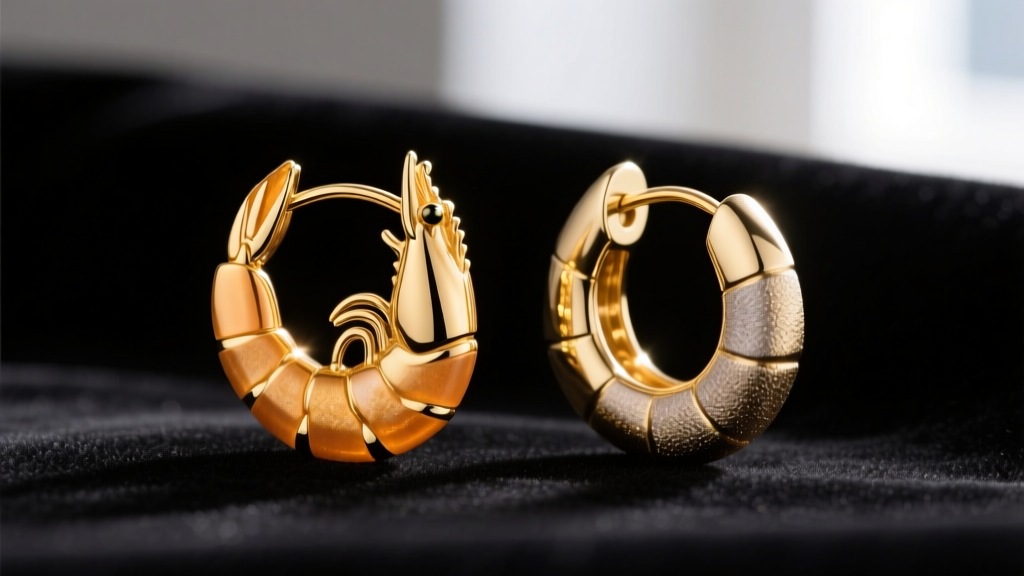
When selecting shrimp hoop earrings, understanding the alloy composition is critical. The thin walls between the ribbed segments are highly susceptible to stress fractures and denting, making the choice between 14k and 18k gold a matter of structural integrity, not just color preference.
Alloy Composition and Vickers Hardness
According to the Gemological Institute of America (GIA), pure 24k gold is far too malleable for daily-wear jewelry. Therefore, it is alloyed with metals like copper, silver, and zinc.
- 14k Gold (58.5% Pure Gold): With a Vickers hardness (HV) of approximately 140-160 (depending on the specific copper/silver ratio), 14k gold is significantly harder and more resistant to scratching. For shrimp hoops, where the ridges act as primary impact zones, 14k is the superior choice for daily wear.
- 18k Gold (75% Pure Gold): Offering a richer, deeper yellow hue, 18k gold has a lower Vickers hardness (around 110-125 HV). While visually stunning, the thin segment walls of an 18k shrimp hoop are more prone to micro-denting if dropped on a hard surface or compressed.
For individuals with metal sensitivities, the Association of Professional Piercers (APP) recommends ensuring that the alloy is strictly nickel-free, particularly in white gold shrimp hoops, which historically relied on nickel for bleaching and hardening. Modern 2026 benchmarks favor palladium-alloyed white gold for biocompatibility.
The Hollow vs. Solid Construction Debate
One of the most critical failure modes in segmented hoop earrings stems from their internal construction. Historically, to keep gold weights (and prices) manageable, manufacturers utilized electroforming or hollow-casting techniques.
Hollow Shrimp Hoops: Created by depositing gold over a wax or resin core that is later melted away. While lightweight, the outer gold shell is often less than 0.4mm thick. If a hollow shrimp hoop is squeezed or dropped, the ridges will crush inward. Once a hollow segment is dented, it is virtually impossible for a jeweler to repair without collapsing the entire structure.
Solid CNC-Milled Hoops: The 2026 industry standard for fine jewelry. Milled from a solid billet of gold, these hoops are heavier but virtually indestructible under normal wear conditions. The ridges can be polished repeatedly over decades without risking structural breach.
Hinge Mechanics: Clicker vs. Saddle Closures
The hinge is the mechanical heart of any hoop earring. Because shrimp hoops feature a thick, tubular profile, the hinge mechanism must be engineered to bear the rotational weight of the hoop without loosening over time.
| Feature | Clicker Closure | Saddle / Snap Hinge |
|---|---|---|
| Mechanism | Internal tension pin snaps into a machined groove. | Hinged post with a notched tip that clicks into a receiver. |
| Security Level | Extremely High (requires deliberate pressure to open). | Moderate to High (can loosen if the post is bent). |
| Audible Feedback | Distinct, sharp 'click'. | Soft snap or dull thud. |
| Best For | Heavy, solid gold shrimp hoops. | Lightweight, hollow, or smaller huggie-style hoops. |
| Failure Mode | Pin tension loss (requires jeweler adjustment). | Post bending or receiver groove wear. |
For standard lobe piercings, a 16-gauge (1.2mm) or 14-gauge (1.6mm) clicker post is ideal. The thicker post provides the necessary internal channel for the clicker pin, ensuring the hinge does not snap under the leverage of a heavy, 5mm-thick shrimp hoop.
Gauge Sizing and Dimensional Math
A common point of confusion when purchasing shrimp hoop earrings online is the discrepancy between Inner Diameter (ID) and Outer Diameter (OD). Because shrimp hoops are tubular and thick, the visual footprint is much larger than the ID suggests.
Calculating the True Footprint
If you require a specific visual size, you must calculate the OD using the formula: OD = ID + (2 × Wall Thickness). For a standard 3.5mm thick shrimp hoop with a 15mm ID, the actual outer footprint will be 22mm. Wearing a 22mm OD hoop on a standard lobe piercing will result in the earring resting closely against the jawline, whereas a 12mm ID (19mm OD) will hug the earlobe tightly.
Maintenance: Cleaning the Segmented Crevices
The transverse ridges that give shrimp hoops their name also create micro-crevices that trap sebum, dead skin cells, cosmetics, and environmental dust. If left uncleaned, this buildup oxidizes and creates a dull, grayish film in the valleys of the hoop.
Expert Warning: Avoid placing hollow shrimp hoops in ultrasonic cleaners. The high-frequency cavitation can create micro-fractures in the thin gold shells or cause trapped moisture inside the hollow core to expand, leading to catastrophic seam splitting.
The Optimal Cleaning Protocol:
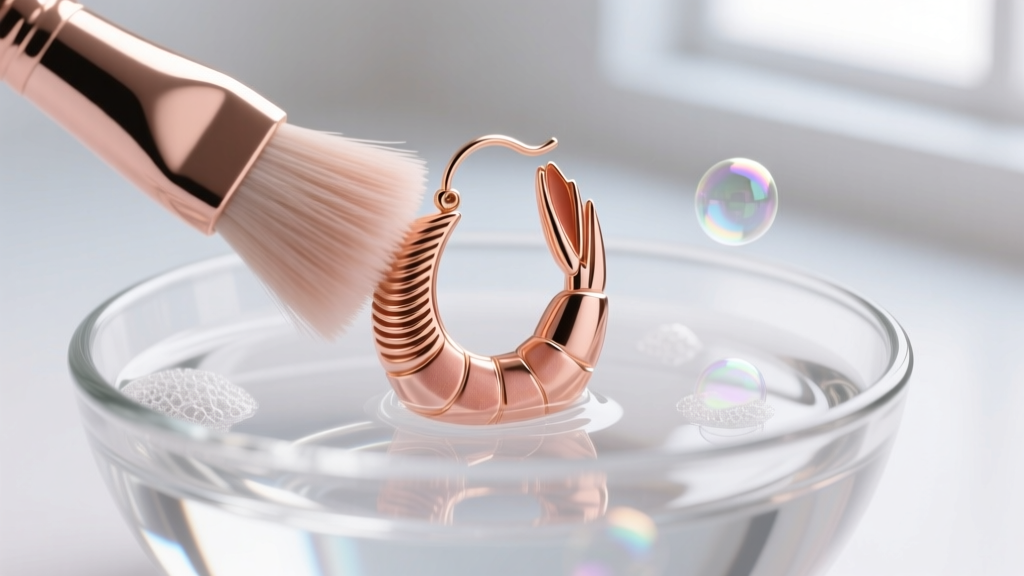
- Submerge the earrings in a bowl of warm water mixed with a few drops of degreasing dish soap (such as Dawn) for 10 minutes.
- Use a soft-bristled detailing brush or a clean, ultra-soft toothbrush to gently agitate the crevices along the grain of the segments.
- Rinse thoroughly under distilled water to prevent hard water spots.
- Dry immediately with a lint-free microfiber cloth, ensuring no fibers are caught in the hinge mechanism.
2026 Pricing Tiers and Brand Benchmarks
The pricing of solid gold shrimp hoop earrings is dictated by three factors: the spot price of gold, the total gram weight, and the manufacturing complexity (CNC milling vs. casting). Based on current 2026 market data, buyers can expect the following pricing tiers for a standard pair (15mm ID, 3.5mm thickness):
- Entry-Level Solid 14k ($250 - $450): Typically cast rather than milled. May feature slight seam lines near the hinge and less defined ridge edges. Excellent for everyday beater hoops.
- Mid-Tier Precision 14k/18k ($500 - $900): CNC-milled from solid billets. Features seamless hinge integration, perfectly uniform segments, and high-polish finishes. Brands in this tier often use proprietary clicker mechanisms with lifetime hinge warranties.
- Designer / High-Jewelry ($1,200 - $3,000+): Often crafted in 18k or 22k gold, featuring hand-chased ridges, micro-pave diamond accents nestled within the valleys, or mixed-metal oxidation techniques. Pricing here reflects brand equity and intensive hand-finishing labor.
Ultimately, investing in shrimp hoop earrings requires looking past the aesthetic and evaluating the engineering. By prioritizing solid construction, appropriate gold hardness, and precision clicker hinges, you secure a piece of jewelry that is as mechanically sound as it is visually striking.


