Silver Chunky Hoop Earrings: The 2026 Style Guide
Discover how to style silver chunky hoop earrings in 2026. Expert analysis on weights, gauges, sterling silver grades, and face-shape pairings.


The Resurgence of Heavy Metal: Why Chunky Silver Hoops Dominate 2026
The jewelry landscape in 2026 has decisively shifted away from the whisper-thin, barely-there minimalism of the early 2020s. Today, volume and architectural presence are paramount, and nowhere is this more evident than in the explosive demand for silver chunky hoop earrings. No longer relegated to nostalgic Y2K revivals, the modern chunky hoop has evolved into a sophisticated, sculptural staple that anchors both high-fashion editorial looks and elevated everyday wardrobes. But as the physical dimensions of these earrings expand, so do the technical challenges regarding material integrity, lobe health, and styling proportions. This comprehensive guide breaks down the metallurgy, biomechanics, and styling frameworks you need to master the heavy silver hoop trend.
The Anatomy of a Perfect Chunky Silver Hoop
What exactly qualifies as 'chunky' in the current market? While standard hoop earrings typically feature a wire thickness of 1.5mm to 2.5mm, true chunky hoops boast a tubular or solid wire diameter ranging from 6mm to 14mm. The outer diameter usually sits between 25mm (a chunky huggie) and 45mm (a statement mid-size hoop).
The Clasp Mechanism: Where Heavy Hoops Fail
The most critical failure point of any heavy earring is the clasp. Standard post-and-butterfly closures are entirely inadequate for chunky silver hoops. The sheer weight of the silver creates a lever effect that pulls the post downward, causing the butterfly back to slip off or the post to bend. In 2026, the industry standard for premium chunky hoops is the hinged snap-back clicker with a reinforced latch. For hoops exceeding 20 grams, look for designs that incorporate a secondary silicone O-ring lock or a tensioned clicker mechanism that requires a deliberate squeeze to open, preventing accidental loss when catching on heavy winter knits or scarves.
Material Grades: 925 Sterling vs. Argentium vs. Plated
When investing in substantial volumes of silver, the specific alloy you choose dictates the longevity, color, and maintenance requirements of the piece. The market is currently saturated with misleading material descriptions, making metallurgical literacy essential.
Standard 925 Sterling Silver
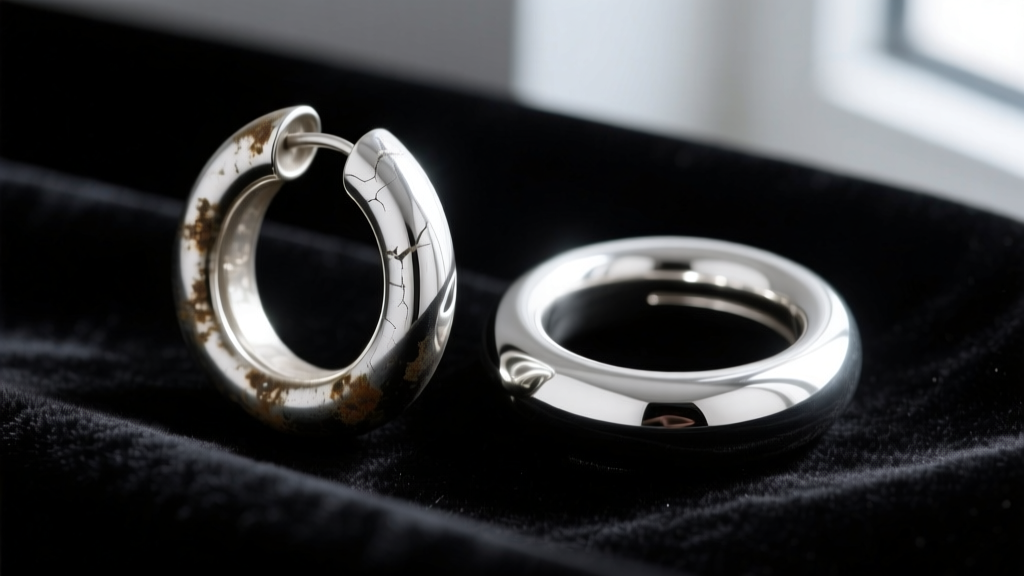
Composed of 92.5% pure silver and 7.5% copper, standard sterling is the industry baseline. The copper provides necessary structural hardness—pure silver is too soft to support a heavy hoop's structural integrity without warping. However, copper is highly reactive to sulfur and moisture, leading to the familiar black silver sulfide tarnish. If you live in a humid climate, 925 silver chunky hoops will require weekly polishing to maintain their high-gloss mirror finish.
Argentium Silver (960 Grade)
For the modern consumer seeking low-maintenance luxury, Argentium silver is the superior choice. By replacing a portion of the copper with the metalloid germanium, Argentium creates a transparent, self-healing layer of germanium dioxide on the surface. According to the Gemological Institute of America (GIA), this unique metallurgical property makes Argentium highly resistant to sulfide tarnish while offering a naturally brighter, whiter luster that more closely mimics expensive platinum or white gold. Expect to pay a 20% to 35% premium over standard 925 for genuine Argentium pieces.
The Plated Brass Trap
Many fast-fashion brands offer 'chunky silver hoops' that are actually hollow brass tubes plated with a microscopic layer of silver. Because the hoop is hollow, it lacks the satisfying weight and acoustic 'clink' of solid silver. More importantly, once the friction of daily wear breaches the plating, the underlying brass will oxidize green against the skin and cannot be polished back to a silver finish. Always verify that the piece is stamped '.925' or 'AG960' and is solid or thick-walled tubular construction.
Weight and Gauge: Avoiding the Dreaded Lobe Stretch
The most overlooked aspect of buying heavy jewelry is the biomechanical impact on the earlobe. A standard, healthy earlobe piercing is performed at 18-gauge (1.0mm) or 20-gauge (0.8mm). While the body of a chunky hoop may be 10mm thick, the wire or post that actually passes through the piercing must remain at this standard gauge to fit the ear. This creates a severe weight-to-surface-area ratio.
The Association of Professional Piercers (APP) frequently warns against the 'cheese-cutter effect,' where prolonged wear of heavy jewelry on a thin wire slowly migrates the piercing downward, permanently stretching the tissue. Below is a functional weight matrix to help you gauge your wearing limits.
| Earring Weight (Per Ear) | Comfort Level | Recommended Wear Time | Support Required? |
|---|---|---|---|
| 5g - 12g | Excellent | 12+ Hours (All Day) | No |
| 13g - 18g | Moderate | 6 - 8 Hours | Optional Silicone Patches |
| 19g - 25g | Heavy / Fatiguing | 3 - 5 Hours (Events) | Mandatory Lobe Patches |
| 26g+ | Unsustainable | Under 2 Hours | Custom Harnesses / Clips |
Pro-Tip for Heavy Hoop Wearers
If you purchase a pair of solid 12mm tubular silver hoops that weigh 22 grams each, invest in invisible silicone earring support patches. These adhesive discs sit behind the earlobe, distributing the downward pressure across a wider surface area of skin and preventing the piercing hole from elongating over time.
2026 Trend Forecast: Sculptural and Asymmetrical Silhouettes
The runway dictates the streets, and the 2026 trend cycle has pushed the chunky silver hoop into avant-garde territory. We are seeing a distinct move away from perfect, machine-stamped circles toward organic, hand-finished forms.
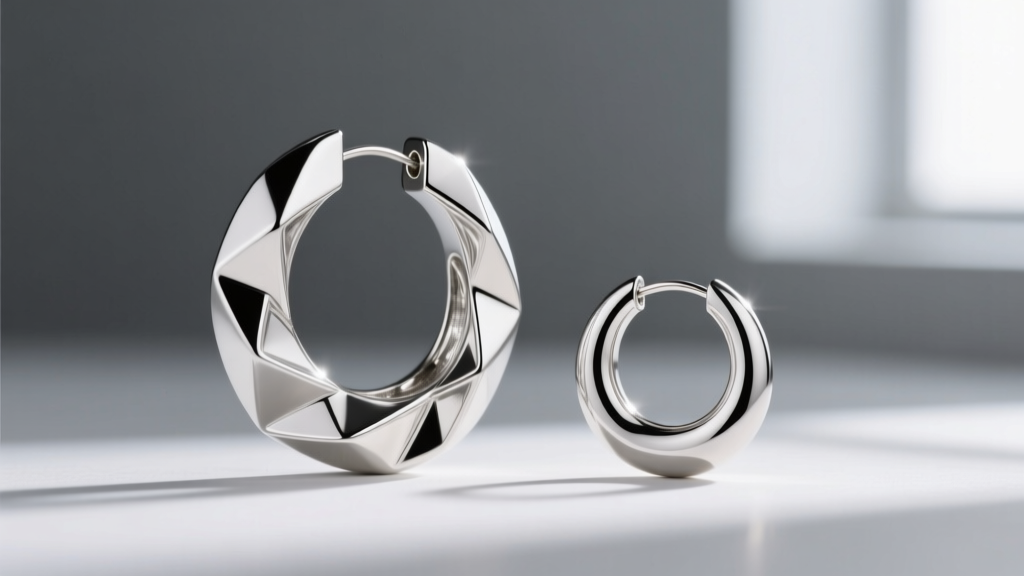
- The Molten Finish: High-polish mirror finishes are being replaced by 'liquid' or 'molten' silver textures. This hand-hammered, slightly irregular surface treatment not only looks incredibly modern but also hides the micro-scratches that inevitably plague wide bands of polished silver.
- The Asymmetrical Stack: Symmetry is out. The dominant styling framework in 2026 involves wearing a single, oversized 40mm chunky hoop on one ear, balanced by a tight, 15mm chunky huggie and a delicate threader on the opposite ear. This creates visual tension and allows the silver to frame the face dynamically.
- The Squircle Silhouette: Blending the sharp geometry of a square with the soft curves of a circle, the 'squircle' hoop offers the visual weight of a chunky tube but with an architectural, modernist edge that pairs flawlessly with structured tailoring and sharp blazers.
Face Shape and Proportion Matrix
Because chunky hoops command significant visual real estate, selecting the correct outer diameter and tube thickness for your specific face shape is crucial for achieving a harmonious balance.
Round and Square Faces
To elongate the facial structure, avoid perfectly circular, wide-tube hoops that end at the jawline, as they will emphasize width. Instead, opt for elongated oval chunky hoops or teardrop silhouettes that draw the eye vertically. A 35mm outer diameter with an 8mm tube thickness provides the perfect anchor without overwhelming the cheekbones.
Oval and Heart Faces
These face shapes possess natural verticality and balanced proportions, meaning they can easily carry the most extreme volumes of the chunky hoop trend. A classic, perfectly round 40mm hoop with a thick 12mm tubular body will highlight the jawline and provide a striking, bold contrast to the natural taper of the chin.
The secret to mastering the chunky hoop trend is treating the earring not as an accessory, but as an architectural extension of your bone structure. The metal should complement your jawline, not compete with it.
Care and Tarnish Prevention for Heavy Silver
Maintaining wide surfaces of silver requires a more rigorous protocol than delicate chains. The wide surface area of a chunky hoop acts as a magnet for ambient sulfur, skin oils, and cosmetic residue.
Daily Maintenance: After removing your hoops, wipe the inner curve (the part that touches the skin) with a microfiber cloth dampened with a mild, phosphate-free dish soap. This removes the acidic skin oils and lotions that accelerate copper oxidation in 925 sterling silver.
Deep Polishing: Avoid liquid silver dips. These harsh chemical baths strip away the oxidized details and can leave a chalky residue in the crevices of molten-finish hoops. Instead, use a high-quality impregnated polishing cloth (such as a Sunshine cloth) and rub strictly in the direction of the metal's grain or texture.
Storage: Never store chunky silver hoops loose in a jewelry box where they can knock against harder gemstones or gold pieces, which will cause deep, irreversible gouges in the relatively soft silver. Store them individually in airtight polyethylene bags equipped with 3M anti-tarnish strips to neutralize ambient sulfur gases.


