Skull Earring Anatomy: Metal Grades, Weight Limits, and Gauge Tech
An expert technical breakdown of skull earring design, covering metal density, gauge stress limits, and casting methods for optimal lobe health.

The Physics of Heavy Metal: Weight Distribution in Skull Designs
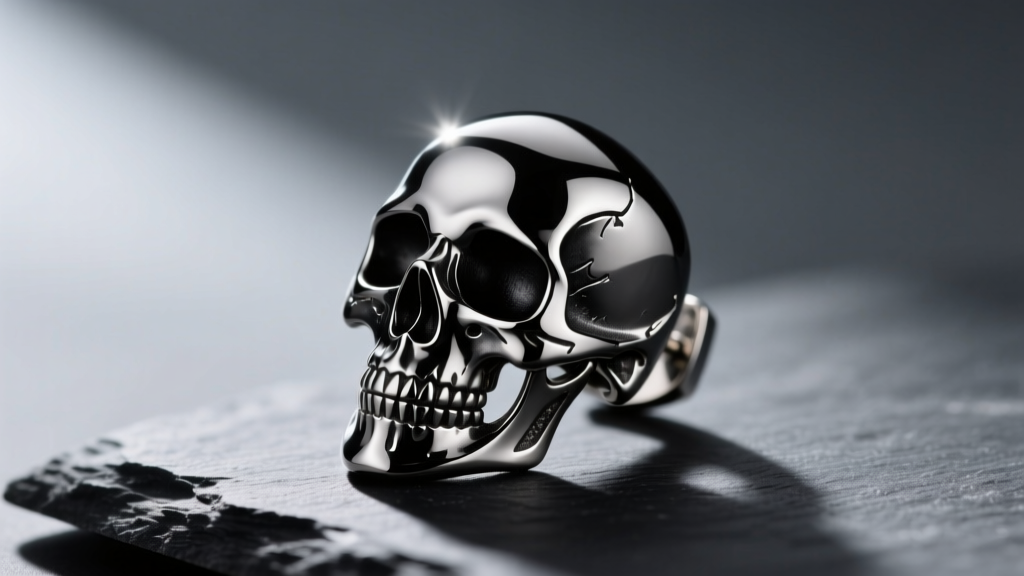
When evaluating a skull earring, aesthetic appeal is only half the equation; the structural physics dictate its long-term wearability. Skull motifs are inherently dense and volumetric. Unlike flat geometric shapes, a 3D skull requires significant mass to render intricate details like eye sockets, nasal cavities, and dental ridges. This volume introduces a severe pendulum effect when used in dangle or drop configurations.
The kinetic energy transferred to the fistula (the piercing hole) is a product of the earring's mass and the distance from the piercing point to the object's center of gravity. A standard 15mm drop skull earring crafted from solid brass can easily exceed 18 grams. The human earlobe, unsupported by cartilage, begins to experience micro-tearing and permanent elongation when subjected to sustained loads exceeding 12 to 15 grams. Understanding the torque generated by heavy metal jewelry is critical for both designers and consumers aiming to preserve lobe integrity over decades of wear.
Metallurgy and Modern Casting Techniques
The material composition of a skull earring directly dictates its weight, tarnish resistance, and biocompatibility. Historically, 925 sterling silver (density: 10.49 g/cm³) has been the default for macabre jewelry due to its excellent casting flow and ability to hold dark oxidized patinas in deep crevices. However, its high density makes large skull designs prohibitively heavy for standard 20-gauge piercings.
As of 2026, advanced manufacturing has shifted the paradigm. According to Stuller Metallurgy Resources, the integration of Direct Metal Laser Sintering (DMLS) and 3D titanium printing allows jewelers to create internal lattice structures within a skull earring. This technique maintains the external solid aesthetic while reducing overall mass by up to 45%.
| Material Grade | Density (g/cm³) | Tarnish Resistance | Best Use Case |
|---|---|---|---|
| Grade 5 Titanium (Ti-6Al-4V) | 4.43 | Exceptional | Heavy, large-scale dangles; fresh piercings |
| 316L Surgical Steel | 8.00 | High | Mid-size huggies and standard studs |
| 925 Sterling Silver | 10.49 | Low (Requires Patina) | Small studs, cartilage cuffs with deep detailing |
| Solid Bronze (CuSn8) | 8.80 | Low (Develops Verdigris) | Artisan, lightweight hollow-cast pieces |
The Lost-Wax vs. DMLS Debate for Intricate Details
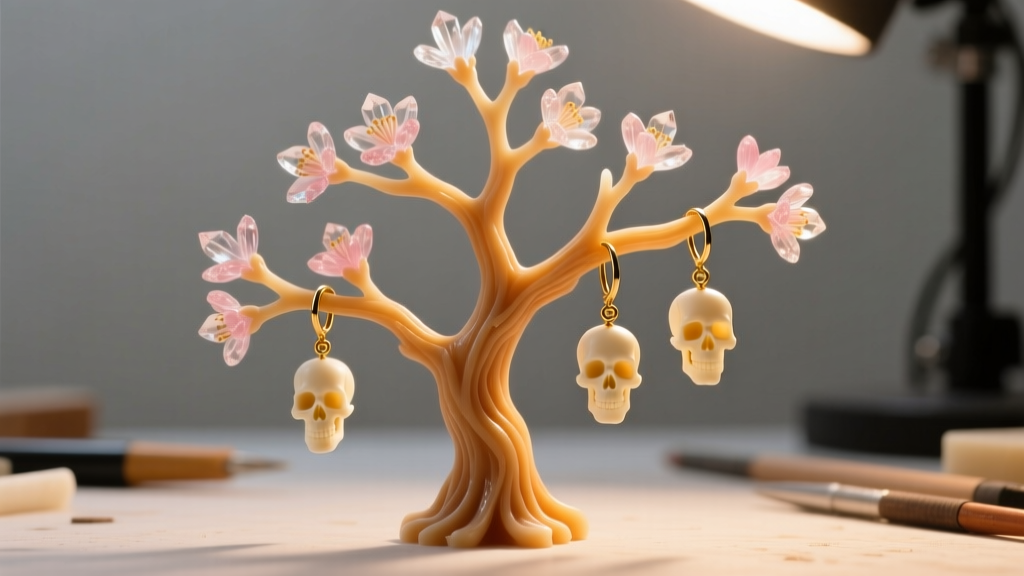
For traditional lost-wax investment casting, achieving sharp definition in a skull's teeth requires a high-flow investment powder and precise burnout temperatures (typically 1350°F for silver). If the metal cools too rapidly, porosity occurs, weakening the structural integrity of thin elements like the zygomatic arch (cheekbone) of the skull. DMLS bypasses this by fusing metal powder layer by layer, allowing for undercuts and hollow chambers that are impossible with traditional sprue-and-cast methods.
Gauge Sizing and the "Cheese-Cutter" Effect
The most common failure mode in heavy skull jewelry is not the breaking of the metal, but the tearing of the flesh. The "cheese-cutter effect" occurs when a thin wire under heavy load concentrates mechanical stress onto a microscopic surface area of the earlobe. A standard 20-gauge (0.81mm) wire hook supporting a 20-gram skull earring exerts enough pounds-per-square-inch (PSI) to slowly slice through the fistula tissue over time.
The Association of Professional Piercers (APP) consistently advises against wearing heavy jewelry in thin-gauge piercings. To mitigate this, structural skull earrings must be engineered with thicker wire hooks or specialized weight-distributing findings.
- 20 Gauge (0.81mm): Strictly for micro-skull studs weighing under 4 grams.
- 18 Gauge (1.02mm): Acceptable for lightweight huggies or small cartilage skull cuffs.
- 16 Gauge (1.29mm): The minimum recommended thickness for any skull dangle exceeding 10 grams.
- 14 Gauge (1.63mm): Required for heavy, solid-metal statement pieces or stretched lobes.
Troubleshooting Lobe Fatigue and Elongation
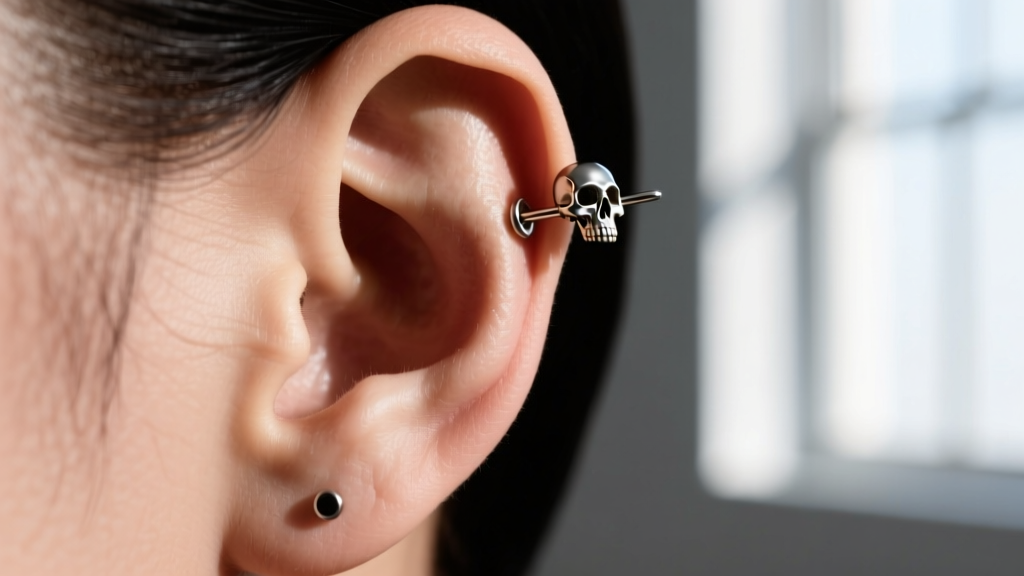
If you already own a heavy skull earring with a thin 20G or 18G hook, do not discard the piece. You can retrofit the finding. A jeweler can easily snip the thin wire and solder on a custom 14-gauge niobium or titanium French hook. Alternatively, utilizing clear silicone O-rings or specialized ear putty (like Blux) behind the earring back can artificially increase the surface area bearing the weight, though this is a temporary mechanical fix rather than a structural one.
"Weight distribution is just as critical as the total mass. A wide, flat-back skull stud will sit flush and distribute its 15-gram weight evenly across the back of the lobe, whereas a 15-gram skull dangling 30mm below the piercing will create a fulcrum that actively pulls the fistula downward."
Maintenance: Ultrasonic Frequencies and Deep Crevices
Skull designs are notorious hygiene traps. The eye sockets, nasal cavities, and interstitial gaps between teeth rapidly accumulate sebum, dead epidermal cells, and environmental dust. When combined with the copper content in sterling silver or brass, this organic matter accelerates localized galvanic corrosion, leading to pitting and foul odors.
Chemical dip cleaners are highly discouraged for skull earrings, as they strip the intentional oxidized blackening (patina) applied to the crevices to enhance the 3D topography. Instead, professional maintenance requires an ultrasonic cleaner operating at exactly 40 to 45 kHz. Frequencies lower than 40 kHz can cause cavitation bubbles large enough to pit soft silver alloys, while frequencies above 50 kHz lack the implosive force required to dislodge compacted sebum from deep orbital cavities. A simple solution of warm distilled water and a few drops of mild, phosphate-free dish soap, run for exactly three minutes, will safely eject debris without compromising the metal's finish.
Sourcing and Pricing Tiers in 2026
When investing in high-quality macabre jewelry, understanding the manufacturing origin prevents overpaying for mass-produced white-label goods.
- Mass Market ($15 - $40): Typically die-cast zinc alloy or hollow electroformed silver. Prone to seam splitting and rapid tarnishing. Hooks are almost universally 20G steel.
- Mid-Tier Artisan ($80 - $180): Hand-finished lost-wax casts in solid 925 silver or 316L steel. Features hand-applied liver of sulfur patinas and upgraded 16G wire hooks.
- Haute Macabre / DMLS ($250 - $600+): Internally latticed titanium or 14k solid gold, designed via CAD and 3D printed. Lightweight, hypoallergenic, and structurally optimized for lifelong daily wear.
Ultimately, a skull earring should be a permanent fixture in a collection, not a disposable novelty. By prioritizing advanced metallurgy, appropriate gauge thickness, and proper acoustic maintenance protocols, collectors can enjoy heavy metal aesthetics without sacrificing their anatomical health.


