How Do You Say Earrings in Spanish? Jewelry Travel Troubleshooting
Learn how do you say earrings in Spanish and master essential jewelry vocabulary to troubleshoot buying, piercing, and material grading abroad.

Whether you are navigating the historic silver markets of Taxco, Mexico, browsing artisan boutiques in Madrid, or seeking custom cartilage piercings in Bogotá, communicating your exact jewelry needs is critical. A simple language barrier can result in purchasing gold-plated brass instead of solid 14k gold, or receiving a standard lobe backing for a fresh helix piercing. If you have ever found yourself at a foreign jewelry counter wondering, "how do you say earrings in spanish?", you are not alone. More importantly, knowing the direct translation is only the first step in troubleshooting cross-border jewelry purchases.
This comprehensive guide solves the most common communication failures English-speaking travelers and expats face when buying, sizing, and piercing earrings in Spanish-speaking regions. We will break down regional dialects, material hallmarks, anatomical terminology, and mechanical backing types to ensure you get exactly what you pay for.
The Core Translation: Regional Variations for Earrings
The direct answer to "how do you say earrings in Spanish" depends entirely on your geographic location. While the Real Academia Española (RAE) recognizes multiple terms, using the wrong regional slang can cause confusion or mark you as an easy target for tourist markups.
Los Aretes (Latin America)
In Mexico, Colombia, and most of Central and South America, the standard term is los aretes. If you are shopping for standard studs or drops, asking for aretes de oro (gold earrings) or aretes de plata (silver earrings) will be universally understood. However, aretes generally implies a post-and-back style or a dangle.
Los Pendientes (Spain & Parts of South America)
In Spain, and occasionally in Argentina and Chile, the preferred term is los pendientes. In Spain, asking for aretes might yield confused looks, as pendientes encompasses everything from diamond studs to chandelier drops. Note that pendiente also means "pending" or "attentive" in Spanish, so context is vital. Always specify pendientes de joyería (jewelry earrings) if the conversation is ambiguous.
Zarcillos and Aritos (Specific Styles & Regions)
In Venezuela and parts of the Caribbean, you will hear zarcillos. Meanwhile, across almost all Spanish-speaking countries, small hoop earrings are universally referred to as aritos (little rings). If you are looking for huggies or continuous sleepers, asking for aritos que duermen (sleeping hoops) or aritos de clic (clicker hoops) is your best troubleshooting strategy.
Troubleshooting Material Miscommunications
The most expensive mistake travelers make is misunderstanding metal purity. In many tourist-heavy Spanish-speaking markets, vendors may use the word oro (gold) or plata (silver) loosely to describe plated items. According to the Gemological Institute of America (GIA), understanding international hallmarking and precise alloy terminology is essential to avoid contact dermatitis and financial loss.
| English Term | Spanish Term | Common Hallmark | Troubleshooting Warning |
|---|---|---|---|
| Solid 14k Gold | Oro macizo de 14 quilates | 14k, 585 | Ensure it says macizo (solid), not baño (plated). |
| Gold Plated | Baño de oro / Chapado en oro | None or GP | Will wear off; avoid if you have nickel allergies. |
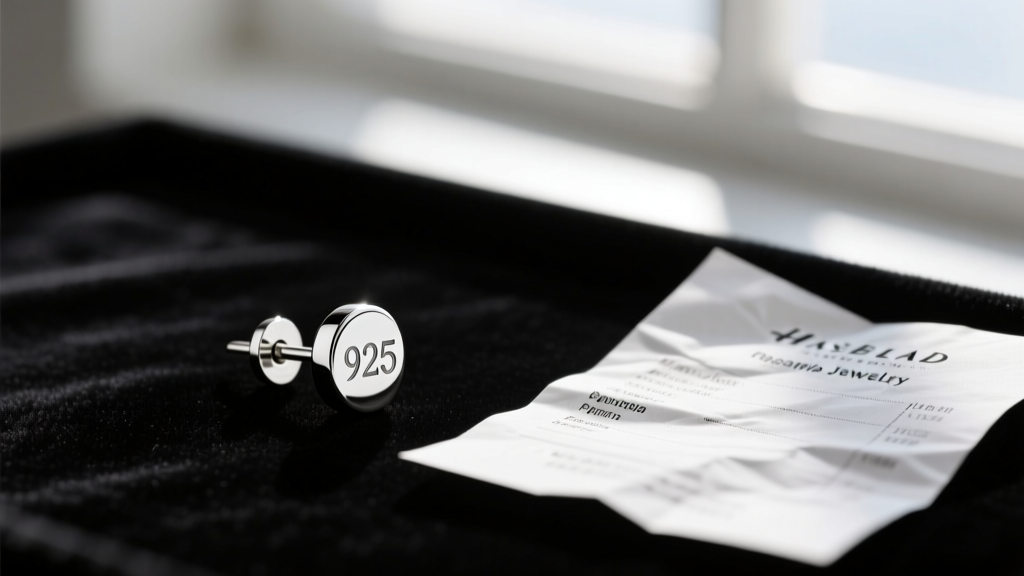
| Sterling Silver | Plata ley 925 / Plata esterlina | 925 | Must be stamped 925. Beware of "alpaca" (nickel silver). |
| Surgical Steel | Acero quirúrgico | 316L | Verify it is 316L for fresh piercings to prevent rejection. |
| Implant Grade Titanium | Titanio grado implante | ASTM F-136 | Crucial for cartilage; ask for the ASTM certification. |
Pro-Tip for Spain: Spain has strict state-regulated hallmarking laws. Look for the contraste (hallmark stamp) from the local assay office. In Mexico and Colombia, hallmarking is less strictly enforced in artisan markets, so bringing a portable precious metal tester or buying from established, certified jewelers is highly recommended.
Piercing Anatomy and Gauge Sizing Vocabulary
When getting a new piercing or buying replacement jewelry for an existing one, anatomical precision is non-negotiable. Using the wrong terminology can result in a piercer placing a helix piercing in the wrong zone, or handing you a 20-gauge post for a 16-gauge fistula, leading to migration and tearing.
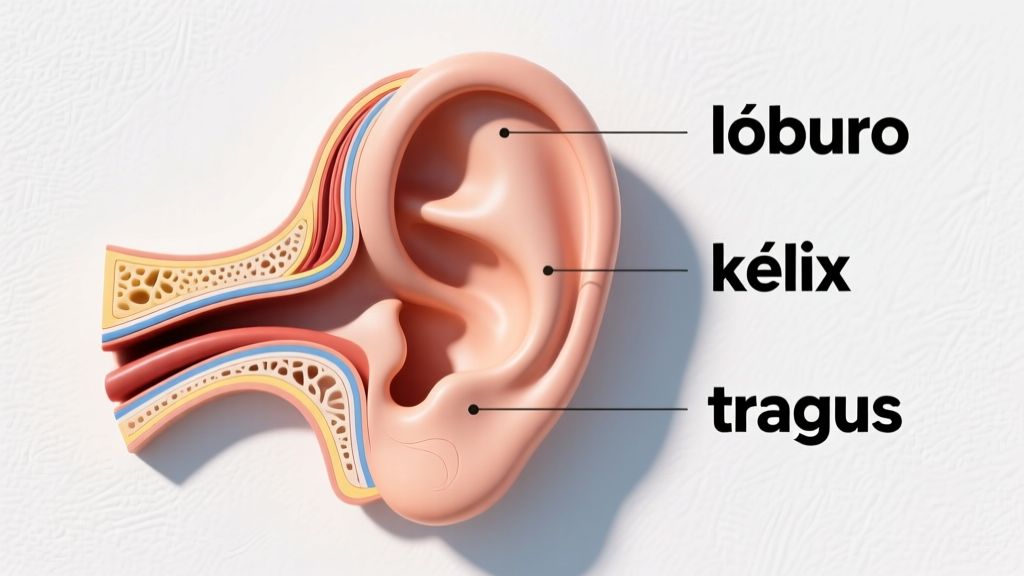
- Lobe: Lóbulo (Standard earlobe piercing)
- Cartilage: Cartílago (General term for upper ear)
- Helix: Hélix (Outer rim cartilage)
- Tragus: Trago (The small flap of cartilage in front of the ear canal)
- Conch: Concha (The bowl-shaped inner cartilage)
- Industrial: Industrial (Two connected helix piercings)
Solving the Gauge (Calibre) Confusion
In the US, we use the AWG (American Wire Gauge) system, where a higher number means a thinner post (e.g., 20G is thinner than 16G). In many Spanish-speaking medical and jewelry contexts, millimeters are preferred. You must know your exact millimeter conversion to troubleshoot sizing issues at the counter.
Standard lobe piercings are usually calibre 20 (0.81mm) or calibre 18 (1.02mm). Cartilage piercings are typically calibre 16 (1.29mm) or calibre 14 (1.63mm). If a vendor hands you a poste (post) that feels too thin for your cartilage, politely say: "Necesito un calibre más grueso, por favor. ¿Tiene en milímetros?" (I need a thicker gauge, please. Do you have it in millimeters?).
Resolving Backing and Mechanical Failures
Earring backings are a frequent source of frustration, especially when traveling. Losing a backing in a foreign city or dealing with a clasp that won't close requires specific mechanical vocabulary.
Common Backing Types in Spanish
Butterfly Backs: Known as mariposas or broqueles de mariposa. These are the standard friction backs. If they are too tight and hurting your lobe, ask for mariposas más flojas (looser butterfly backs) or switch to silicone alternatives (topes de silicona).
Screw Backs: Known as tuercas de rosca or cierre de rosca. Highly recommended for expensive diamond studs or active travelers, as they prevent loss. If the threading is stripped, you will need to tell the jeweler: "La rosca está barrida" (The threading is stripped).
Hinged Hoops / Clickers: Known as cierre de bisagra or broche de clic. A common failure mode with hinged hoops is the pin becoming misaligned. You can ask a jeweler to realign it by saying: "El pasador de la bisagra está desalineado, ¿puede ajustarlo?" (The hinge pin is misaligned, can you adjust it?).
Navigating Allergies, Infections, and Returns
Nickel allergies are a global issue, but the American Academy of Dermatology notes that contact dermatitis from cheap jewelry is a leading cause of travel-ruining ear infections. In Spanish-speaking countries, the term "hypoallergenic" (hipoalergénico) is sometimes used as a marketing buzzword rather than a medical guarantee.
Crucial Phrase for Allergy Sufferers:
"Soy muy alérgico/a al níquel. ¿Este metal es libre de níquel y apto para piel sensible?"
(I am very allergic to nickel. Is this metal nickel-free and suitable for sensitive skin?)
If you experience an adverse reaction and need to return the item, consumer protection laws vary wildly. In Spain, the EU mandates a 14-day return window for online purchases, but physical boutique returns are often limited to store credit (vale de cambio) unless the item is defective (defectuoso). Always ask for a detailed receipt (recibo detallado) that explicitly states the metal purity, as this is your only leverage for a warranty claim (reclamo de garantía) if the metal tarnishes or causes a reaction.
Quick Reference Cheat Sheet for the Jewelry Counter
Save this troubleshooting list to your phone before stepping up to the glass counter:
- I am looking for stud earrings: Busco aretes de broquel / pendientes de botón.
- Do you have this in rose gold? ¿Tiene esto en oro rosa?
- Can you shorten the post? ¿Puede acortar el poste?
- I need a flat-back labret for my cartilage: Necesito un labret de poste plano para mi cartílago.
- Is the gemstone natural or synthetic? ¿La piedra es natural o sintética?
- Do you offer ultrasonic cleaning? ¿Ofrecen limpieza ultrasónica?
Mastering how to say earrings in Spanish is just the beginning. By understanding the nuanced vocabulary of metallurgy, anatomy, and jewelry mechanics, you transform from a vulnerable tourist into an informed, respected buyer. Whether you are securing a pair of vintage aritos in an Andalusian market or troubleshooting a cierre de bisagra in Mexico City, precise communication ensures your jewelry remains safe, secure, and beautifully crafted.


