Spikeball Earrings: A Technical Guide to Materials & Fit
Discover the technical specs of spikeball earrings. Learn about implant-grade titanium, weight distribution, gauge sizing, and safe cartilage placement.

The Architecture and Manufacturing of Spikeball Earrings
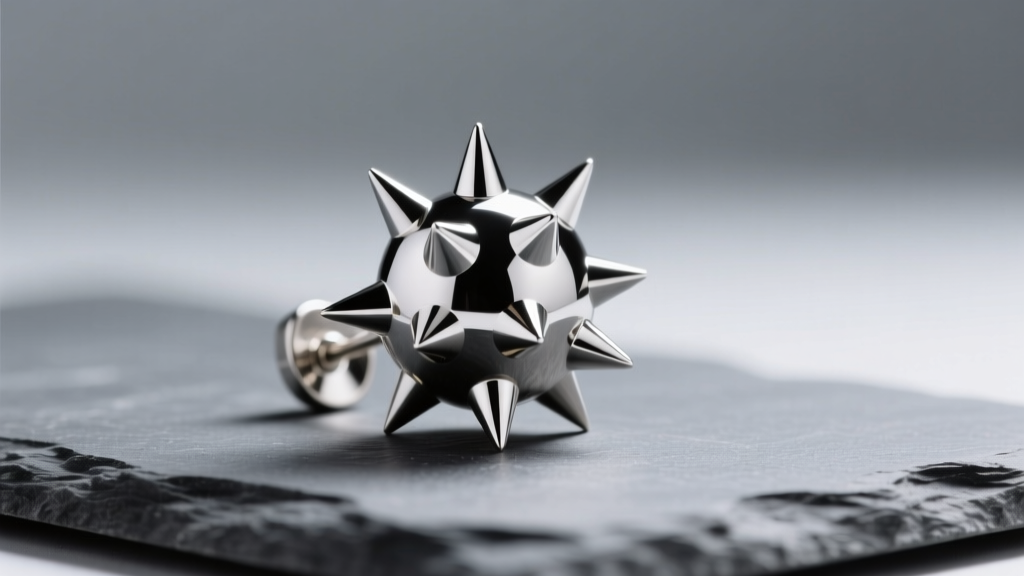
Spikeball earrings represent a unique intersection of avant-garde aesthetics and structural engineering. Unlike standard spherical studs, a spikeball features a central core with multiple protruding conical spikes. From a manufacturing perspective, the quality of these pieces varies drastically based on the production method. Mass-market options are typically cast using the lost-wax method. While cost-effective, cast jewelry often suffers from microscopic porosity and weak structural integrity at the junction where the spike meets the sphere. Under stress, these sharp joints are prone to micro-fractures.
Conversely, high-end body jewelry brands utilize CNC (Computer Numerical Control) machining from a single billet of metal, or employ laser-welding with a pronounced fillet radius at the base of each spike. This fillet radius is critical; it distributes shear stress away from the joint, preventing the spikes from snapping off during accidental snags. When evaluating spikeball earrings, inspecting the base of the spikes under a jeweler's loupe for smooth, continuous transitions rather than sharp, cast seams is the first step in assessing longevity and safety.
Metallurgy: ASTM F136 Titanium vs. 316L Surgical Steel
The material composition of heavy alternative earrings dictates both biocompatibility and long-term wearability. The Association of Professional Piercers (APP) strictly recommends specific alloys for prolonged skin contact, particularly for heavy pieces that cause micro-tears in the fistula.
Implant-Grade Titanium (ASTM F136)
Ti-6Al-4V ELI (Extra Low Interstitial) is the gold standard for spikeball earrings. Its primary advantage is its density. Titanium has a density of approximately 4.43 g/cm³. For a large 14mm diameter spikeball core, this translates to a base weight of roughly 6.3 grams before the spikes are added. Furthermore, it contains zero nickel, eliminating the risk of allergic contact dermatitis.
Surgical Stainless Steel (316LVM)
While 316LVM is common, it has a density of about 8.0 g/cm³. That same 14mm core weighs over 11.4 grams. This 5-gram difference drastically alters the pendulum effect and tissue stress on the earlobe. Additionally, 316L contains 10-14% nickel. While the chromium oxide layer usually traps the nickel, the heavy friction of a swinging spikeball can degrade this passive layer over time, leading to nickel leaching that exceeds the EN 1811 safety standard, triggering reactions in sensitive individuals as noted by the Mayo Clinic.
PVD Coatings on Black Spikeballs
Matte black or gold spikeballs are achieved via Physical Vapor Deposition (PVD). Ensure the PVD coating is applied over an ASTM F136 titanium base. If applied over brass or cheap steel, the inevitable wear on the threading will expose the base metal directly to the piercing channel.
Gauge Sizing, Threading Mechanics, and the Cheese-Cutter Effect
One of the most catastrophic failure modes in heavy earring wear is the 'cheese-cutter effect.' This occurs when a heavy piece of jewelry rests on a thin gauge wire, creating sustained point-load pressure that slowly slices through the tissue, causing the piercing to migrate downward and eventually tear out entirely. Spikeball earrings, due to their extreme center of mass, accelerate this process if the gauge is insufficient.
| Gauge Size | Diameter (mm) | Max Recommended Spikeball Weight | Optimal Placement |
|---|---|---|---|
| 16g | 1.2mm | 3.5 grams | Standard Lobe (Small 6-8mm cores only) |
| 14g | 1.6mm | 6.0 grams | Lower Lobe / Upper Lobe |
| 12g | 2.0mm | 9.5 grams | Stretched Lobe / Conch |
| 10g | 2.4mm | 14.0 grams | Stretched Lobe / Scaffold |
Internal vs. External Threading
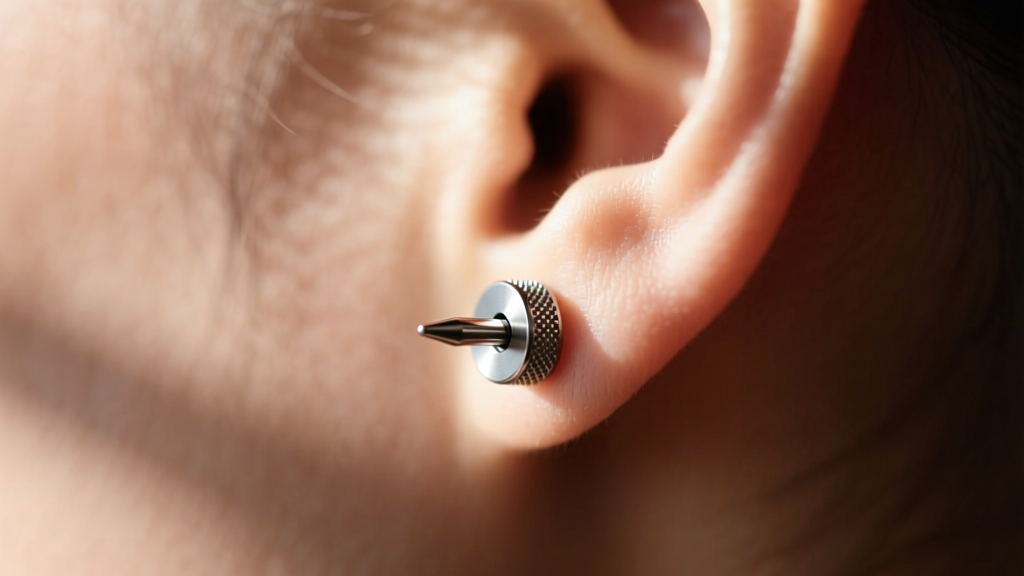
For spikeball earrings, the threading mechanism is paramount. External threading (where the post has sharp screw threads that pass through the fistula) is highly discouraged. Dragging sharp threads through the piercing channel causes micro-trauma and introduces bacteria. Internal threading (where the post is smooth and the spikeball features a threaded pin that screws into the post) is mandatory for safe insertion and removal. The precision of these internal threads, typically cut to ISO metric standards, ensures the heavy spikeball remains securely fastened without vibrating loose.
Weight Distribution and Cartilage Placement Physics
Placing spikeball earrings in cartilage piercings (such as the helix, conch, or tragus) introduces complex torque variables. Cartilage lacks the elastic give of lobe tissue and is highly susceptible to pressure necrosis and hypertrophic scarring. When a heavy spikeball is mounted on a flat-back labret post in a conch piercing, the weight of the spikes creates a lever arm. If the decorative end is too heavy, it pulls the post at an angle, pressing the flat back plate unevenly against the rear of the cartilage.
Expert Rule of Thumb: For cartilage placements, the total weight of the spikeball end should not exceed 4 grams. If you desire a larger visual footprint, opt for hollow-core CNC machined spikeballs or 3D-printed titanium lattices that maintain the aggressive silhouette while reducing mass by up to 60%.
Maintenance Protocol: Managing the Crevices
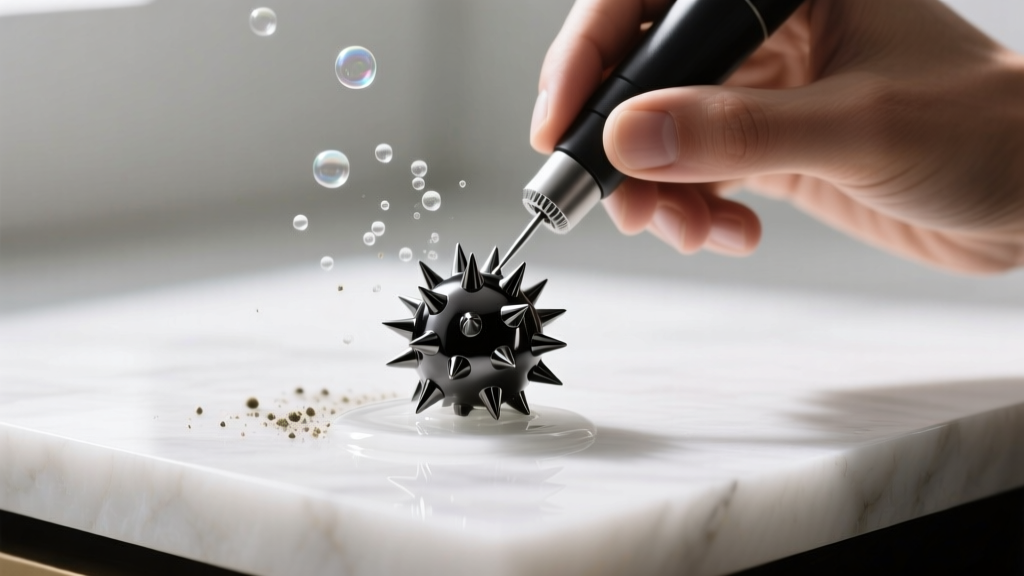
The geometry of a spikeball creates a nightmare for hygiene. The acute angles where the spikes meet the spherical core trap sebum, dead epidermal cells, and environmental debris. Over time, this organic buildup calcifies, leading to foul odors and localized bacterial infections. Standard wiping with alcohol pads is entirely insufficient for this design.
- Ultrasonic Cleaning: Submerge the earrings in a 40 kHz ultrasonic cleaner filled with distilled water and a few drops of pH-neutral jewelry soap for exactly 3 to 5 minutes. The cavitation bubbles will implode inside the microscopic crevices, dislodging trapped sebum without scratching the metal.
- Soft Bristle Agitation: After the ultrasonic bath, use a baby-soft toothbrush to gently sweep the base of each spike. Never use hard nylon brushes on PVD-coated or mirror-polished titanium, as this will induce micro-scratches that harbor even more bacteria in the future.
- Drying: Moisture trapped at the spike joints can lead to water spots or, in non-implant-grade metals, oxidation. Use a compressed air duster or a low-heat hair dryer to ensure the piece is bone-dry before reinsertion.
Troubleshooting Common Failure Modes
Even with premium jewelry, wearers of spikeball earrings encounter specific mechanical issues. Understanding how to troubleshoot these saves both the jewelry and the piercing.
Cross-Threading Internal Pins
Because spikeballs are heavy and awkward to grip, users often force the threaded pin into the post at an angle, cross-threading the titanium. If you feel resistance, stop immediately. Forcing it will strip the threads, ruining the post. Back the pin out, ensure it is perfectly perpendicular to the post opening, and turn counter-clockwise until you feel a subtle 'click' indicating the threads have aligned, then screw clockwise.
Snagging and Tissue Trauma
The aggressive spikes frequently catch on hair, sweaters, and towels. A sudden snag on a 14g lobe piercing can result in a bifurcated (torn) earlobe requiring surgical reconstruction. For daily wear in high-risk environments, consider swapping the sharpest spikes for 'blunted' or 'domed' spike variants, or utilize silicone O-rings behind the earlobe to restrict the pendulum swing and keep the earring flush against the body.
By prioritizing precise metallurgy, respecting gauge-to-weight ratios, and implementing rigorous cleaning protocols, spikeball earrings can be worn safely and comfortably, transforming an extreme aesthetic into a sustainable, long-term body modification.


