Square Pearl Earrings: Technical Guide to Cuts & Settings
Explore the gemology and metallurgy of square pearl earrings. Learn about carved freshwater cuts, bezel settings, and post gauges.

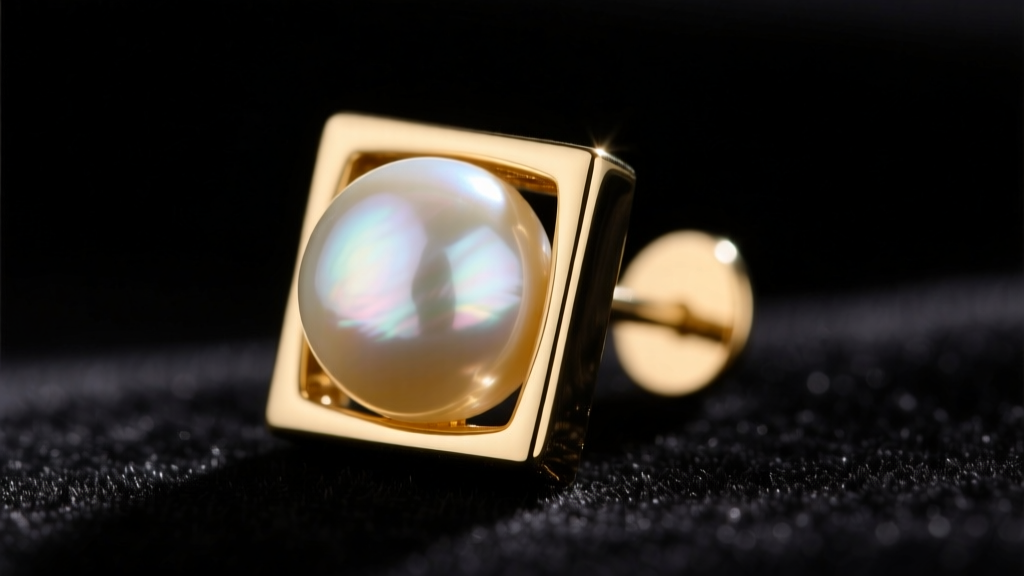
The Anatomy of a 'Square' Pearl: Gemological Realities
In the jewelry trade, the term 'square pearl earrings' represents a fascinating intersection of organic gemology and precision lapidary work. Because pearls form within the soft tissue of mollusks, their natural growth patterns yield spherical, oval, or baroque shapes. A true, naturally occurring square pearl does not exist. Therefore, when jewelers and gemologists refer to square pearl earrings, they are categorizing one of three distinct structural designs: carved solid-nacre freshwater pearls, geometric mother-of-pearl (MOP) shell inlays, or round pearls housed within square bezel mountings.
Understanding the distinction between these three categories is critical for evaluating structural integrity, pricing, and long-term wearability. According to the Gemological Institute of America (GIA), the structural composition of nacre—microscopic aragonite platelets bound by conchiolin—dictates how the material responds to lapidary cutting and geometric mounting. Let us break down the technical specifications of each variation.
Lapidary Realities: Carving Freshwater Pearls
To carve a perfect square shape with sharp 90-degree vertices from a pearl, the starting material must possess exceptional nacre thickness. Standard Akoya pearls, which typically feature nacre layers between 0.2mm and 0.8mm over a shell bead nucleus, cannot be carved into squares; the cutting wheel would immediately expose the inner bead or cause catastrophic delamination.
Instead, master lapidaries rely on high-density, nucleated Edison freshwater pearls or solid-nacre baroque pearls with a minimum nacre thickness of 2.5mm to 4.0mm. The Mohs hardness of pearl ranges from 2.5 to 4.5, making it highly susceptible to thermal shock. Cutting a square pearl requires diamond-impregnated lapidary saws operating under continuous, temperature-controlled water cooling to prevent the conchiolin matrix from overheating and cracking the sharp corners.
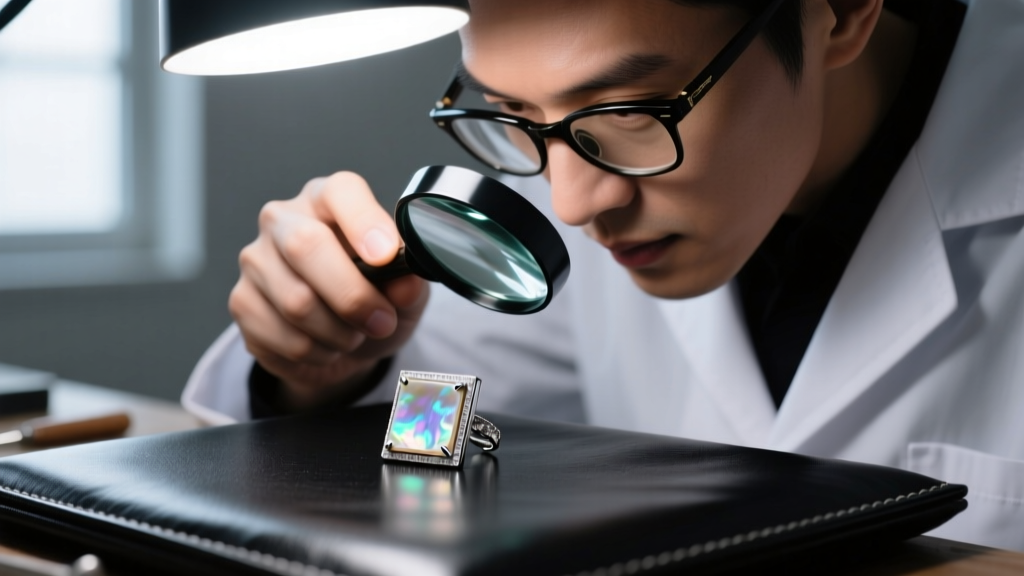
Metallurgy and Mounting: Engineering the Square Setting
Whether setting a carved square pearl or a geometric MOP inlay, the metal mounting must account for the vulnerability of 90-degree angles. The most secure and aesthetically appropriate setting for square pearl earrings is the square bezel. However, the karat weight of the gold fundamentally alters the setting's performance.
| Metal Alloy | Gold Purity | Vickers Hardness (HV) | Setting Suitability |
|---|---|---|---|
| 18k Yellow Gold | 75% | ~130 HV | Excellent for burnishing over sharp MOP corners; highly malleable but prone to scratching. |
| 14k Yellow Gold | 58.5% | ~160 HV | Ideal for tension settings and structural bezels; provides superior memory and impact resistance. |
| Platinum (950) | 95% | ~140 HV | Superior density and durability; requires highly skilled bench jewelers to push over fragile pearl corners without chipping. |
As noted by Jewelers of America, the malleability of the precious metal must be carefully balanced against the fragility of the pearl's corners. If a bench jeweler applies uneven pressure while pushing an 18k gold bezel over a square-cut pearl, the localized stress can cause a micro-fracture along the pearl's cleavage plane.
Structural Integrity: Post Gauges and Friction Backs
A common failure mode in geometric pearl jewelry is earlobe droop and subsequent loss, caused by inadequate hardware. A 10mm x 10mm square pearl has a significantly larger surface area and mass than a 10mm round pearl. When set in a solid gold bezel, a single square pearl earring can easily weigh between 4.5 and 8.0 grams.
- 20-Gauge Posts (0.81mm): The industry standard for lightweight studs. Completely inadequate for heavy square pearl earrings. The torque exerted by the top-heavy square shape will bend a 20G post within weeks of daily wear.
- 18-Gauge Posts (1.02mm): The mandatory minimum for square pearl earrings. The increased cross-sectional area provides the rigidity needed to keep the earring facing forward on the earlobe.
- 16-Gauge Posts (1.29mm): Reserved for oversized, statement square pearl drops or cartilage conversions where maximum structural support is required.
Furthermore, standard butterfly friction backs fail under the weight of square pearls. Expert jewelers equip heavy geometric earrings with La Poussiere locking backs or threaded screw backs to ensure the center of gravity remains stable against the earlobe.
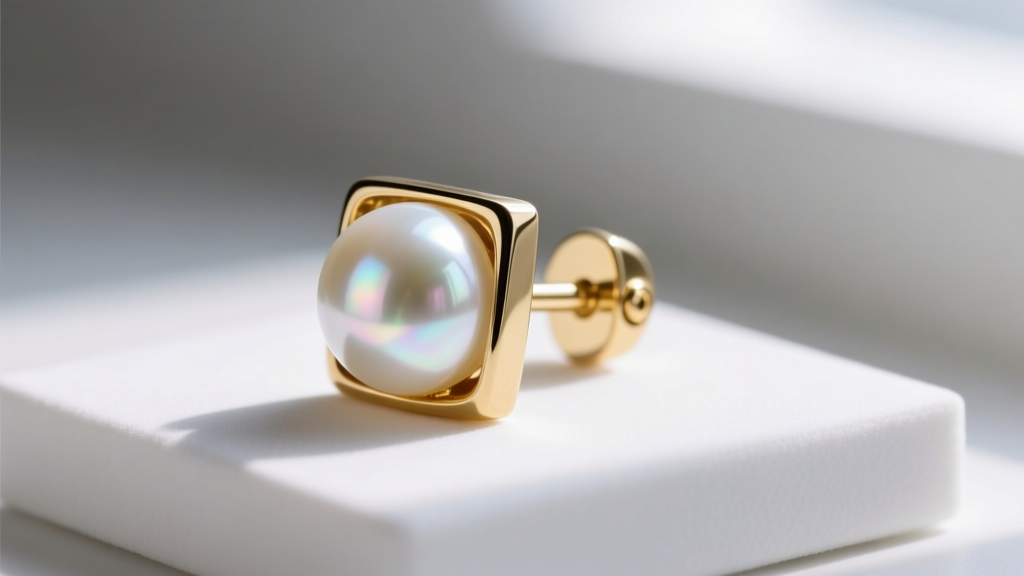
Maintenance and Failure Modes in Geometric Pearl Jewelry
The primary failure mode unique to square pearl earrings is 'corner blowout.' Because the 90-degree vertices lack the structural distribution of a curved surface, any accidental impact against a hard surface concentrates kinetic energy directly into the corner, resulting in immediate chipping.
Never place square pearl earrings in an ultrasonic cleaner. The high-frequency cavitation bubbles will aggressively strike the sharp geometric vertices, causing microscopic pitting and eventual nacre delamination along the cut lines.
Routine maintenance must be restricted to manual wiping with a damp, lint-free microfiber cloth. For square MOP inlays, avoid exposing the earrings to acidic skin pH or chlorinated water, as the geometric cut exposes the porous cross-section of the shell layers, making them highly susceptible to chemical etching and yellowing over time.
Face Shape and Geometric Styling Mechanics
From a stylistic perspective, the sharp, linear geometry of square pearl earrings creates a distinct visual contrast against organic facial features. The rigid 90-degree angles are highly effective at adding structure to round or oval face shapes, providing a modern, architectural framing effect. Conversely, individuals with highly angular or square jawlines should opt for square pearl earrings with heavily chamfered (beveled) corners or round pearls set within square bezels to soften the visual impact and avoid harsh geometric repetition.


