The 2026 Sunburst Earrings Trend: Celestial Style Guide
Explore the 2026 sunburst earrings trend. Our style guide covers metal grades, cartilage placements, and face-shape matching for celestial jewelry.

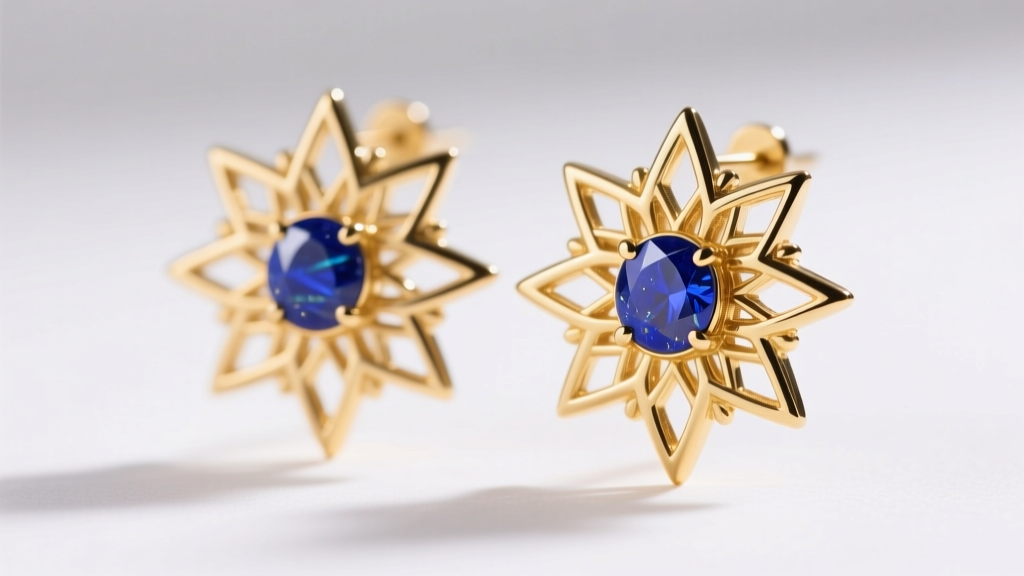
The Celestial Revival: Why Sunburst Earrings Are Dominating 2026
The jewelry landscape of 2026 has decisively pivoted from the ultra-minimalist, barely-there studs of the early 2020s toward structured, historically rooted maximalism. At the forefront of this shift are sunburst earrings. Characterized by radiating metallic rays emanating from a central focal point—often a cabochon gemstone or a cluster of micro-pave diamonds—these pieces bridge the gap between vintage Art Deco revival and modern celestial aesthetics. According to trend forecasts from Vogue Fashion, the sunburst motif has become the defining silhouette for both red-carpet styling and elevated everyday wear this year.
However, the structural complexity of sunburst earrings introduces unique challenges regarding durability, weight distribution, and styling. Unlike a simple cast hoop or a solid stud, a sunburst design requires precise metallurgical choices to ensure the delicate rays do not bend, warp, or catch on clothing. This comprehensive guide breaks down the anatomy, material grades, and styling frameworks necessary to master the sunburst trend in 2026.
Anatomy of a Sunburst: Material Grades and Ray Configurations
The defining feature of any sunburst earring is its ray configuration. Designers typically utilize 12, 16, or 24 individual rays. The higher the ray count, the denser and more rigid the overall structure, but the higher the risk of micro-pave stone loss if the metal flexes. The choice of metal alloy is therefore not just an aesthetic preference, but a structural necessity.
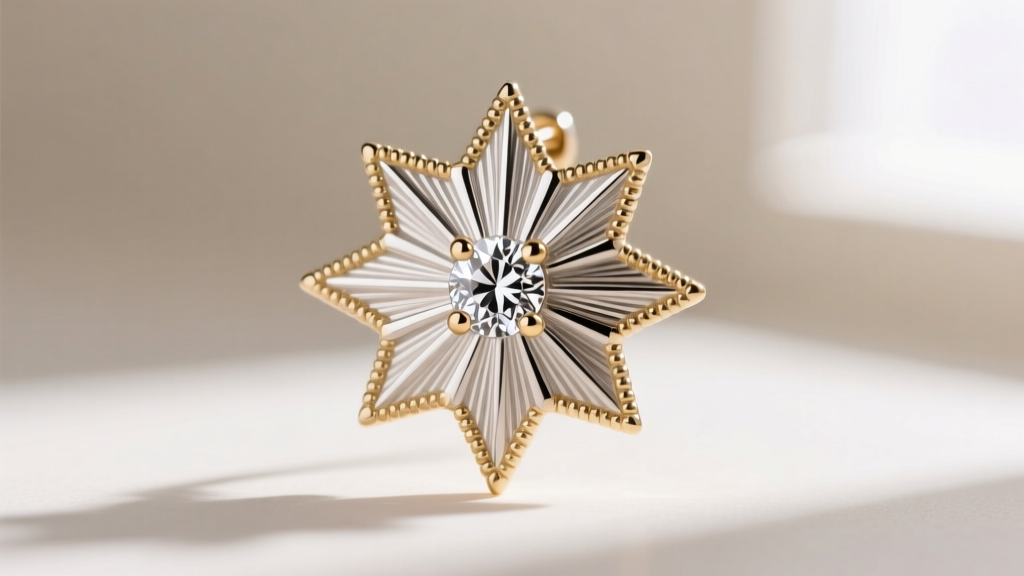
The Vickers Hardness Factor
When selecting sunburst earrings, particularly those with elongated, dramatic rays exceeding 25mm in diameter, the Vickers hardness (HV) of the gold alloy is critical. Pure 24k gold (approx. 25 HV) is entirely unsuitable for radiating structures. Even 18k gold (approx. 120-140 HV), while prized for its rich, warm hue and high precious metal content, can be prone to bending if the rays are cast too thinly.
For optimal structural integrity in sunburst designs, 14k solid gold (approx. 135-160 HV) is the industry standard. The higher proportion of alloy metals like copper, silver, and zinc provides the necessary tensile strength to keep the rays perfectly aligned over years of daily wear. For white gold sunbursts, ensuring a thick rhodium plating over a nickel-free 14k palladium-white base prevents the yellowish undertones from bleeding through the high-polish rays.
| Metal Alloy | Vickers Hardness (HV) | Best Sunburst Style | Durability Risk |
|---|---|---|---|
| 18k Yellow Gold | 120 - 140 | Chunky, short-ray vintage replicas (12 rays) | High bending risk on long, thin rays |
| 14k Yellow/Rose Gold | 135 - 160 | Intricate, long-ray modern celestial (16-24 rays) | Low; excellent structural memory |
| Sterling Silver (925) | 60 - 90 | Fashion jewelry, occasional wear | High; prone to severe warping and tarnish |
| Implant-Grade Titanium | 350+ | Cartilage/helix flat-back sunburst studs | None; highly rigid and hypoallergenic |
Face Shape & Placement: Styling Radiating Silhouettes
Because sunburst earrings inherently draw the eye outward due to their radial geometry, they interact with facial proportions differently than linear drop earrings or circular hoops. Applying a deliberate styling framework ensures the earrings enhance rather than overwhelm your features.
- Round Faces: Avoid wide, perfectly circular 16-ray sunburst studs, which can exaggerate facial width. Instead, opt for elongated sunburst drops or asymmetrical sunburst dangles where the rays point downward, creating a vertical line that lengthens the jawline.
- Angular/Square Faces: Soften sharp jawlines with medium-sized, circular sunburst studs featuring curved or petal-shaped rays rather than sharp, geometric spikes. A central cabochon moonstone or opal adds a softening, diffused light effect.
- Heart-Shaped Faces: Balance a narrower chin with wider, dramatic 24-ray sunburst chandeliers or drops that add visual weight to the lower half of the face.
- Oval Faces: The universal canvas. Oval faces can effortlessly carry the most extreme, avant-garde sunburst silhouettes, including ear cuffs that integrate the sunburst motif into the cartilage.
The Cartilage Conundrum: Gauge Sizing for Helix Sunbursts
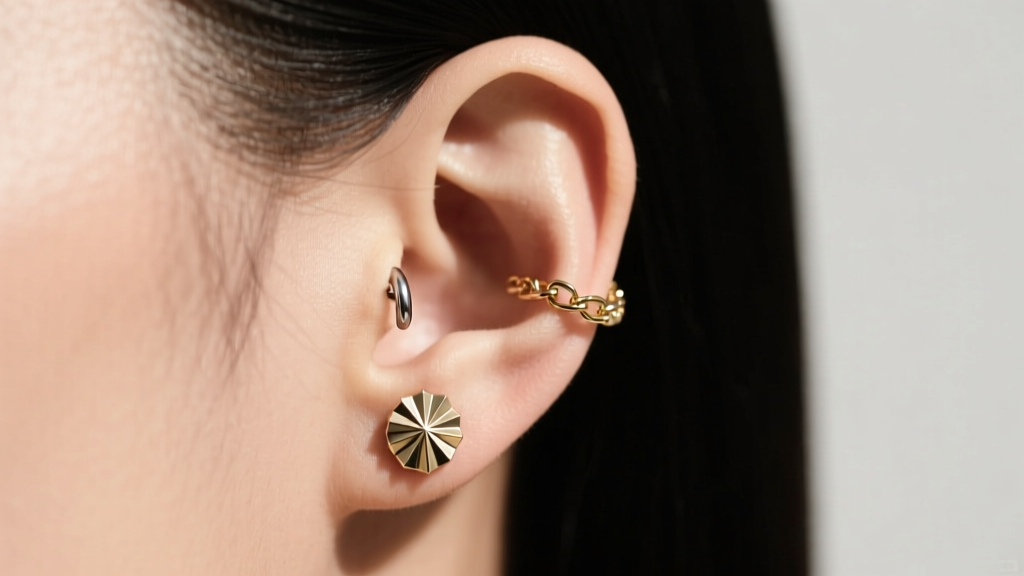
One of the most prominent 2026 styling trends is migrating the sunburst motif from the standard earlobe to the upper helix and flat cartilage. However, the weight distribution of a sunburst top is inherently front-heavy. If you place a standard 20-gauge or 18-gauge butterfly-back sunburst stud in a cartilage piercing, the weight of the rays will cause the earring to droop, pointing awkwardly downward or outward.
The solution is to utilize a 16-gauge implant-grade titanium flat-back labret post. The thicker 1.2mm post provides the necessary rigidity to hold the sunburst face perfectly flush against the ear, while the flat-back disc prevents the post from shifting within the fistula. When shopping for cartilage sunbursts, always verify that the threaded or threadless end is compatible with 16g (1.2mm) posts, as many mass-market brands default to flimsy 19g (1.0mm) posts that will bend under the radial weight.
Price Tiers and Investment Value
The market for sunburst earrings in 2026 is highly stratified, offering entry points for trend-focused consumers and heirloom-quality pieces for serious collectors. Understanding what drives the price beyond mere metal weight is crucial for making informed purchases.
- Entry-Level ($80 - $250): Typically crafted in sterling silver or 10k/14k gold vermeil. Ray details are often cast rather than hand-finished, resulting in slightly rounded edges. Expect synthetic or composite central stones like cubic zirconia or block turquoise. Brands like Mejuri or Monica Vinader often occupy this space with seasonal celestial drops.
- Mid-Tier / Fine Jewelry ($400 - $1,200): Solid 14k or 18k gold with genuine gemstones. This tier features hand-applied milgrain detailing along the edges of the rays, a hallmark of quality Art Deco-inspired craftsmanship. Central stones are usually natural lapis lazuli, malachite, or ethically sourced sapphires. Independent designers on platforms like 1stDibs or specialized boutiques offer the best value here.
- Haute & Luxury ($2,500+): The domain of high jewelry houses like Anita Ko, Maria Tash, and vintage Cartier. These pieces feature complex micro-pave diamond rays, invisible settings, and articulated joints that allow the sunburst to move fluidly with the wearer. The investment value here relies on brand provenance and exceptional diamond clarity (typically VVS1-VVS2).
Maintenance and Prong Failure Prevention
The intricate topography of sunburst earrings makes them notorious debris traps and prone to specific mechanical failures. The spaces between the radiating rays easily accumulate lotions, sebum, and environmental dust, which can severely dull the brilliance of the central stone and any pave diamonds.
Furthermore, the extended rays act as levers. If a long ray catches on a knit sweater or a towel, the localized stress is transferred directly to the central setting. According to gemological care guidelines from the Gemological Institute of America (GIA), repeated micro-stresses from snagging can fatigue the metal prongs holding the central stone, leading to catastrophic stone loss.
Safe Cleaning Protocols
While ultrasonic cleaners are excellent for solid metal jewelry, they are highly dangerous for sunburst earrings featuring micro-pave rays or fracture-filled central gemstones (like emeralds or treated turquoise). The high-frequency vibrations can easily shake loose the tiny melee diamonds set into the delicate rays.
The Expert Cleaning Method:
- Use a dedicated, ultra-soft baby toothbrush and a few drops of mild, phosphate-free dish soap diluted in warm (not hot) water.
- Gently brush from the center stone outward along the rays, following the direction of the metalwork to avoid bending the prongs.
- Rinse under a gentle stream of lukewarm water, ensuring the drain is securely plugged.
- Pat dry with a lint-free microfiber cloth. Never use paper towels, as the wood fibers will snag on the ray tips and micro-prongs.
By understanding the structural demands, metallurgical realities, and styling nuances of sunburst earrings, you can confidently integrate this commanding 2026 trend into your personal curation, ensuring your pieces remain as striking and structurally sound as the day you acquired them.


