The Golden Earring Going to the Run: 2026 Active Trend
Discover why the golden earring going to the run is 2026's top athleisure trend. Explore sweat-proof 14k gold hoops, huggies, and secure fittings.


The Rise of the Active Gold Aesthetic
The intersection of high-performance athleisure and fine jewelry has birthed a highly specific micro-trend for 2026: the golden earring going to the run. No longer are endurance athletes, marathon trainers, and daily commuters relegated to silicone bands or bare ears. Today’s active consumer demands luxury that can withstand high-impact movement, fluctuating body temperatures, and the corrosive nature of human sweat. However, simply grabbing any pair of gold earrings from your jewelry box and heading out for a 10K is a recipe for lost jewelry, torn lobes, and severe contact dermatitis. To master this trend, we must look closely at the biomechanics of movement, the metallurgy of gold alloys, and the engineering of earring backings.
Biomechanics: The Cheese-Cutter Effect
Running involves repetitive vertical oscillation. With every stride, your earlobes experience a micro-gravitational pull. If you are wearing a standard 3-gram dangle earring or a heavy hoop, this dynamic force is magnified. Over the course of a 5-mile run, this repetitive stress causes micro-tears in the fistula (the piercing channel), leading to what dermatologists and piercers call the "cheese-cutter effect." Over time, the piercing migrates downward, permanently elongating the lobe.
The solution for the active wearer is strict weight management. For high-impact cardio, earrings must weigh under 1.5 grams per ear. This immediately eliminates most drop earrings, large statement hoops, and heavy gemstone clusters. The ideal silhouettes for the golden earring going to the run trend are micro-huggies, flat-back labret studs, and continuous seamless hoops that hug the earlobe tightly without dangling.
Material Science: Which Gold Survives the Sweat?
Human sweat is a complex fluid containing water, sodium chloride (salt), lactic acid, and trace urea, with a pH typically ranging from 4.5 to 7.0. This mildly acidic, saline environment is highly reactive to certain metals. Understanding gold karats is critical for the active wearer.
The Alloy Breakdown
- 24k Gold (99.9% pure): Completely hypoallergenic and immune to sweat tarnishing, but far too soft for active wear. It will bend and warp upon accidental impact.
- 18k Gold (75% pure): Excellent for sensitive skin, but still relatively soft. The higher gold content means less structural integrity for the thin posts required in athletic earrings.
- 14k Gold (58.5% pure): The undisputed champion for the active lifestyle. The remaining 41.5% consists of alloy metals like silver, copper, and zinc, providing the tensile strength needed to withstand daily abuse.
However, not all 14k gold is created equal. 14k white gold is frequently alloyed with nickel to achieve its silvery color. When exposed to the chloride in sweat, nickel ions leach out rapidly, triggering allergic contact dermatitis. According to the American Academy of Dermatology, nickel is the most common cause of metal allergies. For runners, 14k yellow gold (alloyed with silver and copper) or nickel-free 14k white gold (alloyed with palladium) is mandatory. Furthermore, if you are prone to heavy sweating, consider earrings that feature a solid 14k gold front but utilize an implant-grade titanium post (ASTM F-136), as titanium is entirely inert and immune to sweat corrosion.
The Hardware: Why Standard Backings Fail
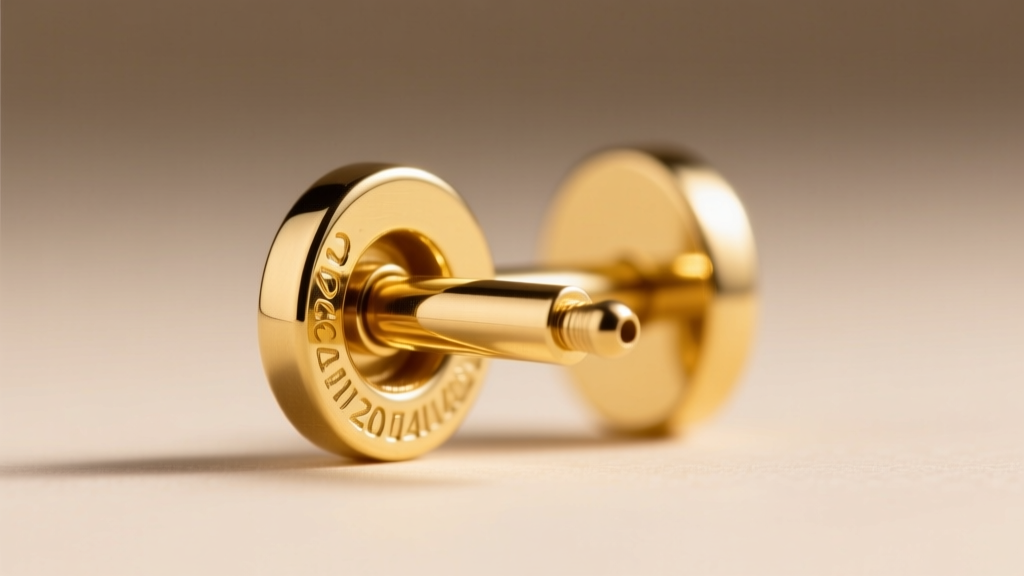
The most common point of failure for the golden earring going to the run is not the gold itself, but the backing mechanism. Standard friction backs (commonly known as butterfly backs) are fundamentally unsuited for athletic activity. The small metal scrolls create a dark, enclosed pocket against the back of the earlobe that traps sweat, dead skin cells, and sebum. This not only creates an unpleasant odor (colloquially known as "ear cheese") but also creates a breeding ground for staphylococcus bacteria, leading to localized infections.
Furthermore, the friction grip of a butterfly back degrades over time. The sudden jolt of taking off a running headband or wiping your face with a towel is often enough to pull a friction back loose, resulting in a lost gold earring on the trail.
The Secure Fitting Matrix
| Backing Type | Security Level | Sweat Resistance | Best For |
|---|---|---|---|
| Friction (Butterfly) | Low | Poor (Traps bacteria) | Sedentary wear only |
| Screw-Back | Medium-High | Medium (Threads trap salt) | Light jogging, tennis |
| Continuous Hoop | High | Excellent (No crevices) | Running, cycling |
| Threadless Push-Pin | Maximum | Excellent (Flush fit) | Marathons, HIIT, swimming |
For serious runners, the threadless push-pin system (often utilizing a 20-gauge or 18-gauge post) is the gold standard. The pin features a slight bend that creates tension against the inside of the hollow post, locking it in place. The harder you pull, the tighter it grips. This mechanism sits completely flush against the back of the ear, eliminating sweat traps and ensuring the earring survives even the most vigorous workouts.
Cartilage: The Runner's Advantage
While lobe piercings bear the brunt of gravitational stress, cartilage piercings offer a distinct biomechanical advantage for athletes. The helix, tragus, and conch are composed of dense, rigid tissue that does not stretch or oscillate during a run. A 16-gauge (1.29mm) gold clicker hoop in the helix or a flat-back stud in the tragus will remain virtually motionless, regardless of your pace.
Because cartilage has less blood flow than the lobe, it is more prone to irritation bumps if subjected to friction. Therefore, the jewelry must be perfectly smooth. High-polish 14k or 18k gold seamless rings are ideal, as they lack the microscopic pores found in lower-quality plated jewelry that can harbor bacteria and irritate the cartilage fistula. As noted by the Gemological Institute of America (GIA), the finish and polish of a gold alloy directly impact its resistance to environmental wear and chemical interactions, making a mirror finish essential for cartilage health during heavy sweating.
Post-Run Care Protocol
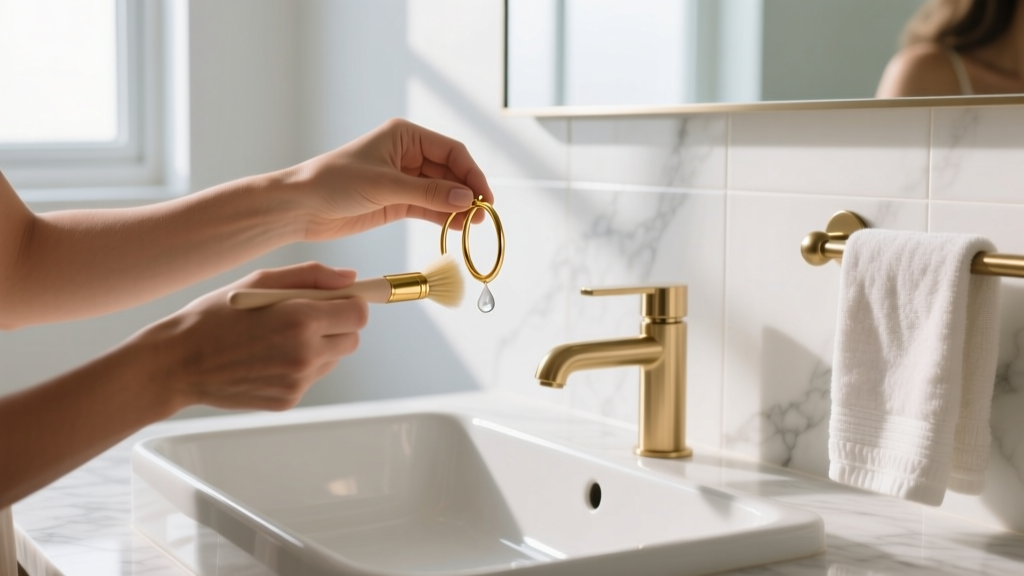
Maintaining the golden earring going to the run trend requires a dedicated post-workout care protocol. Sweat dries quickly, leaving behind a microscopic crust of salt and urea that dulls the luster of gold and can degrade the structural integrity of the alloy over time.
- The Immediate Rinse: Within 30 minutes of finishing your run, rinse your ears and earrings with lukewarm tap water. This dissolves the salt before it can crystallize in the crevices of your huggies or the threads of your screw-backs.
- Weekly Deep Clean: Once a week, remove your earrings and soak them in a bowl of warm water with a few drops of mild, phosphate-free dish soap. Gently agitate the water and use a soft-bristled baby toothbrush to sweep away any accumulated sebum from the post and backing.
- Avoid Chlorine at All Costs: If your run transitions into a recovery swim, you must remove your gold earrings. Chlorine reacts violently with the copper and zinc alloys in 14k gold, causing a phenomenon known as "stress corrosion cracking." This can cause the delicate solder points on hoop hinges to snap without warning.
Final Verdict
The golden earring going to the run is more than just a fleeting fashion statement; it is a demand for functional luxury. By prioritizing sub-1.5 gram weights, opting for nickel-free 14k yellow gold or titanium-hybrid posts, and upgrading to threadless or continuous backing systems, you can safely integrate fine jewelry into your most rigorous training blocks. In 2026, performance and elegance are no longer mutually exclusive—they are engineered to cross the finish line together.


