The Technical Guide to Choosing an Earring Tray Organizer
Discover the material science, gauge sizing, and spatial geometry required to select the perfect earring tray organizer for fine jewelry.

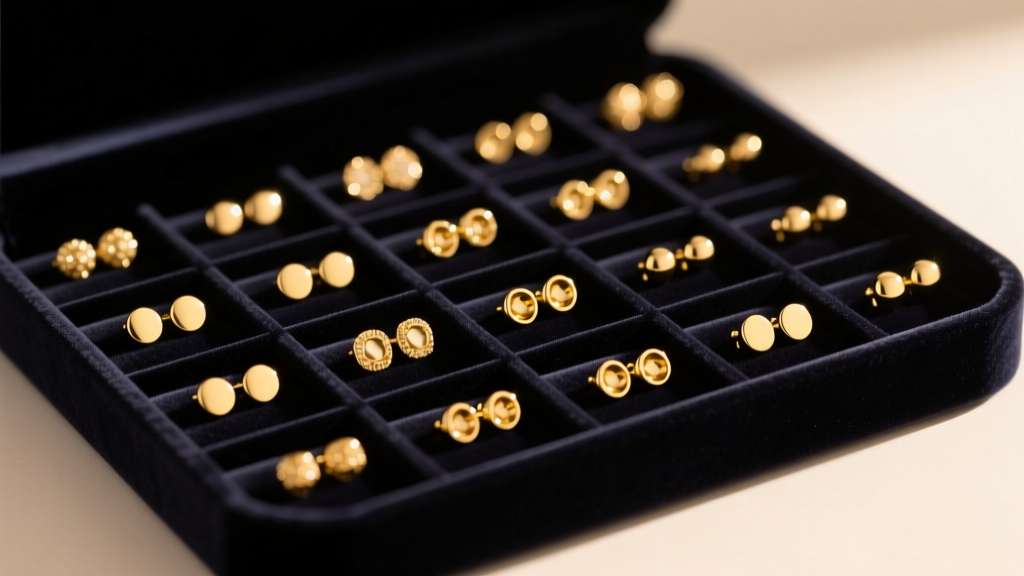
For serious jewelry collectors and boutique owners, an earring tray organizer is not merely a convenience; it is a critical preservation tool. The improper storage of fine earrings leads to micro-scratches, galvanic corrosion, clasp fatigue, and accelerated tarnishing. While the market is saturated with cheap plastic grids and acidic cardboard inserts, a true expert approaches jewelry storage through the lens of material science, structural ergonomics, and spatial geometry. As of 2026, advancements in archival-grade polymers and precision-milled storage matrices have redefined what collectors should expect from high-end organization. This deep dive explores the technical specifications you must evaluate when investing in a premium earring tray organizer.
The Material Science of Tarnish Prevention
The primary enemy of silver and copper-alloy earrings is sulfur dioxide in the ambient air, which reacts to form silver sulfide (tarnish). Furthermore, many budget organizers are constructed from Medium-Density Fiberboard (MDF) or low-grade polyvinyl chloride (PVC). These materials off-gas formaldehyde, sulfur compounds, and acidic plasticizers that actively corrode precious metals and degrade porous gemstones like pearls and opals.
When evaluating the lining of an earring tray organizer, demand archival-quality materials. The gold standard is Pacific Silvercloth or tightly woven microfiber treated with anti-tarnish nanoparticles. Standard velvet, while aesthetically pleasing, often traps dust and microscopic silica particles that can cause micro-abrasions on high-polish gold and platinum surfaces. According to the American Institute for Conservation, maintaining a stable microclimate free of acidic off-gassing is paramount for preserving silver artifacts and fine jewelry alike. Always look for organizers lined with acid-free, lignin-free polyethylene foam or treated micro-suede.
Ergonomics and Gauge Compatibility: Sizing the Post Holes
A glaring flaw in mass-produced earring organizers is the uniform drilling of post holes. Earring posts vary drastically in thickness depending on their intended piercing location and structural requirements. Forcing a thick post into a narrow hole bends the metal, while placing a thin post in a wide hole allows the earring to shift, scratching adjacent pieces.
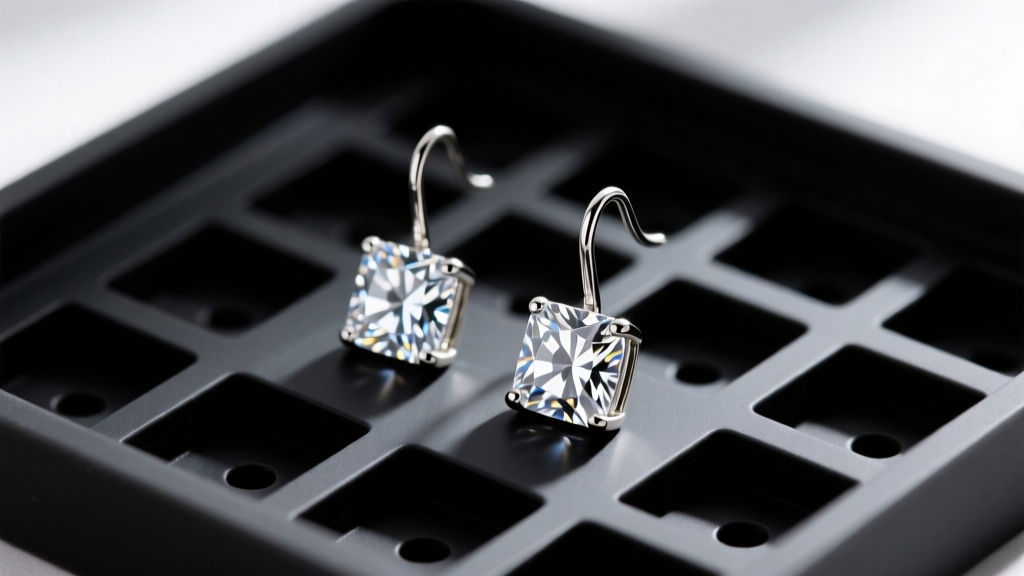
To protect your collection, an expert-level earring tray organizer must feature variable-diameter perforations. Here is the technical breakdown of standard earring gauges and the required hole tolerances:
- 22-Gauge (0.64mm): Used for ultra-lightweight studs and vintage pieces. Requires 0.8mm to 1.0mm holes to prevent bending the delicate wire.
- 20-Gauge (0.81mm) & 18-Gauge (1.02mm): The industry standard for lobe studs and lightweight drops. Requires precision 1.2mm to 1.5mm holes.
- 16-Gauge (1.29mm) & 14-Gauge (1.63mm): Standard for cartilage, tragus, and heavy structural drops. Requires 2.0mm+ reinforced holes to accommodate the thicker wire without friction.
If an organizer only offers a single hole size (typically around 1.0mm), it will inevitably damage your 14-gauge cartilage studs or fail to secure your 22-gauge diamond solitaires.
Structural Geometry: Designing the Ideal Layout
The spatial geometry of an earring tray organizer must account for the center of gravity and vertical clearance required by different earring silhouettes. A poorly zoned tray results in tangled chains, crushed filigree, and stressed solder joints.
Zone 1: High-Density Stud Matrices
Studs require minimal vertical clearance but high horizontal density. The optimal layout utilizes a staggered honeycomb grid rather than a strict square grid. A honeycomb matrix increases storage capacity by approximately 15% while ensuring that the gemstone settings of adjacent studs do not make contact, preventing diamond-on-diamond scratching (as diamonds can easily scratch other diamonds or softer metals).
Zone 2: Suspension Drops and Chandelier Clearances
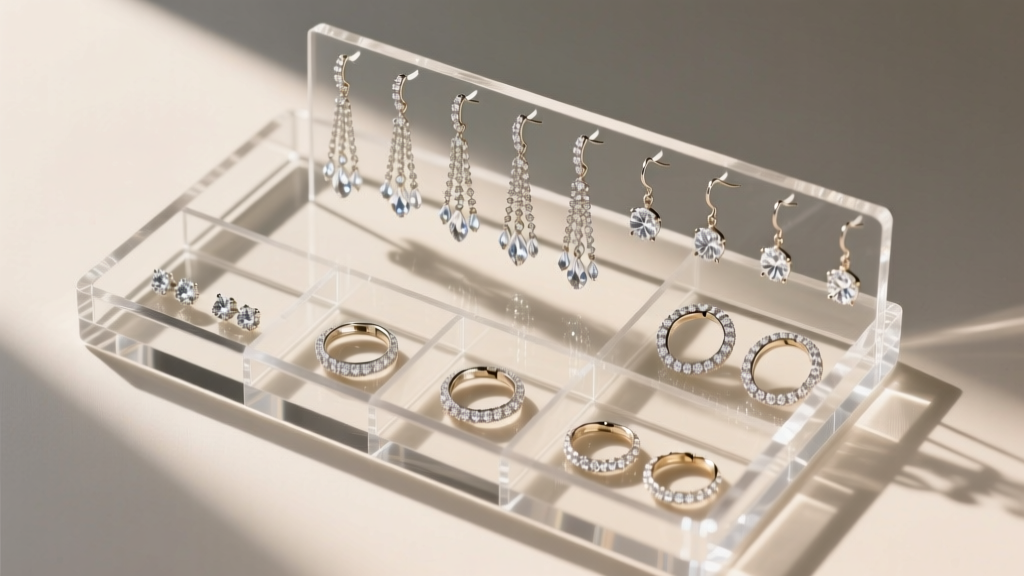
Chandelier and elongated drop earrings require vertical suspension. The Gemological Institute of America (GIA) notes that laying complex drop earrings flat can cause the articulated joints to warp under their own weight over time. A technical organizer will feature elevated suspension bars with at least 4.5 inches of vertical clearance, allowing gravity to keep the articulation points aligned and stress-free.
Zone 3: Huggie and Hoop Retention Grooves
Huggies and medium-diameter hoops should never be laid flat, as this puts lateral pressure on the hinge mechanisms. Premium trays utilize angled, V-shaped silicone retention grooves that hold the hoop upright by its thickest structural point (usually the bottom curve), keeping the delicate top hinge completely uncompressed.
Clasp Fatigue and Mechanical Stress
Beyond the posts and gemstones, the mechanical clasps of your earrings are highly susceptible to storage-induced fatigue. Omega backs, leverbacks, and screw-backs rely on precise spring tension. When an earring is shoved into a shallow, flat tray, the clasp is often pressed against the hard base, keeping the spring mechanism under constant compression. Over months and years, this leads to spring failure and a loss of tension.
A technically sound earring tray organizer features recessed 'drop zones' or relief channels beneath the post holes. These channels ensure that the earring back or clasp mechanism hangs freely in empty space, completely eliminating mechanical compression when the tray is stacked or moved.
Material Comparison Chart for High-End Storage
When sourcing an organizer, use this matrix to evaluate the base and lining materials commonly found in the 2026 luxury storage market:
| Material | Archival Safety | Impact on Metals | Best Use Case |
|---|---|---|---|
| Standard Velvet | Low | Traps silica/dust; risks micro-scratches | Costume jewelry, short-term display |
| Acid-Free Polyethylene | Excellent | Inert, zero off-gassing, no chemical transfer | Long-term vault storage, pearls, opals |
| Silicone (Platinum-Cured) | High | Non-reactive, high friction for grip | Hoop grooves, heavy cartilage pieces |
| Treated Microfiber | High | Actively absorbs ambient sulfur/tarnish | Silver studs, daily-wear gold pieces |
| MDF / Particle Board | Poor | Off-gasses formaldehyde and sulfur | Avoid entirely for fine jewelry |
Environmental Controls and Maintenance
Even the most perfectly engineered earring tray organizer cannot combat high ambient humidity. Tarnish and gemstone degradation accelerate exponentially when Relative Humidity (RH) exceeds 65%. For collectors storing trays inside drawers or safes, it is critical to integrate environmental controls.
Place 3M Anti-Tarnish strips or activated charcoal sachets in the periphery of the organizer tray. Avoid using standard silica gel packets directly touching silver, as some cheap silica gels are treated with cobalt chloride, which can be corrosive. Instead, opt for indicating silica gel that is cobalt-free. Furthermore, keep your organizers away from direct UV exposure, which can fade heat-treated gemstones like kunzite and amethyst, and dry out the organic matrices of pearls.
Conclusion
Upgrading to a technically proficient earring tray organizer is an investment in the longevity and structural integrity of your jewelry collection. By prioritizing archival-safe materials, respecting gauge-specific tolerances, and implementing ergonomic zoning for different earring silhouettes, you transition from merely storing your jewelry to actively preserving it. Evaluate your current setup against these engineering principles, and ensure your fine earrings are resting in an environment that matches their craftsmanship.


