Chain Dangle Earrings: Metallurgy, Link Types, and Lobe Stress
Explore the technical mechanics of chain dangle earrings. Learn about link types, gauge sizes, weight distribution, and metallurgy for lobe health.

The Biomechanics of the Pendulum Effect
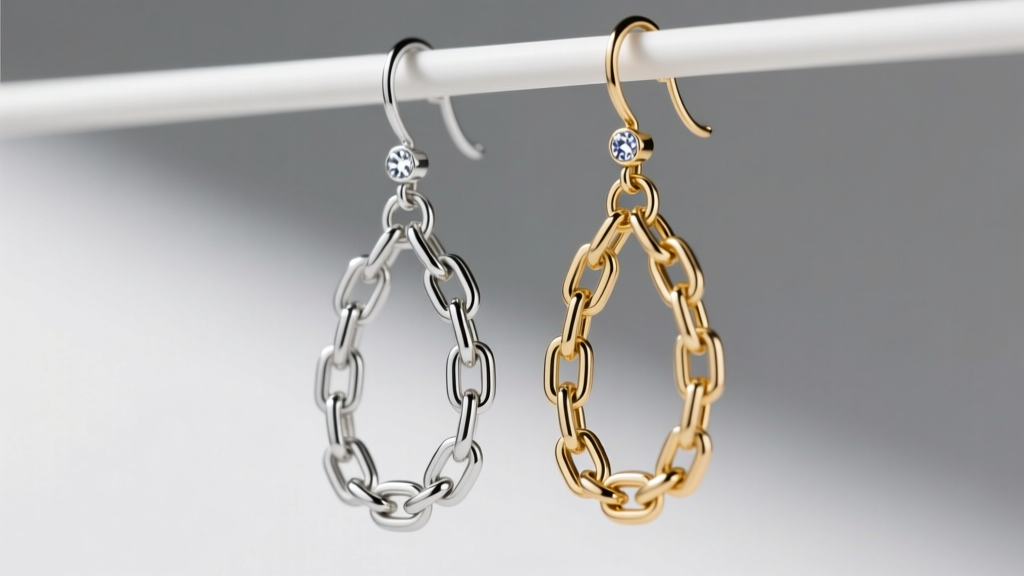
When evaluating chain dangle earrings, most consumers focus exclusively on aesthetic drape and visual length. However, from a structural and anatomical perspective, a dangling chain operates as a micro-pendulum. Every time the wearer turns their head or walks, kinetic energy travels down the chain, culminating in a localized torque spike at the fistula (the piercing channel). This dynamic load is vastly different from the static load of a stud earring. Understanding the biomechanics of this movement is critical for preventing tissue migration, lobe tearing, and premature metal fatigue at the jump rings.
The severity of the pendulum effect is dictated by three variables: the total mass of the chain, the distance of the center of gravity from the earlobe, and the rigidity of the chain links. A fluid, heavy chain will generate significantly more momentum at the terminal end than a rigid, lightweight one, directly translating to increased shear stress on the earlobe's collagen matrix.
Metallurgy: Tensile Strength and Hypoallergenic Profiles
The structural integrity of chain dangle earrings relies entirely on the metallurgical properties of the base alloy. Because the individual links are subjected to repetitive micro-tensions, the metal must possess high tensile strength and excellent fatigue resistance. According to the Gemological Institute of America (GIA), the alloy composition directly dictates both the longevity and the biocompatibility of the jewelry.
Comparative Tensile Strength and Hardness
- Grade 23 Titanium (Ti 6AL-4V): The gold standard for biocompatibility and strength. With a tensile strength of approximately 895 MPa and a Vickers hardness of 334 HV, titanium chain links resist deformation and are entirely nickel-free, making them ideal for reactive lobes.
- 316L Surgical Stainless Steel: Features a tensile strength of roughly 515 MPa. While highly durable and cost-effective, it contains trace amounts of nickel. The 'L' denotes low carbon, which improves corrosion resistance but makes it slightly softer than standard 316 steel.
- 14k and 18k Gold Alloys: Pure 24k gold is too soft for chain links (tensile strength ~120 MPa). 14k gold (58.5% gold) alloyed with copper and silver increases tensile strength to ~350 MPa, providing the necessary rigidity for fine chain dangle earrings without sacrificing the hypoallergenic benefits of high karatage.

Chain Link Architectures and Failure Modes
The geometry of the chain link determines its flexibility, kink-resistance, and ultimate failure mode. Selecting the right link architecture is essential for balancing visual fluidity with structural longevity.
| Link Type | Flexibility | Kink Resistance | Primary Failure Mode | Best Use Case |
|---|---|---|---|---|
| Cable | High | Moderate | Link elongation and ovaling under heavy pendants. | Lightweight, minimalist dangles under 5 grams. |
| Box | Low | Excellent | Corner fracturing if bent at a sharp 90-degree angle. | Geometric, structured dangles requiring rigid lines. |
| Snake | Fluid | Poor | Irreversible kinking and internal moisture trapping. | Short, thick choker-style ear cuffs or very short drops. |
| Rope | Moderate | Good | Laser-weld seam failure under extreme tensile load. | Medium-weight dangles requiring a vintage or textured aesthetic. |
| Mariner | High | Excellent | Wear at the central crossbar junction over years of friction. | Heavy, long chain dangle earrings requiring maximum durability. |
For long chain dangle earrings, the Mariner and Box links are technically superior. The interlocking geometry of the Mariner link distributes stress across multiple planes, while the Box chain's rigid structure prevents the tangling that frequently plagues longer cable chains.
Gauge Sizing and the Cheese-Cutter Effect
One of the most common technical errors in manufacturing and wearing chain dangle earrings is the misalignment of gauge size relative to the earring's total weight. Standard lobe piercings are typically done at 20-gauge (0.81mm) or 18-gauge (1.02mm).
When a heavy chain dangle is suspended from a thin 22-gauge (0.64mm) or 24-gauge (0.51mm) wire or jump ring, it triggers the "cheese-cutter effect." The high localized pressure (Force divided by Area) exceeds the structural tolerance of the earlobe's connective tissue. Over time, the thin metal slowly migrates downward through the fistula, thinning the lower lobe and eventually causing a complete blowout. The Association of Professional Piercers (APP) strongly advises against wearing thin-gauge jewelry in stretched or heavily weighted piercings to prevent irreversible tissue damage.
Expert Rule of Thumb: If your chain dangle earrings exceed 10 grams per earring, the primary wire or post passing through the ear must be a minimum of 18-gauge (1.02mm), and ideally 16-gauge (1.29mm), to safely distribute the load across a wider tissue surface area.

Weight Distribution and Lobe Matrix Preservation
Preserving the structural integrity of the earlobe requires managing both static and dynamic weight. The human earlobe is composed of areolar connective tissue and fat, lacking the rigid cartilage found in the upper ear. This makes it highly susceptible to stretching (creep deformation) under constant load.
Strategies for Heavy Chain Dangles
- Hollow vs. Solid Links: High-end jewelers often use hollow-form links for large, voluminous chains. This maintains the visual impact and light-catching surface area while reducing the overall mass by up to 40%, significantly reducing lobe stress.
- Tapered Designs: A technically sound chain dangle earring will feature a graduated taper—thicker, heavier links at the bottom and finer, lighter links near the ear post. This lowers the center of gravity without adding unnecessary dead weight near the pivot point.
- Support Patches: For vintage or solid gold chain dangles exceeding 20 grams, utilizing clear silicone earlobe support patches behind the ear distributes the clasp pressure across the entire posterior lobe surface rather than just the fistula.
Maintenance and Ultrasonic Cleaning Protocols
The intricate junctions of chain links trap sebum, dead skin cells, and environmental pollutants. While ultrasonic cleaners operating at 40 kHz are highly effective for solid studs, they require caution when used on chain dangle earrings.
The high-frequency cavitation bubbles can force moisture deep into unsealed links, particularly in snake or tightly woven rope chains, leading to hidden oxidation or tarnish if not thoroughly dried. Furthermore, the vibrations can loosen friction-fit end caps or weaken poorly executed laser welds on budget-tier chains. For routine maintenance, a targeted approach using a soft-bristled detailing brush, warm distilled water, and a mild non-phosphate surfactant is the safest method to preserve both the metal's polish and the structural integrity of the micro-welds.