Ribbed Earrings: Manufacturing, Metals, and Structural Integrity
Explore the technical manufacturing, metal grades, and structural integrity of ribbed earrings. An expert guide to casting, stamping, and gauge sizing.

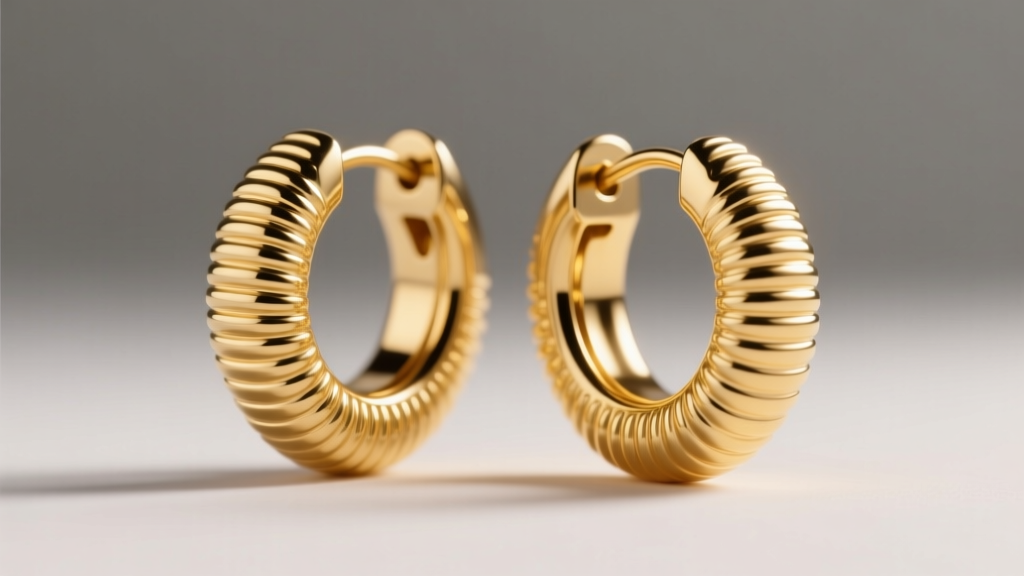
The Anatomy of Corrugation in Fine Jewelry
Ribbed earrings—often referred to in the trade as fluted, corrugated, or reeded designs—represent a fascinating intersection of aesthetic light manipulation and structural engineering. Unlike smooth, high-polish hoops that reflect light uniformly, the alternating peaks and valleys of a ribbed surface create high-contrast refraction. This optical illusion gives the earring substantial visual weight without requiring the dense, heavy mass of solid metal. From a structural engineering perspective, the corrugation acts much like an I-beam in architecture; it drastically increases the moment of inertia, making a lightweight 14k gold hoop highly resistant to lateral bending and deformation. As we move through 2026, advancements in micro-milling have allowed jewelers to push these corrugated textures to sub-millimeter precision, demanding a deeper understanding of metallurgy and manufacturing tolerances.
Manufacturing Techniques: How Ribs Are Formed
The method used to create the ribbed texture fundamentally dictates the earring's durability, weight, and price point. There are three primary manufacturing techniques utilized in modern jewelry fabrication.
Lost-Wax Casting and 3D Resin Printing
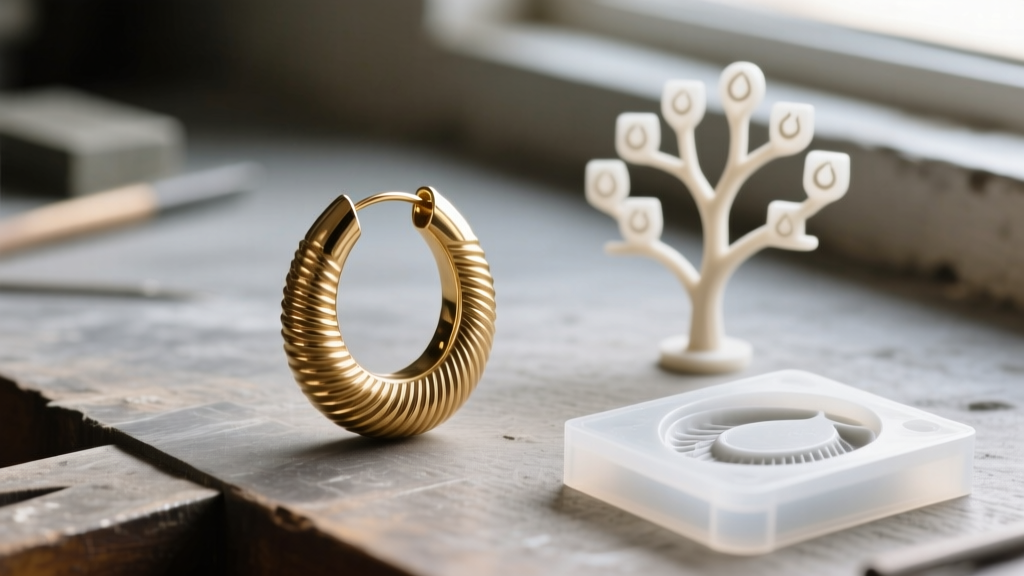
For complex, three-dimensional ribbed huggies, lost-wax casting remains the industry standard. In 2026, the majority of master models are no longer hand-carved but are printed using high-resolution castable resins on DLP 3D printers. These resins allow for ridge tolerances as tight as 10 microns. However, when casting these intricate wax/resin trees into 14k or 18k gold, the investment material must flow perfectly into the narrow valleys. If the flask is not vacuum-assisted or if the gold is poured at an improper temperature, microscopic porosity will occur in the valleys of the ribs, creating weak points that can trap moisture and accelerate tarnishing.
Die Stamping and Work-Hardening
For larger, lightweight ribbed hoop earrings, die stamping is the preferred method. A hardened steel die presses the corrugated pattern into a flat sheet of precious metal, which is then rolled into a tubular hoop. This process induces severe work-hardening. According to manufacturing guidelines from Rio Grande, if the jeweler does not carefully anneal the metal between the stamping and rolling phases, micro-fractures will appear along the ridges. Stamped ribbed earrings are exceptionally strong but can become brittle over time if subjected to repeated bending.
CNC Milling for Micro-Ribbing
CNC (Computer Numerical Control) milling is reserved for high-end, solid metal pieces where sharp, geometric ribs are required. Unlike casting, which can result in slightly rounded edges due to surface tension during the molten phase, CNC milling cuts the ribs directly from a solid billet of metal. This yields razor-sharp peaks that catch light aggressively, though it requires significantly more raw material and machine time, driving up the retail cost.
Metallurgy: Alloy Hardness and Ridge Retention
The longevity of a ribbed earring's texture is directly tied to the Vickers Hardness (HV) of the chosen alloy. Soft metals will gradually wear down at the peaks due to friction against hair, clothing, and daily handling. The Gemological Institute of America (GIA) notes that alloying metals like copper, silver, and zinc drastically alter the physical properties of gold. Below is a technical comparison of common metals used for ribbed earrings.
| Material | Vickers Hardness (HV) | Best Manufacturing Method | Rib Edge Retention |
|---|---|---|---|
| 14k Yellow Gold | 130 - 150 HV | Casting / Stamping | Excellent (Peaks resist blunting) |
| 18k Yellow Gold | 110 - 125 HV | Casting | Good (Requires careful handling) |
| Platinum 950 (Ru) | 135 - 160 HV | CNC Milling / Casting | Superior (Dense, wears very slowly) |
| Titanium Grade 5 | 330 - 360 HV | CNC Milling | Permanent (Will not deform) |
For everyday wear, 14k gold offers the best balance of workability and ridge retention. Platinum 950 alloyed with ruthenium is incredibly durable and holds CNC-milled ribs beautifully, but its high density makes large ribbed hoops uncomfortably heavy for the earlobe. Titanium Grade 5 is exceptionally hard and hypoallergenic, making it ideal for cartilage piercings, but it cannot be easily cast and must be machined, limiting design complexity.
Structural Vulnerabilities: Hinges and Metal Fatigue
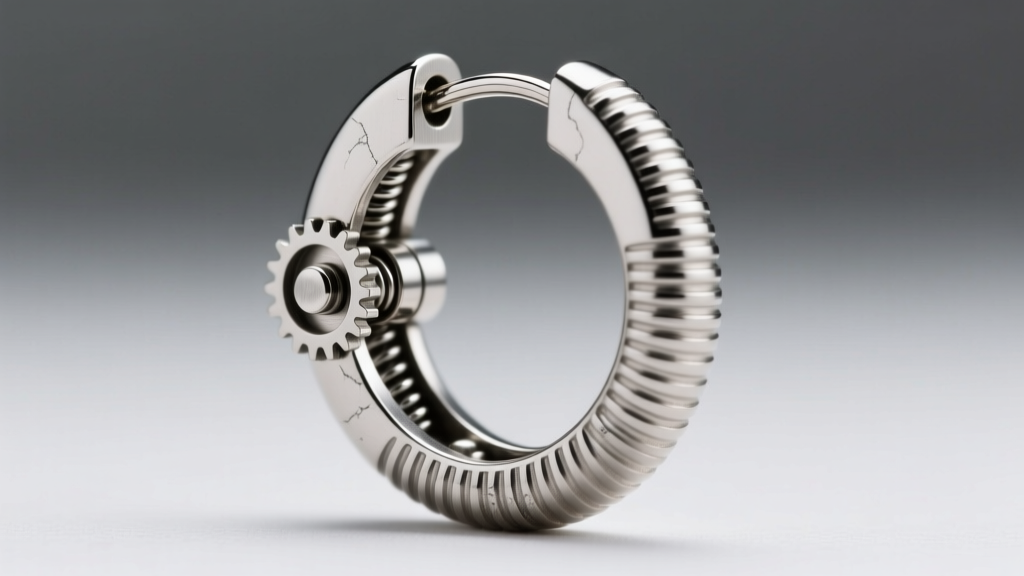
The most critical failure point in any ribbed huggie or clicker hoop is the hinge mechanism. To maintain the illusion of a solid, thick hoop, manufacturers often use a hollow tubular construction for the ribbed body. This means the hinge bears 100% of the mechanical stress. Standard post thicknesses for these earrings are 1.0mm (18 gauge) or 1.2mm (16 gauge) to accommodate standard lobe and cartilage piercings.
In a hollow ribbed tube, the hinge pin must be laser-welded to the outer shell. If the weld penetration is too shallow, the repeated opening and closing of the earring will cause metal fatigue, eventually snapping the hinge pin. Furthermore, the corrugated texture must be precisely terminated before the hinge joint. If the ribs extend too close to the interlocking clicker mechanism, the tolerance (which requires a clearance of less than 0.05mm) will be compromised, resulting in a weak "click" or a hinge that fails to lock securely. As noted by the Jewelers of America, regular inspection of hinge tension is vital for hollow-bodied textured earrings to prevent accidental loss.
Polishing and Finishing Textured Surfaces
Finishing a ribbed earring requires specialized techniques. A standard muslin buffing wheel loaded with rouge compound cannot be used, as it will aggressively round off the sharp peaks of the ribs and destroy the light-refracting geometry. Instead, expert jewelers utilize magnetic pin tumblers. These machines use thousands of microscopic stainless steel pins suspended in a soapy solution to burnish the deep valleys of the corrugation without touching the peaks. Alternatively, artisans will hand-polish the valleys with impregnated string or felt cones, deliberately leaving the peaks with a matte, sandblasted, or satin finish. This two-tone finishing technique (polished valleys, matte peaks) maximizes the optical contrast and is a hallmark of high-end ribbed jewelry.
Expert Purchasing Framework: Evaluating Ribbed Earrings
When sourcing or purchasing ribbed earrings, particularly for fine jewelry collections, apply this technical checklist to ensure structural integrity and manufacturing quality:
- Inspect the Valleys for Porosity: Use a 10x jeweler's loupe to examine the deepest parts of the ribs. Pinpoint black spots indicate casting porosity, which compromises structural integrity and traps skin oils.
- Test the Hinge Acoustics: A well-machined clicker hinge should produce a sharp, high-frequency "snap." A dull thud indicates poor tolerance matching or a loose hinge pin.
- Check the Draft Angles: The sides of the ribs should not be perfectly vertical (90 degrees). A slight taper (draft angle of 2-3 degrees) is necessary for clean casting release and prevents the metal from tearing during the manufacturing process.
- Verify the Post Gauge: Ensure the wire entering the piercing is at least 18g (1.0mm). Thinner wires (20g or 22g) in heavy ribbed hoops will act as a lever, slowly stretching and migrating through the earlobe tissue over time.
"The beauty of a ribbed earring lies in its shadows, not just its highlights. When evaluating a piece, I look at how the jeweler treated the valleys. If the valleys are perfectly burnished while the peaks retain a soft satin finish, you are looking at a piece that required hours of meticulous hand-finishing, rather than a quick tumble in a vibratory bowl."
Understanding the metallurgy, manufacturing constraints, and structural engineering behind ribbed earrings transforms them from a simple fashion accessory into a marvel of micro-architecture. By prioritizing alloy hardness, precise hinge mechanics, and expert finishing, you ensure that the corrugated textures will continue to catch the light flawlessly for decades.


