The Metallurgy of Sterling Silver Heart Earrings: An Expert Guide
Discover the metallurgy, casting methods, and structural specs behind sterling silver heart earrings. An expert guide to alloys, gauges, and tarnish.

The Alloy Breakdown: Standard 925 vs. Argentium Silver
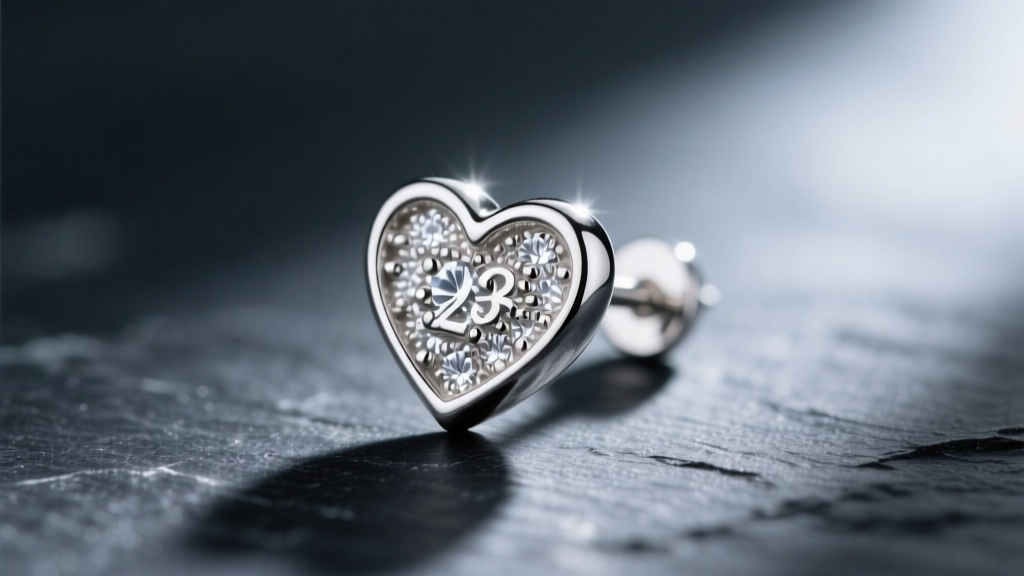
When evaluating sterling silver heart earrings from a metallurgical perspective, the distinction between traditional 925 silver and modern Argentium alloys dictates the longevity, color stability, and structural integrity of the piece. Standard sterling silver, as defined by the Gemological Institute of America (GIA), consists of 92.5% pure silver and 7.5% copper. While the silver provides the prized luster and malleability, the copper is strictly necessary to increase the tensile strength of the metal, allowing it to withstand the mechanical stress of daily wear.
However, copper is highly reactive. When exposed to sulfur compounds in the atmosphere or the natural oils and acids of the human skin, the copper in 925 silver oxidizes to form silver sulfide and copper sulfide, manifesting as black tarnish. Furthermore, during the manufacturing process—specifically during annealing or soldering—the copper reacts with oxygen to form cuprous oxide, creating a stubborn purple-grey subsurface stain known as firescale.
For high-end sterling silver heart earrings, many master jewelers now utilize Argentium silver (typically 935 or 960 purity). By replacing a portion of the copper with germanium, Argentium forms a transparent, self-healing layer of germanium dioxide on the surface. This layer acts as an impermeable barrier against sulfur and oxygen, making the earrings virtually immune to firescale during fabrication and drastically slowing down environmental tarnishing. For consumers seeking low-maintenance luxury, verifying whether a manufacturer uses Argentium over standard 925 is a critical purchasing metric.
Casting and Structural Integrity: The Geometry of the Heart
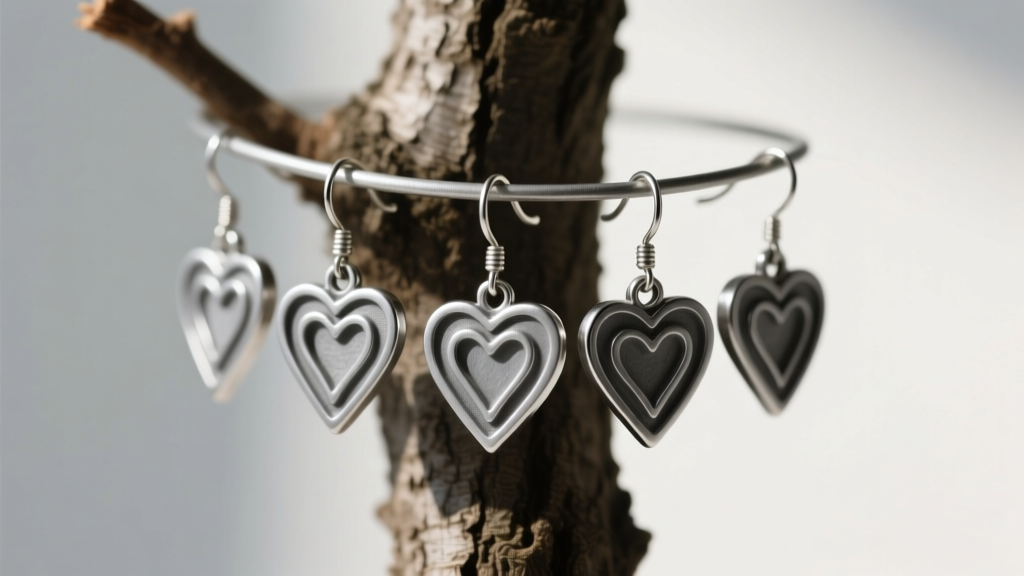
The heart shape is notoriously difficult to execute flawlessly in metal casting due to its complex geometry. Most commercial sterling silver heart earrings are produced via lost-wax investment casting. In this process, a wax model is encased in a plaster-like investment material, burned out in a kiln, and replaced with molten silver alloy. While efficient for mass production, the heart silhouette introduces specific structural vulnerabilities that expert fabricators must engineer around.
The Heart Cleft Stress Concentrator
The most critical point of failure on any heart-shaped earring is the inner vertex, or 'cleft,' where the two upper lobes meet. In physics and materials science, sharp internal angles act as severe stress concentrators. If the cleft is cast with a sharp 90-degree internal angle, any torsional stress—such as the earring being snagged on clothing or hair—will concentrate at that exact point, leading to micro-fractures and eventual catastrophic snapping.
To mitigate this, precision jewelers design a micro-fillet (a tiny, rounded curve) at the base of the cleft in the initial CAD model. This fillet distributes mechanical stress evenly across the upper lobes. Additionally, the spruing process (the channels through which molten silver flows into the mold) must be carefully planned. If a sprue is attached directly to the delicate point of the heart and improperly filed down during finishing, it leaves a structural weak point prone to snapping under pendulum stress in dangle earrings.
Gauge Specifications and Piercing Compatibility
The aesthetic appeal of sterling silver heart earrings must be balanced against the biomechanical limits of the human ear. The weight of the earring dictates the required wire gauge for the post or hook. A solid cast 15mm heart earring can easily weigh between 3.5 and 5.0 grams. If this weight is suspended from a standard 20-gauge (0.81mm) wire, the continuous downward force will gradually stretch the earlobe piercing, leading to the irreversible 'cheese-cutter effect,' where the thin wire slowly slices through the tissue.
According to fabrication guidelines from Rio Grande, a leading jewelry supply authority, matching the earring weight to the correct gauge is non-negotiable for structural safety. Below is the technical matrix for heart earring configurations:
| Earring Style | Average Weight | Recommended Gauge | Wire Diameter | Piercing Type |
|---|---|---|---|---|
| Micro Heart Studs (5-8mm) | 0.8g - 1.5g | 20G or 22G | 0.81mm - 0.64mm | Standard Lobe |
| Medium Solid Hearts (10-15mm) | 2.5g - 4.5g | 18G | 1.02mm | Standard Lobe |
| Large Dangle Hearts (>20mm) | 5.0g - 8.0g+ | 16G or Hollow Cast | 1.29mm | Stretched Lobe / Heavy Duty |
| Heart Huggies / Cartilage | 1.5g - 3.0g | 16G or 14G | 1.29mm - 1.62mm | Helix / Tragus / Upper Lobe |
For large heart dangles that exceed 5 grams, expert manufacturers often employ electroforming or hollow-casting techniques. This creates a voluminous, three-dimensional heart earring with a thick outer shell but a hollow interior, reducing the weight by up to 60% while maintaining the structural rigidity required to prevent denting.
Surface Treatments and Plating Protocols
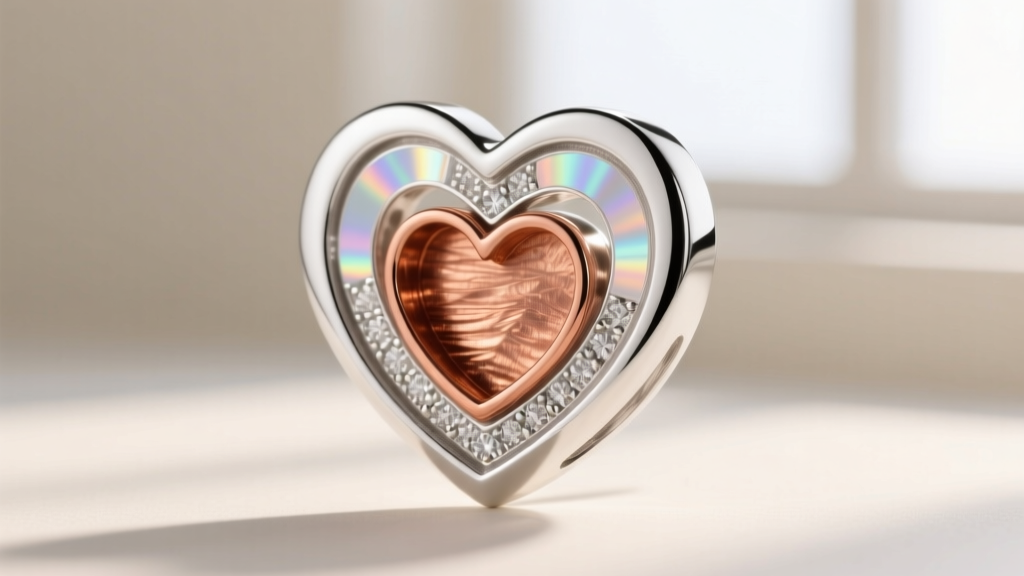
Bare sterling silver requires frequent polishing. To provide a maintenance-free, high-reflectivity finish, manufacturers apply microscopic surface treatments. The two industry standards for sterling silver heart earrings are rhodium plating and electrophoretic lacquer (e-coating).
Rhodium Plating: Rhodium is a platinum-group metal that provides a brilliant, white-metal finish that is highly resistant to scratching and tarnish. However, rhodium cannot be plated directly onto sterling silver; the copper in the alloy will contaminate the rhodium bath and cause poor adhesion. A 'strike' layer must be applied first. Historically, nickel was used as a strike layer, but due to strict nickel-sensitization regulations like the EU's REACH compliance standards enforced by the European Chemicals Agency (ECHA), premium jewelers now use a palladium strike. A high-quality rhodium-plated heart earring will feature a 0.1 to 0.2-micron layer of rhodium over a palladium strike, ensuring biocompatibility and lasting brilliance.
E-Coating: Electrophoretic coating involves submerging the polished silver earrings in a water-based lacquer bath and applying an electrical current. This deposits an even, 2-to-5-micron layer of clear, anti-tarnish polymer over the metal. While e-coating is highly effective at preventing silver sulfide formation and is generally less expensive than rhodium plating, it is a sacrificial layer. Over 12 to 24 months of friction against the skin and hair, the e-coating will wear away, eventually exposing the raw 925 silver beneath to the elements.
Hallmarking and Authenticity Verification
The market is saturated with silver-plated brass or copper alloys masquerading as solid sterling silver. A genuine piece of sterling silver heart jewelry must bear a '925' hallmark, usually stamped on the flat pad behind the heart stud or on the inside curve of a huggie hoop. However, physical stamps can be easily counterfeited.
For high-value or artisan-crafted pieces, professional jewelers rely on X-ray Fluorescence (XRF) spectrometry. XRF analyzers bombard the earring with X-rays and measure the fluorescent X-rays emitted back, providing a precise elemental breakdown to the tenth of a percent. This non-destructive testing ensures that the core metal is not a base alloy coated in a thick layer of pure silver, a deceptive practice known as 'heavy silver plating' that will eventually wear through to reveal green-oxidizing brass underneath.
Maintenance and Tarnish Mitigation Protocols
Even with advanced alloys and protective coatings, sterling silver heart earrings require specific maintenance protocols to preserve their geometry and finish. Avoid ultrasonic cleaners for heart earrings that feature oxidized (blackened) recessed details, as the high-frequency cavitation will strip the intentional patina from the clefts and engravings.
For routine maintenance, utilize a chemically treated jeweler's polishing cloth impregnated with micro-abrasives and anti-tarnish agents. When polishing the outer curves of the heart, use linear strokes rather than aggressive circular motions, which can create microscopic swirl marks in the rhodium or bare silver. If the earrings feature gemstone pavé set into the heart face, ensure the prongs are inspected under 10x magnification annually, as the malleability of silver means prongs can slowly lift over time, risking stone loss.


